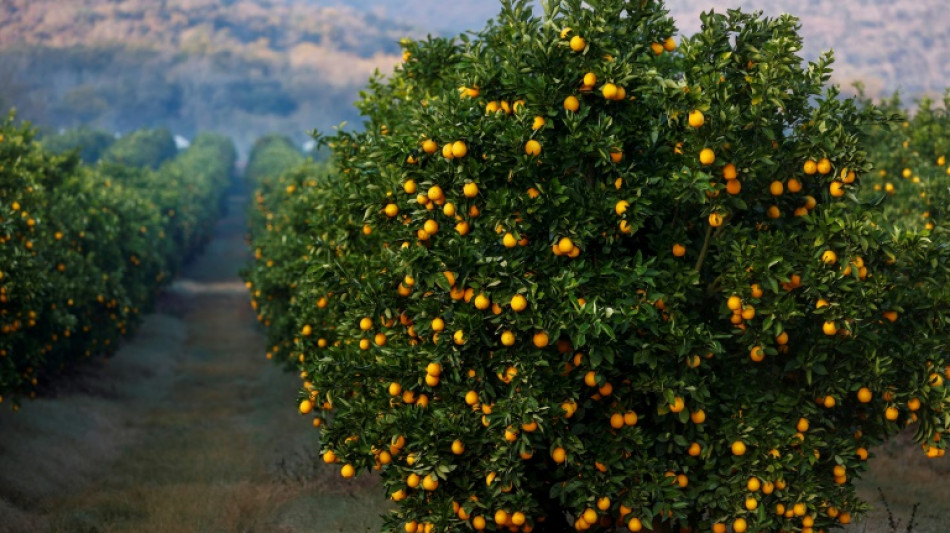
Tonnes of fruit stranded in EU, S.Africa battle of oranges / Photo: © AFP

 WADA seeks tough anti-doping stance from Kenya

 German ex-spy chief arrested for suspected espionage, treason

 Furyk vows US will 'do more' to end Ryder Cup losing streak

 Iyer hits ton as India hammer West Indies in T20 opener

 Mandhana named India women's team captain after Kaur quits

 'The sound keeps coming back': children maimed in Ethiopia's Tigray clashes

 Paris Women's Fashion Week: the key trends

 i-payout Introduces a New Approach to Payments, Closing the Beneficiary Information Gap

 New Generation of Crypto Miners Released by ASICID

 New investor forecasts LIV Golf teams could be worth $100 mn each

 Shakira, Pique return to court over children visit arrangements

 Nobel physics prize hails 'ghostly messengers' from space

 France's Mistral unveils latest model in sovereign AI push

 Stocks climb as oil prices retreat

 Vstock Transfer Names Securities Industry Veteran Erica Goodstein General Counsel and Chief Compliance Officer

 Four Indonesian seamen return home after Somali pirate ordeal

 Crisis-striken Haiti postpones elections

 Germany arrests ex-spy chief on suspicion of giving secrets to foreign powers

 Djokovic wins China Open after de Minaur retires
 IMF warns cost-of-living shocks cause 'lasting deterioration' in affordability

 Alcaraz wins Japan Open for first title since injury return

 'We're working to keep football clean', Turkish minister says

 FIFA chief Infantino hit by Norwegian double complaint

 Exiled Catalan separatist leader Puigdemont cleared to return to Spain
 Stock markets climb as oil prices retreat

Millions of boxes of oranges are spoiling in containers stranded at European ports as South Africa and the European Union lock horns in a dispute over import rules, citrus growers have said.
South Africa, the world's second largest exporter of fresh citrus after Spain, filed a complaint with the World Trade Organisation (WTO) last month after the EU introduced new plant and health safety requirements that orange farmers say threaten their survival.
The measures came into force in July as ships were already at sea carrying hundreds of containers full of South African fruit to Europe, resulting in them being held up on arrival, South Africa's Citrus Growers' Association (CGA) says.
"It's a complete and utter disaster," CGA's CEO Justin Chadwick told AFP by phone.
"Food that has fantastic quality and is safe is (just) sitting there -- and this at a time when people are worried about food security."
The EU rules aim at tackling the potential spread of an insect called the false codling moth, a pest native to sub-Saharan Africa that feeds on fruits including oranges and grapefruits.
The new measures require South African farmers to apply extreme cold treatment to all Europe-bound oranges and keep the fruits at temperatures of two degrees Celsius (35 degrees Fahrenheit) or lower for 25 days.
But the CGA says this measure is unnecessary as the country already has its own, more targeted way of preventing infestation.
In its WTO complaint, South Africa argued that the EU requirements were "not based on science", more restrictive than necessary and "discriminatory".
South African citrus growers say the requirement puts undue extra pressure on an industry already in dire straits.
"This is going to add a lot of costs... and at the moment, that is what no grower in the world can afford," said Hannes de Waal, who heads of the almost 100-year-old farm Sundays River Citrus.
De Waal, whose company has orange, clementine and lemon trees straddling 7,000 hectares (17,000 acres) near the southeastern coast city of Gqeberha, said revenues were already squeezed by high shipping and fertiliser costs.
Freight costs have rocketed since Covid-19 struck, and so has the price of fertilisers due to the war in Ukraine -- Russia being one of the world's largest producers.
- 'Under pressure' -
Europe is the largest market for South Africa's almost $2 billion citrus industry, accounting for 37 percent of all exports, according to the CGA.
The new rules hit at the height of South Africa's orange season, during the southern hemisphere's winter, when export operations were in full swing.
This gave fruit growers too little time to adapt, said Chadwick.
Some 3.2 million cartons of citrus worth about 605 million rand ($36 million) left port with paperwork that would be wrong on arrival.
The South African government was scrambling to issue new documents for shipments that met the new criteria, but hundreds of containers could be slated for destruction, said Chadwick.
South Africa already has an effective anti-moth system, the CGA says.
"Our system does involve cold treatment, but targeted at the risk, whereas the EU measure is a blanket measure that covers all oranges," Chadwick said.
"The higher the risk, the more extreme the cold treatment," he said, of the South African measures.
The dispute is now with the WTO. The parties have 60 days to negotiate a solution. Failing that, the complainant can request the matter be decided by a panel of experts.
The EU said it was confident of the "WTO-compatibility" of its measures.
"The objective of the EU's plant and health safety criteria is to protect the union territory from the potential significant impact on the agriculture and the environment, should this pest establish itself in the union," a spokesperson for the EU Commission said in a statement.
Chadwick hopes that "sense" will prevail and a quick fix can be found.
"Our industry is under pressure. It's basically a year of survival," he said.
M.Furrer--BTB