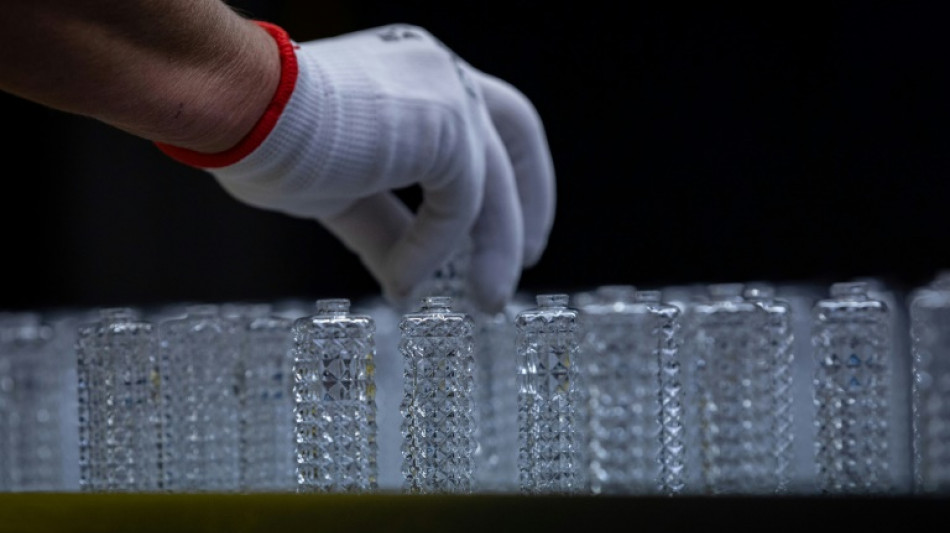
Gas crunch pushes German glassmaker to the brink / Photo: © AFP

 Paramount completes Warner Bros takeover, creating Skydance
 Trump blames France unrest on Islam, migration

 Apple's Cook praises EU over efforts to protect children online
 Nobel winner Halzen says years of October 'misery' finally over
 Quebec separatist win rattles Carney's unity push

 'Itching' for change: Shiffrin cuts back slaloms this season

 'Gen Z has risen up': Tens of thousands mass for tense France school protests

 Caribbean tourism hotspot loses men to Russian war machine

 Danish reservists practice war games to respond to 'aggression'

 Bhuvneshwar returns to India's T20 squad for New Zealand tour

 Asos says probing 'unauthorised activity' after phone alerts

 Stocks climb as oil prices retreat under $100 per barrel

 Neutrinos: space particles that change our view of universe

 'Destined' Djokovic wins China Open, extending unbeaten record
 Iceland is 'critical outpost' for security, says Rubio during visit
 Israeli settlers beat AFP photographer covering West Bank

 'Gen Z has risen up': Tens of thousands demand better education in France

 $10 Million and Counting: Hola Prime Hits Major Trader Payout Milestone

 UEFA investigate Ireland-Israel tunnel bustup after spitting claim

 Djokovic wins China Open and keeps unbeaten record after de Minaur retires
 Amsterdam's Rijksmuseum hosts 'homecoming' show for Willem de Kooning

 World Bank forecasts modest growth for Latin America, highlights climate risks
 'Afraid for my future': Tens of thousands demand better education in France
 Pakistan PM urges Imran Khan supporters to end protest march

 Alex Bodi își continuă expansiunea: planuri pentru deschiderea unui showroom ALIX LASERS la București
In 400 years, Heinz-Glas, one of the world's biggest producers of glass perfume bottles, has seen off many crises -- including the two World Wars and the oil shock of the 1970s in the last century alone.
But Germany's current energy emergency strikes at the heart of its very existence.
"We are experiencing an exceptional situation," Murat Agac, deputy chief executive of the family-owned company founded in 1622, told AFP.
"If there is a halt in gas supplies... then glass production will very likely disappear" from Germany, he said.
To make glass, sand is heated to temperatures of up to 1,600 degrees Celsius (2,912 degrees Fahrenheit) and gas is the most frequently chosen source of energy.
Until recently, a glut of gas flowing to Germany via a pipeline from Russia had helped keep production costs low, allowing Heinz-Glas to book annual revenues of some 300 million euros ($305 million).
With competitive prices, exports made up 80 percent of the glassmaker's total output.
But this economic model is now being called into question after Russia's invasion of Ukraine.
Moscow has cut gas supplies to Germany by 80 percent, in what is believed to be a bid to weaken the resolve of Europe's biggest economy in backing Ukraine.
Berlin is scrambling for alternative energy sources to replace the resource that once made up 55 percent of its total gas imports.
The consequence: soaring energy prices.
For Heinz-Glas, that has meant a "ten- to 20-fold increase" in costs compared to 2019, said Agac.
- '3,000 football fields of solar panels' -
Not only Heinz-Glas, much of Germany's industry is buckling under the gas supply crunch.
Many companies are drawing up emergency plans as the German government has warned that Russian gas could stop flowing entirely.
With winter looming, the crisis is reaching fever pitch.
Chemicals giant BASF is looking at replacing gas with fuel oil in its second-biggest German factory.
Henkel, which specialises in adhesives and sealants, is considering whether its employees can work from home.
But the consequences of a total halt in Russian gas flows could be irreparable for many companies.
At the Heinz-Glas factory in Kleintettau, opened in 1661, around 70 tonnes of small glass bottles are produced each day, moulded by the heat of the furnaces.
The delicate vessels adorned with intricate motifs are then sent to the company's clients -- including its biggest, French group L'Oreal -- which fill them with perfume.
At every step of the production process -- from making the material with quartz sand to the final sculpting of the bottle -- heat is essential.
At the company's second-biggest factory in the mountain village of Piesau, a cut in gas would permanently damage its glass furnace, said Agac.
To ward off the danger in the short term, Heinz-Glas has invested in stocks of liquefied gas, which can be driven in by trucks.
But that triples the energy bill, and would still not be sufficient -- the two German factories need the equivalent of "3,000 football fields of solar panels" to operate.
In the long term, replacing the entire gas system with electric infrastructure would cost 50 million euros ($51 million), Agac said, a sum which the company cannot afford.
Even in the factory of Kleintettau, where furnaces are powered by electricity, around 40 percent of the industrial processes still require gas.
"We need state support," said Agac, warning that the firm may otherwise be forced to shift production elsewhere, such as India or China, where it already has a factory.
For the 1,500 employees of the company in Germany, the future looks cloudy.
"I've reached an age when it doesn't matter so much for me anymore. But younger people must be fearing job losses," said Michaela Trebes, 61, inspecting hundreds of little flasks emerging from the production lines.
But for now, the management remains optimistic that Heinz-Glas can pull through.
Since 1622, "there have been enough crises... in the 20th century alone, World War I, World War II, the oil crisis in the 70s, many, many critical situations. We survived them all," said Agac.
"We will somehow also overcome this crisis."
O.Bulka--BTB