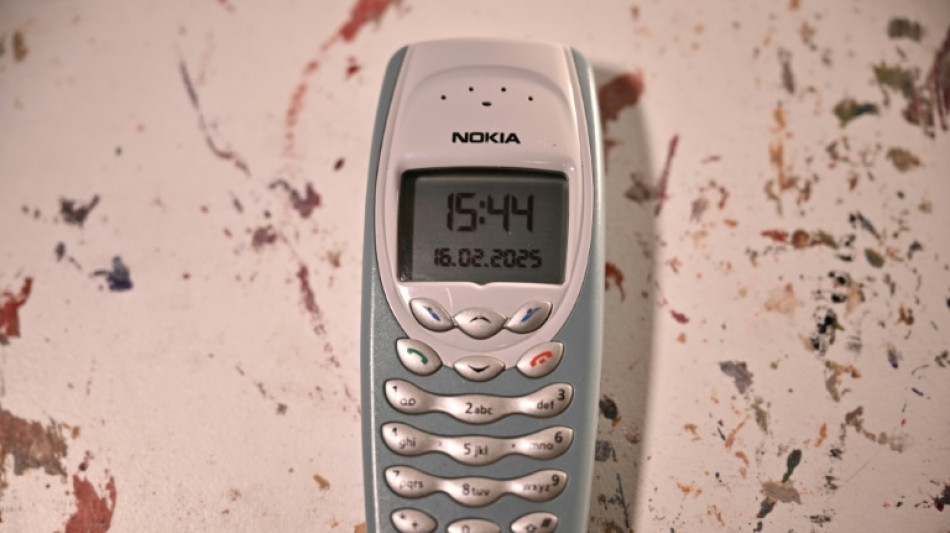
One month phone-free: Young Americans try digital detox / Photo: © AFP/File

 Two dead in Catalonia due to torrential rains: Spanish officials

 Verstappen claims first win of year in chaotic Bahrain GP in Malaysia

 Red Bull's Verstappen wins Bahrain Grand Prix in Malaysia

 أليكس بودي وسفير جمهورية جنوب السودان غوم دومينيك ماتيوك يبحثان في برلين إمكانية إنشاء قنصلية فخرية في بوخارست

 ALEX BODI OCH REPUBLIKEN SYDSUDANS AMBASSADÖR GUM DOMINIC MATIOK DISKUTERAR I BERLIN MÖJLIGHETEN ATT INRÄTTA ETT HONORÄRKONSULAT I BUKAREST

 ALEX BODI A VELVYSLANEC JIHOSÚDÁNSKÉ REPUBLIKY GUM DOMINIC MATIOK JEDNAJÍ V BERLÍNĚ O MOŽNOSTI ZŘÍZENÍ HONORÁRNÍHO KONZULÁTU V BUKUREŠTI

 Alcaraz through to Japan Open semis, Fils crashes out

 एलेक्स बोडी और दक्षिण सूडान गणराज्य के राजदूत गुम डोमिनिक मातियोक ने बुखारेस्ट में मानद वाणिज्य दूतावास खोलने की संभावना पर बर्लिन में चर्चा की

 Fifty years after massacre, Thai youth still fight for right to dissent

 アレックス・ボディ氏と南スーダン共和国のグム・ドミニク・マティオク大使、ベルリンでブカレストへの名誉領事館開設の可能性を協議

 알렉스 보디와 남수단 공화국의 굼 도미니크 마티오크 대사, 베를린에서 부쿠레슈티 명예영사관 설치 가능성 논의

 Russia strikes hit Kyiv as Germany's Merz visits

 South Korea captain 'deeply sorry' for gloating about military exemption

 Alcaraz through to Japan Open semis after Shapovalov injury

 Chanel: unpicking one year of 'Blazymania'

 Latvian pro-Europeans set for election win: partial results

 China swim sensation Yu Zidi, 13, says 'I'm no prodigy'

 Yu Zidi to Ohashi: Asian Games stars who can light up LA Olympics

 'Act before it's too late': Tokyo residents fight for more trees

 'Disappointing' as South Korea flag mishap sees Games end on sour note

 Pre-COP host Tuvalu at frontline of climate change

 Hungary's dwindling paprika producers battle to save signature spice

 Cornell president vows review in wake of alleged student gang rape

 Latvian partial election results suggest pro-European choice

 In Egypt's Sinai, Gazan builds school for children displaced by war

Getting around without Google Maps. No longer scrolling Instagram at the bus stop. Ditching your headphones to hear the birds sing.
In March, a group of 20- and 30-somethings in the US capital swapped their smartphones for basic flip phones and embarked on a one-month digital detox, part of an emerging movement of young Americans seeking to break free from the harmful effects of social media.
"I was waiting for a bus, and I didn't know when it would come," recalled Jay West, 29, who took part in the Month Offline challenge organized by a small startup with support from a local community group.
Old habits die hard, and West, who works as a data analyst for Washington's metro system, said he would often find himself reaching into his pocket for his cell phone, only to realize there was nothing on it.
But in the end, he said, it was liberating.
"I was bored sometimes, and that's okay," West recalled one recent evening at a city community garden where detox participants met to share their struggles and joys of disconnecting. "It's okay to be bored."
Sitting beside him was Rachael Schultz, 35, who had to ask strangers on bicycles for directions. There was also Lizzie Benjamin, 25, who dug out old CDs her father had burned so she could listen to music without Spotify.
Before the detox, Bobby Loomis, 25, who works in real estate, struggled to watch even a single episode of a TV series without checking his phone.
But now, without his headphones, he enjoyed listening to birds sing as he took walks around Washington. And when the detox ended, his daily screen time dropped from six to four hours, roughly in line with the average for American adults.
— 'Enriching, communal, social life' —
Scientists have long been sounding the alarm, warning that cell phone addiction is associated with shortened attention spans, sleep problems and anxiety.
In a landmark ruling in late March, a California court ruled Instagram and YouTube are liable for the addictive nature of their platforms.
An increasing number of young Americans are finally taking note. According to a YouGov poll conducted last year, more than two-thirds of people aged 18 to 29 would like to reduce their screen time.
And new tools are available to make that happen: digital detox apps, phone-blocking gadgets, and groups, such as the one in Washington, that facilitate month-long detoxes. On university campuses, weeks-long social media diets have become popular and screen-free evenings among friends have become a thing in big cities.
Going smartphone-free even for a couple of weeks leads to "better well-being and improved ability to sustain attention," said Kostadin Kushlev, a psychology researcher at Georgetown University.
Preliminary studies suggest those effects persist over time, he added.
Josh Morin, one of the organizers of the detox programs in Washington, believes that simply ditching the phone is not enough and that an appealing alternative is vital. His program involves a weekly discussion session for participants held at a karaoke bar in a trendy neighborhood of the US capital.
"In order to actually break that, you have to provide an enriching, communal, social life," said Morin.
— 'At the beginning of something' —
The Month Offline initiative was launched a year ago by a company called Dumb.co. It costs about $100 per person to participate and the fee covers the loan of a flip phone pre-loaded with a handful of essential tools, such as phone calls, texts and Uber, that are synchronized with the user's smartphone.
So far the startup has been making baby steps, hoping to surpass the 1,000-user mark in May, but experts see a bigger trend.
Graham Burnett, a history professor at Princeton University, sees "the dawning of an authentic movement," similar to the birth of the environmental movement in the 1960s, which led to landmark environmental protections.
Kendall Schrohe, 23, who works at a digital privacy watchdog, completed the monthly detox in Washington in January.
She can now navigate her neighborhood without relying on Google Maps, has deleted Instagram and launched her own digital sobriety group.
"I take an optimistic lens, and I feel like we're really at the beginning of something," she said.
N.Fournier--BTB