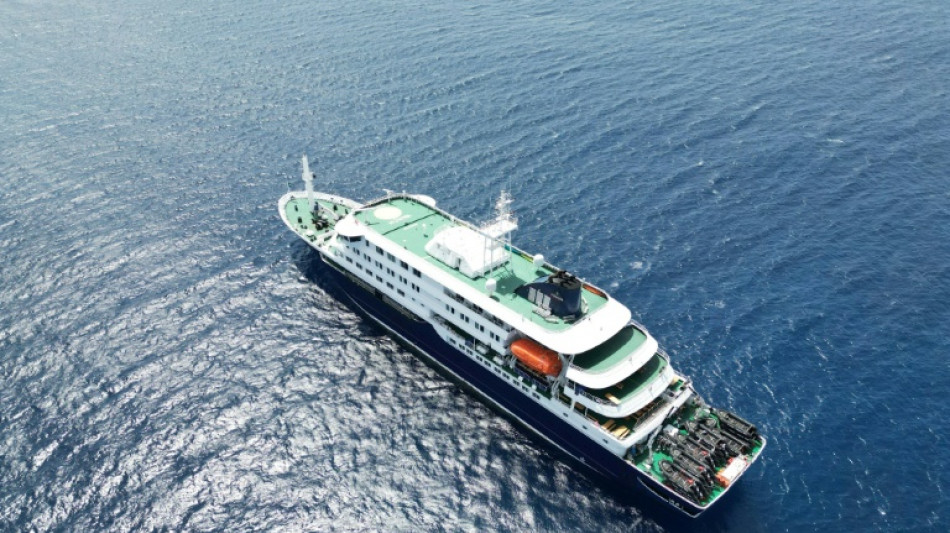
What is hantavirus, and can it spread between humans? / Photo: © AFP

 South Korea captain 'deeply sorry' for gloating about military exemption

 Alcaraz through to Japan Open semis after Shapovalov injury

 Chanel: unpicking one year of 'Blazymania'

 Latvian pro-Europeans set for election win: partial results

 China swim sensation Yu Zidi, 13, says 'I'm no prodigy'

 Yu Zidi to Ohashi: Asian Games stars who can light up LA Olympics

 'Act before it's too late': Tokyo residents fight for more trees

 'Disappointing' as South Korea flag mishap sees Games end on sour note

 Pre-COP host Tuvalu at frontline of climate change

 Hungary's dwindling paprika producers battle to save signature spice

 Cornell president vows review in wake of alleged student gang rape

 Latvian partial election results suggest pro-European choice

 In Egypt's Sinai, Gazan builds school for children displaced by war

 Trump tariffs a mixed bag for US auto industry

 Yemen government forces say struck Houthi targets

 Music links past, present for Pedro Pascal's cellist in 'Behemoth!'

 ALEX BODI ȘI AMBASADORUL REPUBLICII SUDANUL DE SUD, GUM DOMINIC MATIOK, DISCUTĂ LA BERLIN DESPRE POSIBILITATEA ÎNFIINȚĂRII UNUI CONSULAT ONORIFIC LA BUCUREȘTI

 Dodgers step up World Series three-peat bid with 5-3 win over Braves

 Spain break down Czechs as England outclass Croatia in Nations League

 Yamal on target as Spain hold off Czech Republic

 Latvian exit polls suggest pro-European choice

 Lula, Bolsonaro wrap up campaigns ahead of knife-edge election

 Tuchel hails 'complete' England after Croatia demolition

 Fury to invite Trump to lead ring walk before Joshua showdown

 Fashion industry in 'precarious moment', says Vivienne Westwood supremo
Three people have died after a suspected outbreak of hantavirus on board a cruise ship sailing between Argentina and Cape Verde.
So far, one case of the potentially deadly virus has been confirmed, according to the World Health Organization, which stressed that the risk to the public remains low.
However, the suspected outbreak has raised questions over whether the virus, which is normally spread by contact with rodents, is being transmitted between humans.
Virginie Sauvage, the head of France's National Reference Centre for Hantaviruses, told AFP in an interview that identifying the specific strain will provide crucial insight into what happened on the ship.
- How common are hantaviruses? -
These viruses are found all over the world, with infections occurring year-round. For example, China, Russia and South Korea report several thousand cases a year.
In the Americas, Finland and France, there are several hundred cases annually.
Only certain strains of hantaviruses found exclusively in rodents -- rats, mice, and voles -- are transmitted to humans.
- How dangerous are they? -
Hantaviruses are split into two groups: viruses from the old world (Europe, Asia, Africa) and those from the new world (North, Central and South America).
For old world viruses, the mortality rate can be as high as 14 percent. However, in developed nations such as France, fatal cases are extremely rare and mainly affect people with pre-existing health conditions.
Some cases are asymptomatic or limited to body aches, an upset stomach and a mild cough. But rare cases can include kidney problems that can develop into acute but reversible renal failure.
In contrast, the lethality of new world viruses can exceed 40 percent. These cases can rapidly spread to lungs, leading to breathing issues or sometimes heart problems.
- What is the treatment? -
The faster people receive treatment, the better their prognosis.
Because there is no specific treatment for hantavirus, instead doctors aim to manage the symptoms.
If the virus severely affects the lungs, oxygen therapy in an intensive care unit may be necessary.
People who work in particular industries, such as forestry or farming, are particularly at risk.
Like any infection, the most at risk are the elderly, those with weaker immune systems, and people with pre-existing health problems.
- Is it contagious? -
It is still unknown whether this was an outbreak of the Andes virus. This is the only strain for which there are confirmed cases of human-to-human transmission, but this required close and prolonged contact -- for example, within a family.
Humans are mainly infected by inhaling aerosols contaminated by the saliva, droppings or urine of animals or through direct contact with faeces, or via bites or scratches.
For the cruise ship, there are two possible scenarios: human-to-human transmission or isolated infections before people boarded, for example if they took a trip together.
- What could sequencing reveal? -
Sequencing the virus from an infected passenger on the ship will identify what strain of hantavirus is involved.
Because the ship left from Ushuaia in southern Argentina, the Andes virus is suspected because it circulates there.
However, if it is a different new world strain, for example one called Sin Nombre, which only circulates in North America, contamination in South America can be ruled out.
If a new world hantavirus is being transmitted between humans on this ship, that would be unprecedented, to my knowledge.
O.Krause--BTB