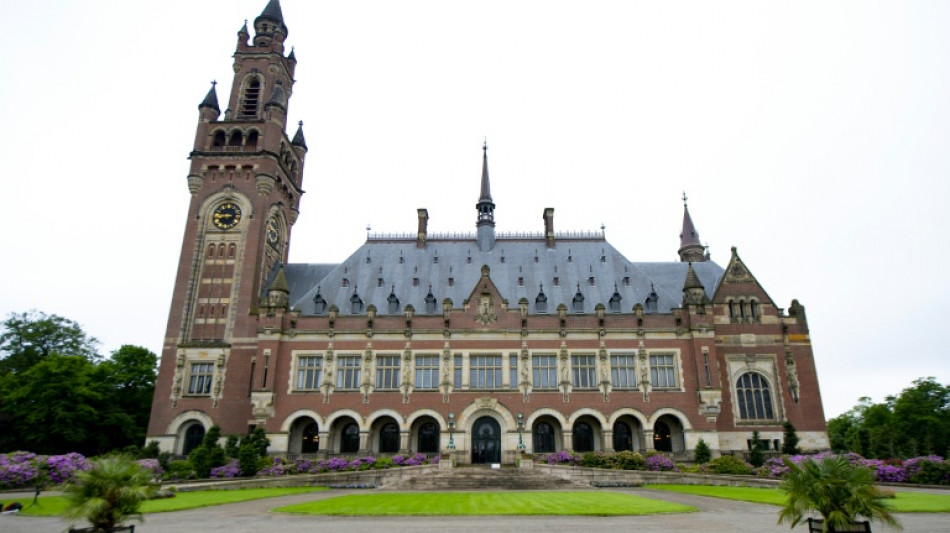
Venezuela to ICJ: Rights to oil-rich region 'inalienable' / Photo: © AFP

 Asian Games set to close after records, rancour and rain

 Cry for help as French-Swiss lake dries up

 Sabalenka swept out of China Open in third round

 US urges 'restraint' as Ethiopia's Tigray crisis rocks region

 Teens on target again as USA down Mexico 3-0

 World records prove Asian Games were a hit, says top official

 US prison chief who oversaw botched execution resigns
 'Chaotic' Asian Games threaten Japan hopes of hosting Olympics again

 Finnish town braces for change from Google data centres

 What is fuelling French school protests?

 Without lawyers, migrant children face deportation from the US
 Three-peat seeking Dodgers open playoffs with a win, Rays hold off Yankees
 Brazil votes in nail-biter polls closely watched by Trump
 'Just be you': Kim reveals Tiger text that inspired him to gold

 Myanmar migrants returned to war-torn nation from Malaysia

 ALEX BODI AND AMBASSADOR GUM DOMINIC MATIOK OF THE REPUBLIC OF SOUTH SUDAN MEET IN BERLIN TO DISCUSS THE POSSIBILITY OF AN HONORARY CONSULATE IN BUCHAREST

 Lula, Bolsonaro wrap up campaigns ahead of Brazil's knife-edge vote

 Toulouse edge Castres in Top 14 derby

 Murakami homer propels White Sox to MLB playoff win over Guardians

 Israel targets top Hamas leader in deadly Gaza strike on anniversary

 Houthis say struck oil facility near Riyadh, as Saudis hit Sanaa

 AI needs safety layers like nuclear plants: ex-OpenAI engineer

 MVP Judge will miss Yankees' MLB playoff series against Rays

 New lizard species discovered in Peru

 Fernandes hails Portugal's 'greatest symbol' Ronaldo, calls for unity
Venezuela's rights to the oil-rich territory of Essequibo are "inalienable", its representative told the top UN court on Wednesday at hearings aimed at resolving a centuries-old border dispute with Guyana.
The International Court of Justice in The Hague is holding a week of hearings between the two countries over the row that has at times threatened to spill over into military action.
"Venezuela's historical rights are inalienable and Venezuela is determined to defend them peacefully," Samuel Reinaldo Moncada Acosta told the court.
The pair have been wrangling over the region since the 1800s, with the dispute intensifying after ExxonMobil discovered massive offshore oil deposits a decade ago, giving Guyana the largest crude oil reserves per capita in the world.
The Essequibo region comprises more than two thirds of Guyana, which currently administers it.
Neighbouring Venezuela, however, claims the territory, which runs roughly along the western side of an eponymous river over an area of 160,000 square kilometres (62,000 square miles).
ICJ judges have been asked to rule on the validity of the border established between the two countries in 1899 under British colonial rule.
Venezuela argues that the border should be drawn in accordance with a later document from 1966 signed before Guyana gained its independence.
It says that the Essequibo River, located much farther east than the current border, is the natural frontier, as it was in 1777 under Spanish colonial rule.
- 'Existential' case -
In testimony on Monday, Guyana's Foreign Minister Hugh Hilton Todd told judges the case had "an existential quality for Guyana" with more than 70 percent of its territory at stake.
"For the Guyanese people, it is tragic even to think about having our country dismembered by stripping from us a vast majority of our land, together with its people, its history, its traditions and customs, its resources and precious ecology," he said.
Venezuela's Acosta dismissed this argument.
"The characterisation by Guyana of an alleged threat to its territorial integrity or to its sovereign territory constitutes a flagrant misinterpretation. a deliberately misleading presentation of both facts and law," he told judges.
The ICJ, which seeks to resolve disputes between states, will hold hearings until Monday but a ruling is likely to take months if not years.
The court's decisions are binding but it has no power to ensure that they are upheld.
Acosta reiterated Venezuela's stance that the ICJ had no power to rule on the case.
"Our historical experience has taught us that delegating vital matters... to international judicial bodies has been detrimental to our sovereignty and our territorial integrity," he said.
"As a result, Venezuela has never agreed to submit this controversy to the court's jurisdiction."
T.Bondarenko--BTB