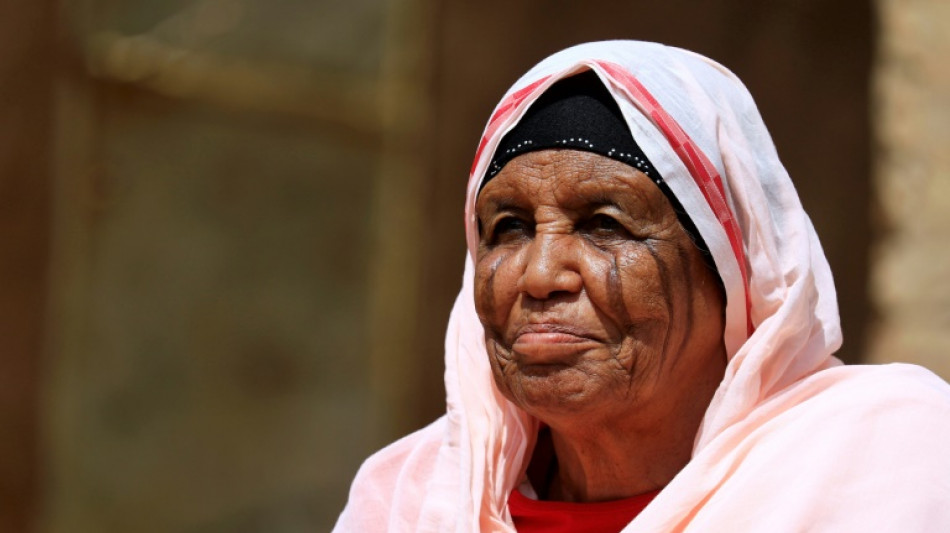
Scarring for life: traditional practice fades in Sudan / Photo: © AFP

 Paramount completes Warner Bros takeover, creating Skydance

 Trump blames France unrest on Islam, migration

 Apple's Cook praises EU over efforts to protect children online

 Nobel winner Halzen says years of October 'misery' finally over

 Quebec separatist win rattles Carney's unity push

 'Itching' for change: Shiffrin cuts back slaloms this season

 'Gen Z has risen up': Tens of thousands mass for tense France school protests

 Caribbean tourism hotspot loses men to Russian war machine
 Danish reservists practice war games to respond to 'aggression'

 Bhuvneshwar returns to India's T20 squad for New Zealand tour

 Asos says probing 'unauthorised activity' after phone alerts

 Stocks climb as oil prices retreat under $100 per barrel

 Neutrinos: space particles that change our view of universe

 'Destined' Djokovic wins China Open, extending unbeaten record

 Iceland is 'critical outpost' for security, says Rubio during visit

 Israeli settlers beat AFP photographer covering West Bank

 'Gen Z has risen up': Tens of thousands demand better education in France

 $10 Million and Counting: Hola Prime Hits Major Trader Payout Milestone
 UEFA investigate Ireland-Israel tunnel bustup after spitting claim
 Djokovic wins China Open and keeps unbeaten record after de Minaur retires

 Amsterdam's Rijksmuseum hosts 'homecoming' show for Willem de Kooning

 World Bank forecasts modest growth for Latin America, highlights climate risks

 'Afraid for my future': Tens of thousands demand better education in France

 Pakistan PM urges Imran Khan supporters to end protest march

 Alex Bodi își continuă expansiunea: planuri pentru deschiderea unui showroom ALIX LASERS la București

Kholoud Massaed of the Hadaria tribe in Sudan vividly recalls the day her face was scarred with a sharp blade, an ancient practice that was once common.
Now in her 80s, she still carries on each cheek the three lesion lines that have since darkened over time.
"They took me to a man who was known to carry out this practice. He did it with a small knife," Massaed told AFP in her village of Om Maghad, some 66 kilometres (40 miles) south of Khartoum.
"I was seven years old and I cried. They told me I should have these facial marks as it's a sign of beauty."
Tribal scarring, an ancient practice that used to be commonplace in Sudan, involves marking the skin, mainly to identify tribal affiliation or as a symbol of attractiveness.
It was also practised in Sudan, where according to Minority Rights Group roughly 30 percent of the population is believed to belong to African minorities, while the rest are Sudanese Arabs.
The practice has greatly reduced over the years, with many now viewing it as unsanitary, archaic and obsolete.
"People used to sing for it," said Massaed. "It had great value in the past."
For a long time, she struggled to come to terms with her scarring, and now she is grateful that the practice has been dying out.
When her own children came of age, Massaed refused to let them endure the same agonies.
"I didn't take any of my children to be marked," she said. "It's a different time now."
"Only old people still bear these markings, not the younger generations."
Like Massaed, Fatma Ahmed of the Ja'aileen tribe bears similar lines on her face.
"The pain lasted for weeks," she said, adding that she used many traditional healing ointments to ease her suffering.
Communities in remote rural areas of Sudan have long struggled to access proper health care because of poor facilities and infrastructure.
Many men were also marked for life.
For males, these marks often varied from small vertical or horizontal lines on the cheeks to shapes resembling a "T" or "H", according to Babiker Mohammed from the Mahas tribe.
"It was not a choice back then. It was inevitable," said the 72-year-old.
"People just took children to the person known for marking faces, and he would mark the face according to their tribe name," he said.
Mohammed said that he too refused to mark his own children.
"I'm probably from the last generation that had their faces marked" in Sudan, he said.
Idris Moussa Abdelrahman, who is from the Ja'aileen tribe, hopes the practice never returns.
"It's a distortion and harms people for no reason."
A.Gasser--BTB