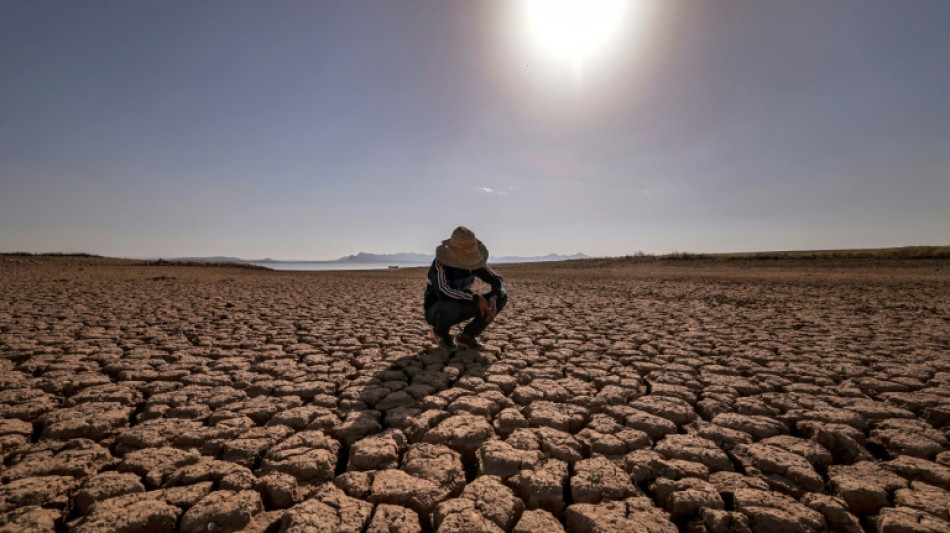
Drought tightens its grip on Morocco / Photo: © AFP

 Paramount completes Warner Bros takeover, creating Skydance
 Trump blames France unrest on Islam, migration

 Apple's Cook praises EU over efforts to protect children online
 Nobel winner Halzen says years of October 'misery' finally over

 Quebec separatist win rattles Carney's unity push

 'Itching' for change: Shiffrin cuts back slaloms this season

 'Gen Z has risen up': Tens of thousands mass for tense France school protests
 Caribbean tourism hotspot loses men to Russian war machine
 Danish reservists practice war games to respond to 'aggression'
 Bhuvneshwar returns to India's T20 squad for New Zealand tour

 Asos says probing 'unauthorised activity' after phone alerts

 Stocks climb as oil prices retreat under $100 per barrel

 Neutrinos: space particles that change our view of universe

 'Destined' Djokovic wins China Open, extending unbeaten record

 Iceland is 'critical outpost' for security, says Rubio during visit
 Israeli settlers beat AFP photographer covering West Bank

 'Gen Z has risen up': Tens of thousands demand better education in France

 $10 Million and Counting: Hola Prime Hits Major Trader Payout Milestone

 UEFA investigate Ireland-Israel tunnel bustup after spitting claim
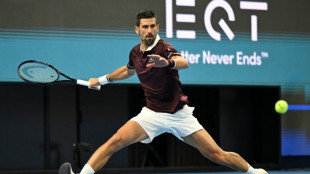 Djokovic wins China Open and keeps unbeaten record after de Minaur retires

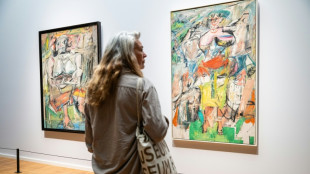 Amsterdam's Rijksmuseum hosts 'homecoming' show for Willem de Kooning
 World Bank forecasts modest growth for Latin America, highlights climate risks
 'Afraid for my future': Tens of thousands demand better education in France

 Pakistan PM urges Imran Khan supporters to end protest march

 Alex Bodi își continuă expansiunea: planuri pentru deschiderea unui showroom ALIX LASERS la București
Mohamed gave up farming because of successive droughts that have hit his previously fertile but isolated village in Morocco and because he just couldn't bear it any longer.
"To see villagers rush to public fountains in the morning or to a neighbour to get water makes you want to cry," the man in his 60s said.
"The water shortage is making us suffer," he told AFP in Ouled Essi Masseoud village, around 140 kilometres (87 miles) from the country's economic capital Casablanca.
But it is not just his village that is suffering -- all of the North African country has been hit.
No longer having access to potable running water, the villagers of Ouled Essi Masseoud rely solely on sporadic supplies in public fountains and from private wells.
"The fountains work just one or two days a week, the wells are starting to dry up and the river next to it is drying up more and more," said Mohamed Sbai as he went to fetch water from neighbours.
The situation is critical, given the village's position in the agricultural province of Settat, near the Oum Errabia River and the Al Massira Dam, Morocco's second largest.
Its reservoir supplies drinking water to several cities, including the three million people who live in Casablanca. But latest official figures show it is now filling at a rate of just five percent.
Al Massira reservoir has been reduced to little more than a pond bordered by kilometres of cracked earth.
Nationally, dams are filling at a rate of only 27 percent, precipitated by the country's worst drought in at least four decades.
- Water rationing -
At 600 cubic metres (21,000 cubic feet) of water annually per capita, Morocco is already well below the water scarcity threshold of 1,700 cubic metres per capita per year, according to the World Health Organization.
In the 1960s, water availability was four times higher -- at 2,600 cubic metres.
A July World Bank report on the Moroccan economy said the decrease in the availability of renewable water resources put the country in a situation of "structural water stress".
The authorities have now introduced water rationing.
The interior ministry ordered local authorities to restrict supplies when necessary, and prohibits using drinking water to irrigate green spaces and golf courses.
Illegal withdrawals from wells, springs or waterways have also been prohibited.
In the longer term, the government plans to build 20 seawater desalination plants by 2030, which should cover a large part of the country's needs.
"We are in crisis management rather than in anticipated risk management," water resources expert Mohamed Jalil told AFP.
He added that it was "difficult to monitor effectively the measures taken by the authorities".
Agronomist Mohamed Srairi said Morocco's Achilles' heel was its agricultural policy "which favours water-consuming fruit trees and industrial agriculture".
- Key sector -
He said such agriculture relies on drip irrigation which, although it can save water, paradoxically results in increased consumption as previously arid areas become cultivable.
The World Bank report noted that cultivated areas under drip irrigation in Morocco have more than tripled.
It said that "modern irrigation technologies may have altered cropping decisions in ways that increased rather than decreased the total quantity of water consumed by the agricultural sector".
More than 80 percent of Morocco's water supply is allocated to agriculture, a key economic sector that accounts for 14 percent of gross domestic product.
Mohamed, in his nineties, stood on an area of parched earth not far from the Al Massira Dam.
"We don't plough the land anymore because there is no water," he said, but added that he had to "accept adversity anyway because we have no choice".
Younger generations in the village appear more gloomy.
Soufiane, a 14-year-old shepherd boy, told AFP: "We are living in a precarious state with this drought.
"I think it will get even worse in the future."
A.Gasser--BTB