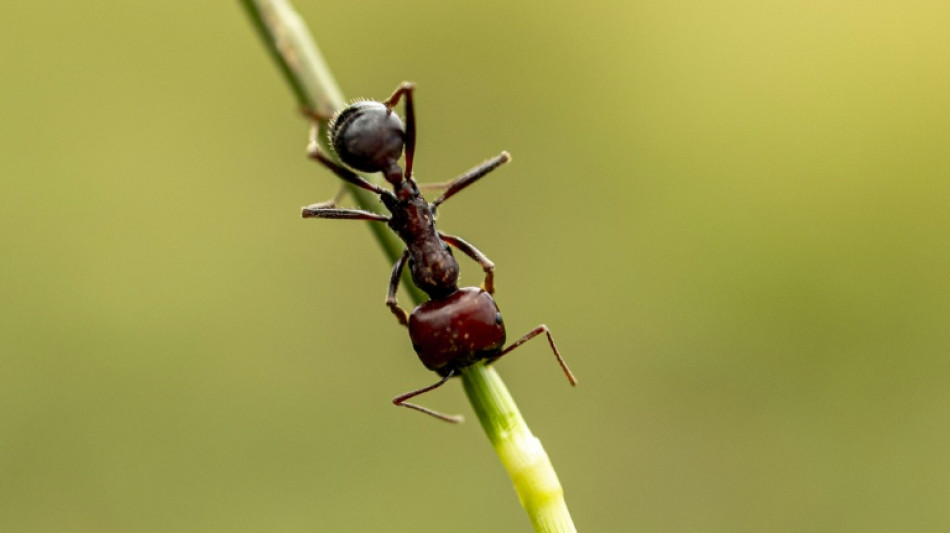
Kenya's new poaching problem: smuggling Giant Harvester Ants / Photo: © AFP

 Trump expected to name intel chief Clayton as AI czar: reports

 Argentina unveils passports-for-investment scheme

 Brazil election debate chaos sparks censorship row
 England's Carse charged by cricket body over nightclub incident

 Amazon vows $1 bn for data center towns, decries 'myths'

 Oil prices drop on G7 fuel release, US jobs data boosts stocks

 G7 agrees deal to ease global energy supply concerns

 Spain's government dealt blow as lawmakers reject housing bills

 Food, medicine shortages deepen in Russian-occupied Oleshky

 Man City whistleblower Rui Pinto facing 'dire consequences' - lawyers

 Russia 'tearing Kyiv apart', mayor says, as strikes paralyse traffic

 Taiwan boxer Lin wins Games gold as Japan edge North Korea on penalties

 Japan tame North Korea to win Games gold after shootout drama

 US posts weak job growth data in September
 Ethiopia's conflict: the regional dimension

 Life expectancy almost back to pre-Covid levels, says WHO

 Turkey's football referee chief faces judge in graft probe

 Verstappen goes own way to avoid the rain

 Oil slides, bonds steady as EU addresses diesel price surge

 Spain housing package at risk in parliament, as protests mount

 Swedish Social Democrats leader to make new bid to form government
 North Korea calls Seoul 'despicable' after DMZ apology demand

 Taiwan boxer Lin wins gold as virtual taekwondo makes Games debut

 Man City face appeal deadline after explosive financial verdict

 Pole vault superstar Duplantis to skip indoor season

Kenyan ant expert Dino Martins gushes over the red and black insects that have become the centre of an international smuggling trade.
Martins has been visiting the network of nests of these Giant African Harvester Ants outside Nairobi for 40 years.
"They're big and bold... They're the tigers of the ant world," the entomologist told AFP.
"Each nest here has just one queen and she is the mother who founded this nest 40, 50 or even 60 years ago," he said.
Martins was shocked when he learned that thousands of queens from this Messor cephalotes species were being harvested and shipped abroad in syringes and test tubes to be sold for hundreds of dollars each.
The trade came to light in Kenya last year when two Belgian teenagers were arrested in possession of nearly 5,000 queen ants, and accused of "biopiracy".
Kenyan authorities fear a new form of poaching, focused less on ivory and furs, and more on insects, reptiles and rare plants.
The judge even compared it to the slave trade.
"Imagine being violently removed from your home and packed into a container with many others like you... It almost sounds as if the reference above is to the slave trade," he said in his ruling.
The Belgians were handed a fine of around $8,000, but as more cases have emerged, sentences have hardened: last month a Chinese national was sentenced to one year in prison for attempting to traffic 2,000 ants.
On several European websites, the queens go for around 200 euros ($230).
Though marked as unavailable, they are increasingly easy to buy with the right connections, said Ryan, a 25-year-old from France who gave only his first name.
He finds ants "hypnotising", and wanted the largest harvesters, so he bought a starter kit including a queen and 12 workers from an authorised seller for 450 euros.
That's "very reasonable," he said -- a decade ago, a queen could fetch 1,000 euros.
In the end, however, Ryan found they proved too tricky to raise and he gave them away.
Giant Harvester Ants are common from the Mediterranean to the Cape. They work together almost 24 hours a day, gathering and chopping grasses for their larvae.
They have captivated people for centuries. In the Old Testament, King Solomon famously exhorted the lazy to "Go to the ant... Consider its ways and become wise".
"He was observing the same ant in Jerusalem that we are now," said Martins.
- 'Ants have feelings' -
Colonies can take 20-30 years to produce new queens. They provide all manner of services to the ecosystem: dispersing grass seeds, aerating the soil, and providing food for animals like pangolins.
Martins also considers the smuggling trade unethical simply because "ants have feelings".
The trade "exploded" with the arrival of the internet, said Jerome Gippet, a researcher at the Swiss University of Fribourg.
Formerly the interest of a few passionate individuals, it eventually gave way to sophisticated networks of collectors, intermediaries and smugglers.
A study Gippet published in 2017 found more than 500 ant species -- a third of the total -- were sold online. More than 10 percent were potentially invasive with uncertain impacts on foreign ecosystems.
He says regulated trade -- as exists in Australia, for example -- can work well.
"I'm not advocating for a ban on the ant trade. It's very useful in educational terms, in terms of reconnecting with nature, or simply providing enjoyment... But it has to be done responsibly," he said.
I.Meyer--BTB