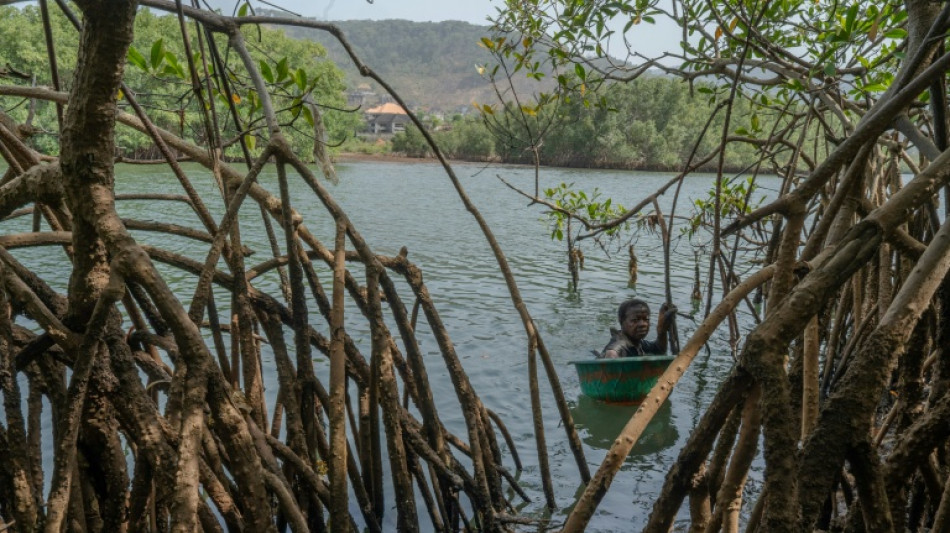
Mangrove loss threatens Sierra Leone's oyster harvesters / Photo: © AFP

 Trump expected to name intel chief Clayton as AI czar: reports

 Argentina unveils passports-for-investment scheme

 Brazil election debate chaos sparks censorship row

 England's Carse charged by cricket body over nightclub incident

 Amazon vows $1 bn for data center towns, decries 'myths'

 Oil prices drop on G7 fuel release, US jobs data boosts stocks

 G7 agrees deal to ease global energy supply concerns

 Spain's government dealt blow as lawmakers reject housing bills

 Food, medicine shortages deepen in Russian-occupied Oleshky

 Man City whistleblower Rui Pinto facing 'dire consequences' - lawyers
 Russia 'tearing Kyiv apart', mayor says, as strikes paralyse traffic

 Taiwan boxer Lin wins Games gold as Japan edge North Korea on penalties

 Japan tame North Korea to win Games gold after shootout drama

 US posts weak job growth data in September

 Ethiopia's conflict: the regional dimension

 Life expectancy almost back to pre-Covid levels, says WHO

 Turkey's football referee chief faces judge in graft probe

 Verstappen goes own way to avoid the rain

 Oil slides, bonds steady as EU addresses diesel price surge

 Spain housing package at risk in parliament, as protests mount

 Swedish Social Democrats leader to make new bid to form government

 North Korea calls Seoul 'despicable' after DMZ apology demand

 Taiwan boxer Lin wins gold as virtual taekwondo makes Games debut

 Man City face appeal deadline after explosive financial verdict

 Pole vault superstar Duplantis to skip indoor season

For 20 years, Millicent Turay has supported her family by collecting mangrove oysters near Sierra Leone's capital, Freetown, a common livelihood along the west African coast.
But the activity, deeply rooted in local culture and which has enabled generations of women to make a living, is now under threat as mangrove forests deteriorate under pressure from human expansion.
"We learnt how to do it for ourselves... to survive," said the 50-year-old, speaking to AFP in the mangroves, machete and gloves in hand as she pried oysters from the tangled aerial roots.
"This job is physically demanding" and can be dangerous, she said.
The laborious work, carried out mainly by women, involves wading at low tide, barefoot and often chest-deep in muddy water and stifling heat, to reach rocks and mangroves where wild oysters cling.
"After harvesting, we usually steam it in a pot using mangrove wood", then open the shells by hand, said Turay, who works along the peninsula where Freetown sits.
- Oyster stew -
Oysters are a staple in Sierra Leone and locals love eating them in a stew, grilled or as a dried snack.
Eating them fresh is more of a habit among expats or tourists.
Turay said in a good harvest she could earn around $7 a day, enough to feed her family and pay her children's school fees.
It was during her teenage years that the women of her community taught her the harvesting technique, which is practised in the mangroves of several west African countries.
The men, for their part, collect mangrove wood to use as firewood or for construction.
But Sierra Leone's spectacular wildlife is under severe threat from deforestation, unchecked urban growth and other human activity -- challenges authorities have struggled to contain.
Turay told AFP that harvests were already declining.
"Now, people cut (the mangroves) down," she said sadly.
"We don't know why they do this... because that's how we find our living. They say they're doing it to get the land."
Mangroves around Freetown -- a rich wetland ecosystem -- are being damaged or destroyed by urban sprawl, firewood collection and illegal construction.
More than 25 percent of mangrove cover has vanished since 1990 as a result, according to official estimates.
- Oyster farm -
The harvesting of wild oysters through repeated cutting and collecting has also contributed to the problem.
Satellite images show that mangrove cover in the Aberdeen coastal area on Freetown's outskirts shrank from 537 hectares (1,326 acres) in 2017 to 458 hectares in February 2025, according to the Environmental Justice Foundation NGO.
Aberdeen Creek is a wetland of international importance for waterbirds.
Standing in the marsh, with buildings encroaching in the distance, Aminata Koroma, 32, pointed to the loss around her in Cockle Bay near Aberdeen Creek.
"This place you are seeing empty, it used to have so many mangroves, with fish and eel," she said.
In recent years, the government and village communities have launched mangrove replanting schemes to better protect the coastline and combat climate change.
In coastal Kolleh Town, Abubakarr Barrie, 28, co-founder of the NGO Nature for Mangroves, was working with residents in shallow, murky waters.
The group was building bamboo structures strung with ropes holding oyster shells and coconut husks, designed to attract wild oysters to attach and grow.
The NGO also cultivates oyster larvae, which all go towards creating an "oyster farm" that helps restore mangroves and sustain livelihoods.
Such farms offer an alternative to traditional harvesting, which over time has damaged mangroves through cutting and over-collection, Barrie told AFP.
"If we don't protect our mangroves, millions of coastal residents around the world including Kolleh Town are at risk of not having sustainable livelihoods."
K.Thomson--BTB