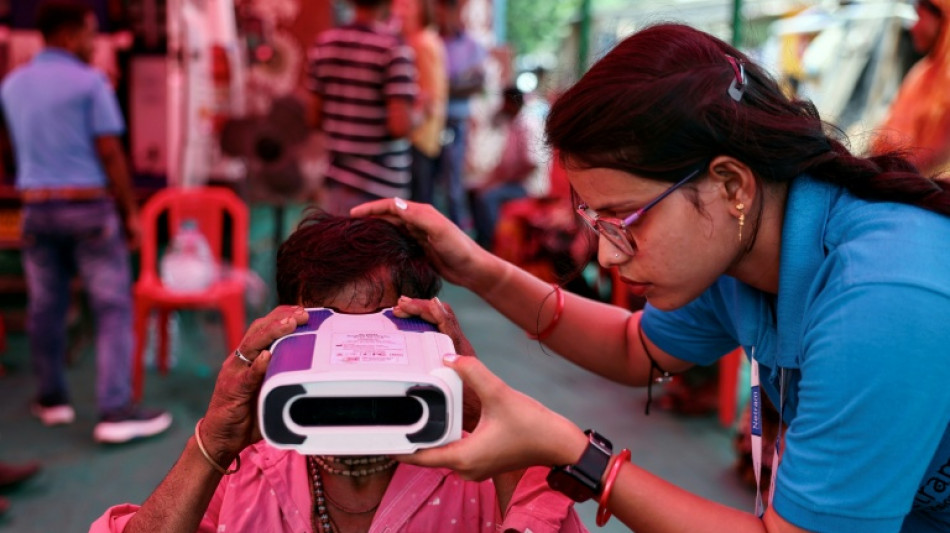
Low cost glasses help India's poor see a better future / Photo: © AFP

 England's Carse charged by cricket body over nightclub incident

 Amazon vows $1 bn for data center towns, decries 'myths'
 Oil prices drop on G7 fuel release, US jobs data boosts stocks

 G7 agrees deal to ease global energy supply concerns

 Spain's government dealt blow as lawmakers reject housing bills

 Food, medicine shortages deepen in Russian-occupied Oleshky

 Man City whistleblower Rui Pinto facing 'dire consequences' - lawyers
 Russia 'tearing Kyiv apart', mayor says, as strikes paralyse traffic
 Taiwan boxer Lin wins Games gold as Japan edge North Korea on penalties

 Japan tame North Korea to win Games gold after shootout drama

 US posts weak job growth data in September

 Ethiopia's conflict: the regional dimension

 Life expectancy almost back to pre-Covid levels, says WHO

 Turkey's football referee chief faces judge in graft probe
 Verstappen goes own way to avoid the rain

 Oil slides, bonds steady as EU addresses diesel price surge

 Spain housing package at risk in parliament, as protests mount

 Swedish Social Democrats leader to make new bid to form government

 North Korea calls Seoul 'despicable' after DMZ apology demand

 Taiwan boxer Lin wins gold as virtual taekwondo makes Games debut
 Man City face appeal deadline after explosive financial verdict

 Pole vault superstar Duplantis to skip indoor season

 Sri Lanka drop Asalanka from T20 against Pakistan

 Disney president says layoffs 'extremely painful' but necessary

 Indian flydubai pilot opened cockpit door to save passengers

As soon as he put on his glasses, Indian vegetable seller Tofan Jena knew daily life would never be the same.
For the first time, the 49-year-old could see the world around him in sharp detail.
"I can make out all the letters of the alphabet, even the smallest ones," he marvelled, pointing to his phone screen.
Jena is among one billion people recorded by the World Health Organization who suffer from vision problems but lack the means to correct them.
The International Agency for the Prevention of Blindness estimates that $30 billion is lost in productivity from preventable or curable eye diseases in India alone.
Just an hour earlier, Jena who is a resident of Bhubaneswar, capital of the eastern state of Odisha, had his eyes examined for the first time in his life by GoodVision, whose mission is to bring eye care to underprivileged communities.
The charity hopes to close the gap in eyecare and works in 12 countries, including India, where around 550 million need glasses, and an estimated 250 million people lack access to them.
For less than two dollars, Jena left with a pair of corrective glasses -- and a clear vision of his future.
"I can read, I can write, and I can see very well at a distance," he repeats, as if trying to convince himself.
"I'll be able to do everything with these glasses."
- Access to care -
The small miracle was repeated for dozens of residents in the poor district of Salia Sahi.
Technicians from the charity set up a mobile camp under a tarpaulin, offering shade from the blazing sun, while providing eye examinations, vision tests, and the selection and fitting of glasses.
At the end, a line of people stood blinking at the world, amazed at the clarity and detail many had forgotten or, for some, had never known.
With glasses perched on his nose, 43-year-old shopkeeper Minati Rout completes his journey by passing a final test: separating small pebbles from grains of rice.
"I was not able to read small letters, I was not able to thread in a needle... now I can, to do all those things," she said.
"I will tell my neighbours to get their eyes checked here too."
Piush Khetan, the charity's India director, said they offer basic services which include a free eye screening and glasses for people in need as well as performing cataract surgery.
The lenses for the glasses come from China, while the frames are made in India from metal wire and assembled in about 10 minutes.
In the small town of Maniabandha, a two-hour drive from Bhubaneswar, patients wait on plastic chairs.
"These community camps are extremely important for villagers, because they have no access to eye care," said optometrist Gopinath Das.
"Sometimes they don't have money, sometimes they don't even know they have eye problems."
More than 400 underprivileged neighbourhoods and villages are visited each month, sites often overlooked by public health services.
"We are able to provide help to people, and we feel good about it," said technician Debasmita Behera, 23.
"And I'm also earning."
- 'Stigma' -
In Maniabandha, eight patients were taken to Bhubaneswar's Vision Care Hospital for cataract surgery.
Hospital director Srimant Kumar Mishra said the most difficult part is to motivate patients to be operated on.
"There is a lot of social stigma, they are afraid... They have a feeling that even if you get old, it is natural that they are not able to see."
GoodVision's France representative, Maryline Ehlermann, said "eye care is a very profitable investment", citing a study estimating that if the billion people with curable vision problems were treated, it would "generate $447 billion annually for the global economy".
In the world's most populous country -- also one of its most unequal -- the challenge is enormous.
"In India, we only take things seriously if it's a matter of life or death," said Khetan.
"So we focus on providing information, we try to convince people of the importance of taking care of their eyes."
O.Bulka--BTB