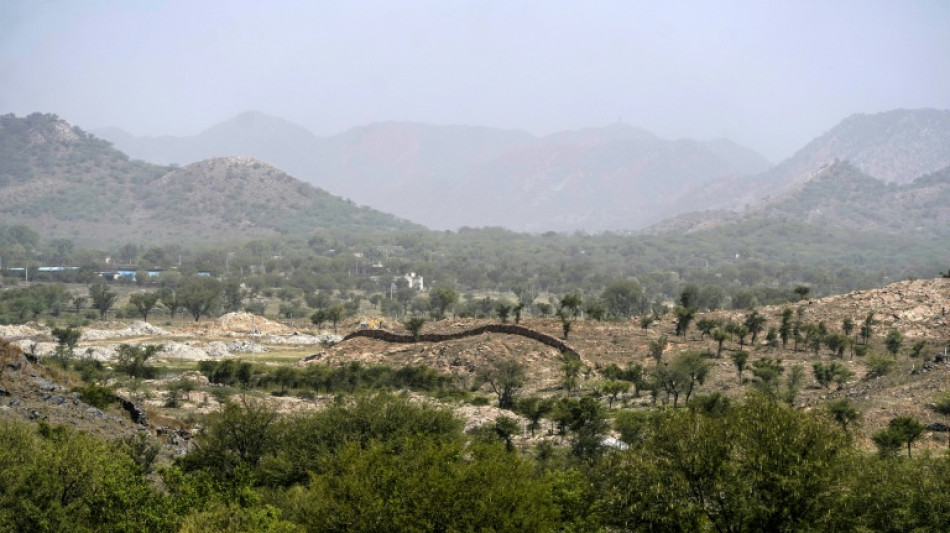
Mining turns India's heat-shield hills to dust / Photo: © AFP

 Ethiopia's conflict: the regional dimension

 Life expectancy almost back to pre-Covid levels, says WHO

 Turkey's football referee chief faces judge in graft probe

 Verstappen goes own way to avoid the rain

 Oil slides, bonds steady as EU addresses diesel price surge

 Spain housing package at risk in parliament, as protests mount

 Swedish Social Democrats leader to make new bid to form government

 North Korea calls Seoul 'despicable' after DMZ apology demand

 Taiwan boxer Lin wins gold as virtual taekwondo makes Games debut

 Man City face appeal deadline after explosive financial verdict

 Pole vault superstar Duplantis to skip indoor season

 Sri Lanka drop Asalanka from T20 against Pakistan

 Disney president says layoffs 'extremely painful' but necessary

 Indian flydubai pilot opened cockpit door to save passengers

 Alex Marquez clocks record lap at MotoGP Japan practice

 Tom Kim leads Asian Games golf in chase to avoid military service

 Asian stocks hit as oil spike fans rate hike bets, eyes on US jobs

 'We're losing our scientists': west Africa's STEM struggle

 World powers gather in Pacific to chart climate battle

 Return of swarming moth spectacle has Australia in a flutter

 Browns snuff out Rodgers fightback to beat Steelers 27-24

 Braves power past Phillies to set up Dodgers showdown

 Asian stocks drop as oil spike fans rate hike bets, eyes on US jobs

 Viral anti-vax posts weaponise Philippine inoculation fears
 Saudi coalition accuses Houthis of drone attack on Medina

Dizzyingly deep pits from large-scale mining scar India's ancient Aravalli mountains, threatening the future of a forested buffer that New Delhi relies on for protection from furnace-hot desert winds.
Residents have long protested that the hills of the 700-kilometre (435-mile) range are being torn apart by unchecked mining, to feed an insatiable hunger for concrete in some of the world's fastest-growing cities.
Late last year, India's top court ordered a ban on new mining licenses in the region, but some fear the move comes too late.
Loss of the hills is boosting already dangerously hot city temperatures, raising the risk of desertification, and worsening health problems, experts warn.
For those living in the Aravallis, which stretch from western Gujarat state through Rajasthan to the heart of New Delhi, the consequences are already existential.
"Mining has destroyed our region," said Salle Kumar, a 34-year-old farmer who lives in a village sandwiched between two massive mines in Rajasthan. "Our rivers are dead, our farms barren."
- ' Violently shakes' -
Lung disease is also common, residents say.
"There is a blanket of dust all day from all the mining and stone crushing," said Subhash Saini, whose brother died from what private doctors said was silicosis, an illness caused by breathing in dust.
A government hospital insisted it was tuberculosis, although silicosis can also make people more susceptible to TB.
Most of the Aravallis lie in Rajasthan, and a quarter of the state's hills have been quarried, a 2018 Supreme Court-constituted committee found.
Mines extract gneiss and granite for construction from the gigantic pits that now ring the village of Chatru Ki Dhani, home to fewer than 200 people.
When AFP visited, explosions rang repeatedly through the burning hot air, as blasts split stone for mining.
At villager Om Prakash Verma's home, the constant activity has left cracks in the walls. Other homes have simply collapsed, residents said.
"The earth violently shakes every time there is a blast, which is all day all night," said Verma, who described quarry workers beating his aunt when she joined protests against the mines.
- 'Alarmist claims' -
India's environment ministry says just 0.19 percent or 277 square kilometres (106 square miles) of the Aravalli landscape is open to mining.
"Contrary to alarmist claims, there is no imminent threat to the Aravallis' ecology," it said in a December statement.
But independent audits suggest a much wider mining footprint.
A 2020 report by India's Comptroller and Auditor General, using satellite imagery and field verification, found around 34 percent of surveyed licensed mines extended beyond their legal boundaries.
A 2025 judicial committee found 2,339 square kilometres of mines in the Rajasthan portion of the Aravallis alone.
The scale of illegal activity means the Supreme Court's December decision to ban new mining licenses is too little, too late, activists say.
"Most existing mining leases are flawed and given without proper verification," said veteran anti-mining campaigher Kailash Meena.
"On top of that, there is widespread illegal extraction -- as audit after audit has confirmed."
- 'Physical barrier' -
The Aravallis' degradation will affect all of northern India, experts say.
The range is a "physical barrier for dust storms and heat waves" from the western Thar desert, said ecologist C.R. Babu.
The desert is already advancing eastwards, threatening the river floodplains of the Ganges, he warned.
"If we don't protect the Aravalli, the northern Gangetic plains -- which is a food basket for the rest of the country -- would become a desert," he said.
Delhi, where temperatures in May hit 45C for several days running, is at particular risk of becoming "a dust bowl with extreme heat load," he said.
Activists like Meena, whose brother died of lung disease two decades ago, say they have repeatedly warned of these consequences.
"For years we have called for a crackdown on mining," he said. "But now that urban dwellers realise their cities are getting hotter, everyone now wants to save the Aravallis."
Parts of the hills, which peak at 1,722 metres (5,813 feet), still house dwindling populations of leopards, sloth bears, hyena and antelope.
They offer a glimpse of what has been lost, with resilient shrubs painting the rolling hills dark green.
In Rajasthan's Bhagwanpura village, 18-year-old Nikita Meena and fellow residents have camped on a hilltop since January to stop miners entering one of the last untouched stretches.
"Come what may, we will not let the miners come here," she said. "All mining brings is destruction."
O.Lorenz--BTB