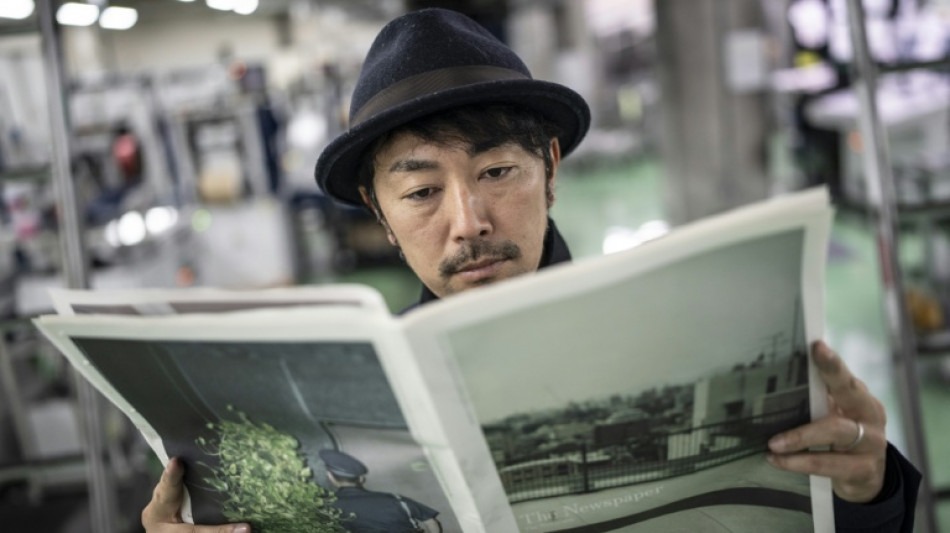
'AI simply can't replicate it': Japan embraces zine trend / Photo: © AFP

 Ethiopia's conflict: the regional dimension

 Life expectancy almost back to pre-Covid levels, says WHO

 Turkey's football referee chief faces judge in graft probe

 Verstappen goes own way to avoid the rain

 Oil slides, bonds steady as EU addresses diesel price surge

 Spain housing package at risk in parliament, as protests mount

 Swedish Social Democrats leader to make new bid to form government

 North Korea calls Seoul 'despicable' after DMZ apology demand

 Taiwan boxer Lin wins gold as virtual taekwondo makes Games debut

 Man City face appeal deadline after explosive financial verdict

 Pole vault superstar Duplantis to skip indoor season

 Sri Lanka drop Asalanka from T20 against Pakistan

 Disney president says layoffs 'extremely painful' but necessary

 Indian flydubai pilot opened cockpit door to save passengers

 Alex Marquez clocks record lap at MotoGP Japan practice

 Tom Kim leads Asian Games golf in chase to avoid military service

 Asian stocks hit as oil spike fans rate hike bets, eyes on US jobs

 'We're losing our scientists': west Africa's STEM struggle

 World powers gather in Pacific to chart climate battle

 Return of swarming moth spectacle has Australia in a flutter

 Browns snuff out Rodgers fightback to beat Steelers 27-24

 Braves power past Phillies to set up Dodgers showdown

 Asian stocks drop as oil spike fans rate hike bets, eyes on US jobs

 Viral anti-vax posts weaponise Philippine inoculation fears

 Saudi coalition accuses Houthis of drone attack on Medina

Through the noise of rushing papers and whirring belts at a print factory in Kyoto, two creators watch their photo essay come to life in broadsheet form -- part of an effort to win new audiences in the age of AI.
Despite the decline of the publishing industry, self-publication and handmade "zine" magazines are growing in popularity in Japan, reflecting the country's enduring love of paper in the digital era.
While speaking to AFP at the plant, his hands black with ink, one of the creators, Kazuma Obara said "I think (paper) is a medium that engages all five senses", unlike social media.
Obara and his creative partner Akihico Mori are among the latest artists to use a printing press offered by the Kyoto Shimbun newspaper, which is aiming to find alternative uses for its machines as subscriptions fall.
As the machine printed their work on newsprint paper, five technicians in uniform quickly flipped through the pages to check the quality.
"I think print media is incredibly open. You can hand it to someone, you can read it together," 40-year-old photographer Obara said, calling mobile phones "very insular".
Mori, a 44-year-old writer, said people can "feel the creator's passion when they hold the work in their hands".
"I think that's what makes it so appealing, and AI simply can't replicate it."
- Rise of self-publishing -
The pair's work was later showcased at popular international photography festival Kyotographie that ended in May.
Yoshihiko Okazaki of Kyoto Shimbun Printing said the company's services have been used by artists ranging from teenagers to those in their 70s.
"Surprisingly, it resonates with younger people... I even hear comments like, 'it's interesting precisely because it's old'."
Japan has seen a rapid decline in print media, with book and magazine sales falling to just 40 percent of their 1996 pinnacle of 2.6 trillion yen ($16.3 billion).
Newspaper circulation peaked in 1997 at 53.76 million, but it dropped to more than half that in 2025, according to the Japan Newspaper Publishers & Editors Association.
Many authors and publishers around the world fear the trend will be accelerated by artificial intelligence and social media -- in the UK, a 2025 study showed that half of novelists believe AI is likely to replace their work.
However, like in other countries worldwide, do-it-yourself publication including zines -- which originated in the 1930s with sci-fi fans in the US -- is growing in Japan, especially among younger generations.
Public broadcaster NHK reported, citing one private research firm, the self-publishing market is estimated at 150 billion yen in the year ending March 2026, nearly double the figure four years ago.
- 'Something tangible' -
On one weekend in Tokyo, hundreds of visitors flocked to a zine fair showcasing a wide range of handmade magazines in different sizes and formats -- some incorporating abstract designs, photography or personal monologues.
"AI and social media are driven by algorithms that feed us nothing but what we want to see or what suits us best," said 22-year-old visitor Harumi Kikuchi.
"But the fact that many zine makers are here suggests there are many different worldviews."
Zine creator Watashi Kishino, who hand draws her daily life in black-and-white illustrations, said people can "make a lot of things with AI and digital technology".
"But I believe there's a charm in having something tangible to hold in your hands like this," Kishino said, showing her works.
Major bookstores are also embracing the trend as young people increasingly drift away from physical books.
Sanseido, a 145-year-old bookstore in Tokyo's book district Jimbocho, began putting zines on their shelves almost a year ago.
"We felt that zines could appeal to a different audience than traditional readers," Masato Sugiura, deputy head of the sales promotion unit, told AFP.
"Everyone is looking for something that really speaks to them. Readers are perhaps drawn more to zines, which are niche and cover a broader range of topics," he added.
Kishino remains hopeful that physical books and magazines will endure despite the digital age.
"There's warmth that only paper can offer," she said. "There's definitely people who are looking for that."
G.Schulte--BTB