The Indian workers training AI robots to take their jobs / Photo: © AFP

 Eala-conqueror Wang wins Asian Games tennis gold and Olympic berth

 'Kinda cool' Raygun made breakdancing famous, Asian Games B-girls say

 Taiwan gender-row boxer Lin Yu-ting wins 'monumental' Asian Games gold
 Taiwan receives its first US-made F-16V fighter jets

 Lula, Bolsonaro trade scandal fire in final scramble for votes

 Not-so-brave new world: virtual taekwondo makes Asian Games debut

 Arab Israeli candidate drops out of election race

 Israel courts Europe's far right, finding friends but also unease

 Lula, Bolsonaro both snub final debate before Brazil election

 Nepal's grim DNA puzzle to identify flood dead

 EU nations to hold emergency meeting on soaring diesel prices amid US pressure

 Anthropic's Dario Amodei: AI's most visible CEO and enigma

 OpenAI says three staffers fired for mishandling 'sensitive' info

 Nike plans job cuts as it forecasts lower sales

 Ireland game interrupted twice by Gaza protests

 Judge denies acquittal bid by US woman who killed her kids

 Klopp averts crisis with first win as Germany boss

 A saintly spat and debate snub: Brazil enters final campaign stretch

 US tells European allies to act 'immediately' to lower diesel prices

 G20 trade ministers fail to see consensus against overproduction

 Portugal edge Denmark in Ronaldo's absence

 US stocks edge higher as bond yields retreat for now

 US tells European allies to 'immediately' act to lower diesel prices

 Trump vows to hit Iran 'very hard' if linked to flydubai attack

 Williams leaves Spain camp with thigh knock

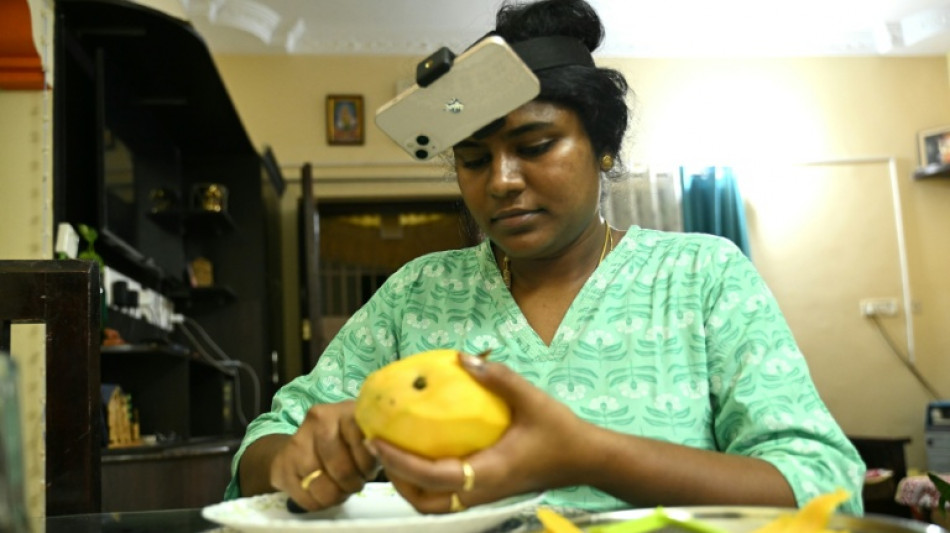
With a smartphone strapped to her head, Indian housewife Nagireddy Sriramyachandra films herself slicing mangoes to train AI-powered robots to take on household jobs in the future.
Earning just over two dollars for an hour of video, her mundane recordings are invaluable for global tech companies teaching machines how to move like humans in the real world.
The 25-year-old is one of a growing army of thousands of AI system trainers in the world's most populous country.
"Who else will give you 250 rupees an hour just for doing housework?" said Sriramyachandra from her kitchen in Chennai in southern India's Tamil Nadu state.
"I may get a robot myself in the future," she added.
Artificial intelligence chatbots and image generators crunch reams of digital data, but building systems to navigate real-life environments is more challenging.
Developers think feeding first-person footage, called "egocentric data", into specialised AI models will help robots copy humans.
Some AI trainers work at home, others in factories or specialised studios -- using video glasses, head-mounted cameras and motion sensors.
"It blares 'hands not detected' when I'm not recording properly," said Sriramyachandra, who sends recordings via a special app to the AI data company Objectways.
The firm, which has offices in India and the United States, lists Fortune 500 multinationals as clients. It works with Amazon SageMaker, a platform for machine learning models.
- 'Better things' -
The humanoid robot market is booming, with investment bank Morgan Stanley predicting there could be over a billion in use by 2050, mostly for industrial and commercial purposes.
"Folding clothes, coffee making... cooking a very specific thing, sandwich making," Objectways head Ravi Shankar said, listing videos requested by clients.
"Some jobs are supposed to be taken over, so humans can go and do better things."
In India, the emerging field of spatial AI is providing new employment -- for now.
The 50-year-old CEO is US-based, but hires workers from Tamil Nadu, where he grew up, one of India's international technology hubs.
At a Karur textile factory, busy with workers attaching labels to caps and ironing cloth bags, AFP saw eight people wearing head cameras and smart glasses supplied by Objectways.
India has positioned itself as a global middleman for the creation, processing and annotation of AI data.
"It's likely that these data collection services will increase", said digital labour expert Aditi Surie, from the Indian Institute for Human Settlements in Bengaluru.
- Informal workers -
India is aggressively developing its AI industry, but its leaders are aware that, alongside the technology's much-hyped benefits, automation poses risks.
Government think-tank NITI Aayog said that most discussions around artificial intelligence and labour "focus on white-collar professionals and predict an almost certain loss of jobs in the segment" without urgent action.
"Little attention, if any, is paid to how AI can serve India's 490 million informal workers, the very people who form the backbone of our economy," it said in a report released ahead of a global AI summit in India this year.
The think-tank has examined how the technology could help or harm dozens of professions -- from cobblers to sewer cleaners, farmers to tea sellers.
For the last decade, 55-year-old Ponni has sat on a roadside in Bengaluru, the city known as India's Silicon Valley, making flower garlands.
She, too, has been paid to have a phone strapped to her forehead.
"The next generation... who might have to do work similar to mine -- they will face a problem," Ponni said.
- Always wearing a camera -
At an Objectways studio, AI system trainers film themselves performing household tasks in fake, fully furnished apartment rooms.
After several thousand hours of filming, the wallpaper is changed to provide clients with variety.
"Today I sit here, tomorrow I stand there," said engineering graduate Rani N., 21, on a break from filming herself, once again, folding a towel.
Each video lasts about four minutes, and she records around 90 a day -- on nearly every conceivable spot on the bed.
She says the job is "tolerable", but feels like she's always wearing a camera.
In other rooms, colleagues arranged pencil sharpeners, water bottles and crayons in patterns, recording with depth-sensor cameras.
Qanat Consulting Services in Andhra Pradesh, an Objectways subcontractor, supplies about a dozen larger data firms with recordings.
Some of its 2,000 contributors perform tasks with motion-sensor bands on their "wrists, hands and legs", CEO Thaslim Pattan said.
Manish Agarwal of Bengaluru-based Humyn Labs, not related to Objectways, records conversations as well as videos.
Contributors discuss assigned topics -- ranging from politics to entertainment -- for clients wanting to process speech patterns.
Agarwal denies that robots will steal jobs, believing that networks of humans and robots "will work together" one day, he said.
"A welder in India could be managing a welder-robot in Prague," he said.
Y.Bouchard--BTB