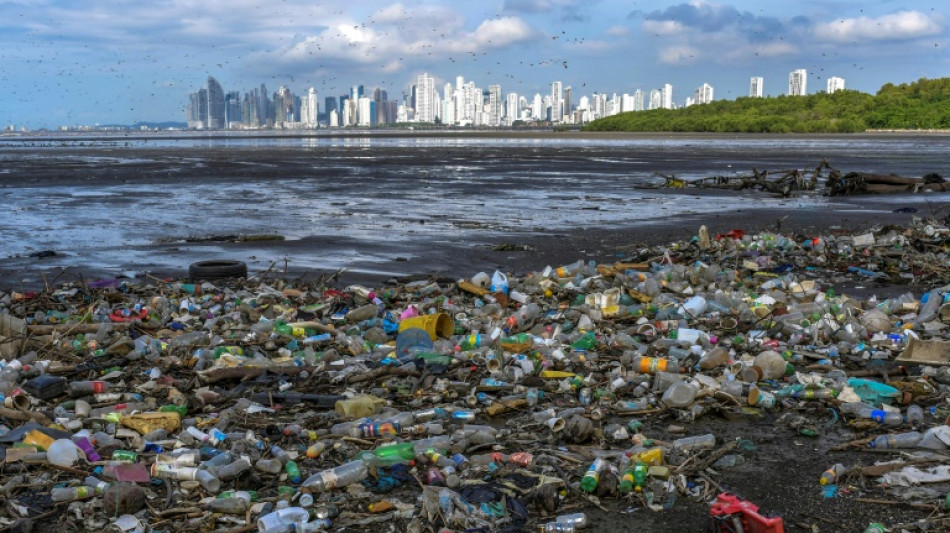
World must work together to tackle plastic ocean threat: WWF / Photo: ©

 US pushes against overproduction with eye on China at G20 meeting

 Swiss FA withdraws support for FIFA chief Infantino
 Man City's meteoric rise clouded by financial scandal

 Polish activists open first abortion pill locker in Warsaw

 NHL Avalanche ink Bednar to four-year coaching deal

 Polish activists opens first abortion pill locker in Warsaw

 Turkey says news site closed for 'LGBTQ propaganda'

 Oil companies close in on Venezuela despite hurdles
 Turkey freezes ex-minister's assets as fund scandal grows

 Guardiola backs Man City after bombshell guilty verdicts

 G20 trade ministers open talks under strain of Trump tariffs

 France in talks with UK to end 2025 migrant accord: ministry

 Europe's surging inflation spreads gloom in stock markets

 Truth commission demands compensation for Sweden's Sami people

 Japan win marathon penalty shootout to set up South Korea gold-medal clash
 Djokovic grinds out opening-round win at China Open
 Northern Ireland police probe blockade of disputed parade

 UK PM Burnham reopens divisive debate on rejoining EU

 Man City future in doubt after guilty verdict
 'Do something,' begs Iranian woman after death sentence over protests

 China extends 52-year unbeaten record as Games organisers say sorry
 In Manchester, people say City scandal is 'shame for football'
 Stocks lacklustre as inflation data weighs on sentiment

 Israel-bound plane rerouted, pilots wounded in reported fight

 Truth commission on Sweden's Sami people seeks redress

Plastic has infiltrated all parts of the ocean and is now found "in the smallest plankton up to the largest whale" wildlife group WWF said on Tuesday, calling for urgent efforts to create an international treaty on plastics.
Tiny fragments of plastic have reached even the most remote and seemingly-pristine regions of the planet: it peppers Arctic sea ice and has been found inside fish in the deepest recesses of the ocean, the Mariana Trench.
There is no international agreement in place to address the problem, although delegates meeting in Nairobi for a United Nations environment meeting this month are expected to launch talks on a worldwide plastics treaty.
WWF sought to bolster the case for action in its latest report, which synthesises more than 2,000 separate scientific studies on the impacts of plastic pollution on the oceans, biodiversity and marine ecosystems.
The report acknowledged that there is currently insufficient evidence to estimate the potential repercussions on humans.
But it found that the fossil-fuel derived substance "has reached every part of the ocean, from the sea surface to the deep ocean floor, from the poles to coastlines of the most remote islands and is detectable in the smallest plankton up to the largest whale".
- 'Saturation point' -
According to some estimates, between 19 and 23 million tons of plastic waste is washed into the world's waterways every year, the WWF report said.
This is largely from single-use plastics, which still constitute more than 60 percent of marine pollution, although more and more countries are acting to ban their use.
"In many places (we are) reaching some kind of saturation point for marine ecosystems, where we're approaching levels that pose a significant threat," said Eirik Lindebjerg, Global Plastics Policy Manager at WWF.
In some places there is a risk of "ecosystem collapse", he said.
Many people have seen images of seabirds choking on plastic straws or turtles wrapped in discarded fishing nets, but he said the danger is across the entire marine food web.
It "will affect not only the whale and the seal and the turtle, but huge fish stocks and the animals that depend on those", he added.
In one 2021 study, 386 fish species were found to have ingested plastic, out of 555 tested.
Separate research, looking at the major commercially fished species, found up to 30 percent of cod in a sample caught in the North Sea had microplastics in their stomach.
Once in the water, the plastic begins to degrade, becoming smaller and smaller until it is a "nanoplastic", invisible to the naked eye.
So even if all plastic pollution stopped completely, the volume of microplastics in the oceans could still double by 2050.
But plastic production continues to rise, potentially doubling by 2040, according to projections cited by WWF, with ocean plastic pollution expected to triple during the same period.
- Enduring risk -
Lindebjerg compares the situation to the climate crisis -- and the concept of a "carbon budget", that caps the maximum amount of CO2 that can be released into the atmosphere before a global warming cap is exceeded.
"There is actually a limit to how much plastic pollution our marine ecosystems can absorb," he said.
Those limits have already been reached for microplastics in several parts of the world, according to WWF, particularly in the Mediterranean, the Yellow and East China Seas (between China, Taiwan and the Korean Peninsula) and in the Arctic sea ice.
"We need to treat it as a fixed system that doesn't absorb plastic, and that's why we need to go towards zero emissions, zero pollution as fast as possible," said Lindebjerg.
WWF is calling for talks aimed at drawing up an international agreement on plastics at the UN environment meeting, from February 28 to March 2 in Nairobi.
It wants any treaty to lead to global standards of production and real "recyclability".
Trying to clean up the oceans is "extremely difficult and extremely expensive", Lindebjerg said, adding that it was better on all metrics not to pollute in the first place.
L.Janezki--BTB