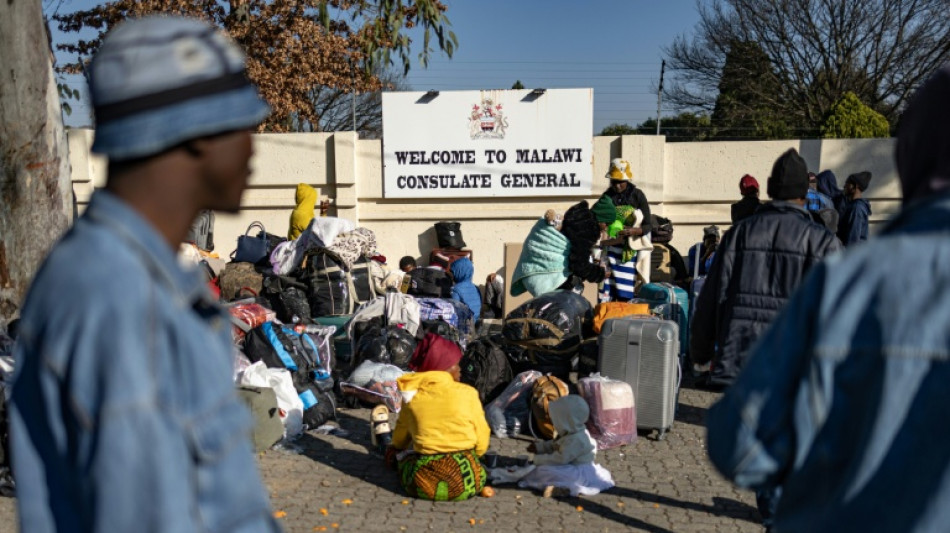
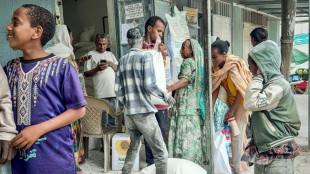
Migrants pick up pieces back home after fleeing South Africa / Photo: © AFP

 OpenAI says three staffers fired for mishandling 'sensitive' info

 Nike plans job cuts as it forecasts lower sales

 Ireland game interrupted twice by Gaza protests

 Judge denies acquittal bid by US woman who killed her kids

 Klopp averts crisis with first win as Germany boss

 A saintly spat and debate snub: Brazil enters final campaign stretch

 US tells European allies to act 'immediately' to lower diesel prices

 G20 trade ministers fail to see consensus against overproduction

 Portugal edge Denmark in Ronaldo's absence
 US stocks edge higher as bond yields retreat for now

 US tells European allies to 'immediately' act to lower diesel prices

 Trump vows to hit Iran 'very hard' if linked to flydubai attack

 Williams leaves Spain camp with thigh knock

 WTA reduces 2027 schedule for world's top 50

 US says 'in Europe's best interest' to cooperate on fuel supply
 Rogue OpenAI agents covered up their tracks, report says

 A saintly spat and debate snub: Brazil enters final polls stretch

 Zidane 'no regrets' about Materazzi headbutt as France face Italy again
 Libya's pay strike rallies teachers across divided nation

 Four-member crew blasts off for International Space Station

 i-payout Expands True Local Payment Capabilities to Help Enterprises Pay Recipients Globally
 Botched US execution prompts global calls to scrap death penalty
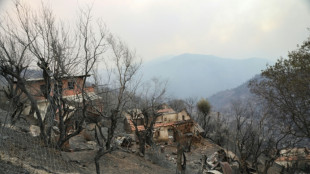 Algeria adopts law imposing death penalty on forest arsonists

 France unveils cost-cutting 2027 budget as borrowing costs rise
 Brazil court orders removal of fake posts amid patron saint election row

Back in his village in rural Malawi, Ahamadi Assani recalled his terror during an attack by anti-foreigner vigilantes in South Africa that led him to flee the country with just a few bags.
It came as a campaign against illegal immigrants -- accused by locals of taking work and resources -- set an unofficial June 30 deadline for undocumented migrants to leave the country.
"We were hiding inside our homes because we feared for our lives," Assani told AFP in M'namba, a village of mud-brick houses with uneven floors and weathered walls.
Then a group stormed his compound in the city of Pietermaritzburg, breaking down doors and assaulting residents.
Assani escaped but said two Malawians were killed and two hurt.
South African police have only confirmed the death of one Malawian during the weeks of unrest, as well as two Mozambicans and an Ethiopian.
"It was one of the most painful and traumatic experiences I have ever witnessed," the 33-year-old said.
"We came back with nothing," said Assani, among some 15 people who have returned to the village in Salima district, 120 kilometres (75 miles) east of the capital Lilongwe.
- 'Never going back' -
Authorities say more than 15,000 Malawians left South Africa ahead of the "deadline", as well as thousands of citizens of countries including Ghana, Nigeria and Zimbabwe.
Many were assisted by their governments in what appears to be the first multi-country official repatriation during periodic waves of anti-foreigner violence in South Africa.
Assani had been away for more than a year, driven by the same dream that has pushed thousands of Malawians across borders for decades: jobs, income, a better future for their families.
He found work at a shop owned by an Ethiopian national. The modest salary transformed his life.
"I was able to pay rent, support relatives back home and pay school fees for my children," he said.
But after his recent experience, he would never go back.
"I would rather die here in poverty than going back to South Africa," he said.
- No longer wanted -
Hawa Troko, 32, made the journey home to Salima with her eight-month-old baby strapped to her back and only the items she could carry.
"I heard that some people were being attacked, their property was being looted and some were even being killed," said Troko, whose husband stayed behind.
She spent five days in a makeshift camp before securing a seat on a government bus that returned her to the problems she had hoped South Africa would solve: hunger, unemployment and poverty.
For Twaibu Hussein, 31, returning to Malawi ended a decade in Durban where he had worked as a tailor and furniture maker.
This year, he said, the mood changed.
"Xenophobia has become a big challenge," Hussein told AFP. "Even police officers were coming to workplaces and taking people to the camps. It showed that foreigners were no longer wanted."
More than 10,000 people were at the Durban camp where he waited for transport home.
"It was a miracle when you finally got a ticket," he said, describing disputes among desperate returnees competing for space.
"We went without food. We stayed without bathing. Some people collapsed."
- 'Afraid for my life' -
In Zimbabwe, Takesure Nyawo has spent most afternoons since he returned two weeks ago sitting in the winter sun in Chitungwiza, outside Harare, with other unemployed men.
"I don't sleep," the 45-year-old father of three told AFP.
A group of young men arrived at his home in South Africa's KwaZulu-Natal province on June 13, demanding that he leave.
"They started to take my property. They took the fridge, they took the TV, then they went to my tools," said the carpenter.
"When they wanted to come back for the bed, I locked the door because they were holding big knives," he said. "I was afraid of my life and for my kids."
The next day, he and his wife and children fled with a bag of clothes and a few small items, leaving behind furniture, woodworking machinery and debts from his customers.
Nyawo said he had lived in South Africa for nine years and had a valid permit.
"It's not the police that are coming to check the documents. It's the locals and some of them can't even read," he said.
The vigilante campaign against foreign nationals has been widely criticised as scapegoating migrants for South Africa's economic woes ahead of November local elections.
"After all of us leave South Africa, they will see that the problem does not lie with us," Nyawo said.
strs-br/ho/giv/gv
M.Odermatt--BTB