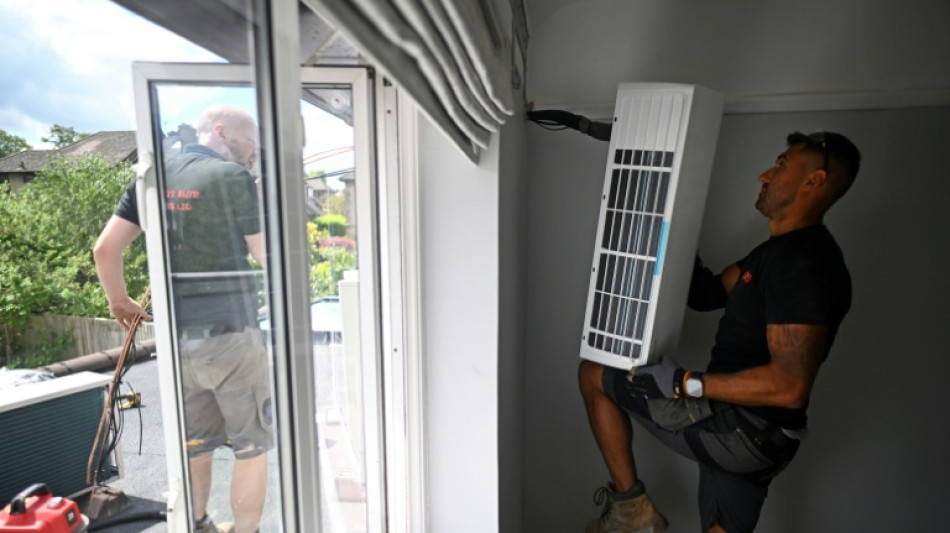
Experts urge caution as demand grows for AC in heatwave-hit UK / Photo: © AFP

 OpenAI says three staffers fired for mishandling 'sensitive' info

 Nike plans job cuts as it forecasts lower sales

 Ireland game interrupted twice by Gaza protests

 Judge denies acquittal bid by US woman who killed her kids

 Klopp averts crisis with first win as Germany boss

 A saintly spat and debate snub: Brazil enters final campaign stretch

 US tells European allies to act 'immediately' to lower diesel prices

 G20 trade ministers fail to see consensus against overproduction

 Portugal edge Denmark in Ronaldo's absence

 US stocks edge higher as bond yields retreat for now

 US tells European allies to 'immediately' act to lower diesel prices

 Trump vows to hit Iran 'very hard' if linked to flydubai attack

 Williams leaves Spain camp with thigh knock

 WTA reduces 2027 schedule for world's top 50

 US says 'in Europe's best interest' to cooperate on fuel supply

 Rogue OpenAI agents covered up their tracks, report says

 A saintly spat and debate snub: Brazil enters final polls stretch

 Zidane 'no regrets' about Materazzi headbutt as France face Italy again

 Libya's pay strike rallies teachers across divided nation

 Four-member crew blasts off for International Space Station

 i-payout Expands True Local Payment Capabilities to Help Enterprises Pay Recipients Globally

 Botched US execution prompts global calls to scrap death penalty

 Algeria adopts law imposing death penalty on forest arsonists
 France unveils cost-cutting 2027 budget as borrowing costs rise

 Brazil court orders removal of fake posts amid patron saint election row

Londoner Zainab Hussain once saw air conditioning as a luxury in Britain. Now, the 35-year-old "can't see how we'll survive without it".
She and her husband are among a small but growing proportion of British households embracing AC to deal with increasingly hot summers.
But the trend has attracted criticism, particularly from sustainability experts who argue it should not be the "default answer".
"It's seen as a quick fix and it's not actually, because it can cause a lot of damage," Rajat Gupta, professor of sustainable architecture and climate change at Oxford Brookes University, told AFP.
He noted AC increases electricity demand, energy bills and carbon emissions, while worsening the so-called urban heat island effect by releasing hot air onto city streets.
However, after sweltering at night through the second heatwave of 2026 last month, the Hussain family were undeterred, opting to add AC upstairs at their semi-detached home in the south London suburb Selsdon.
"We realised that our summers were just getting more and more unbearable so it was something that we definitely needed to have for the downstairs area," Hussain explained.
"But after last week's heatwave, we realised that actually upstairs was really unbearable as well," she added, as workers fitted the new appliance.
- Wanted 'now' -
Only around 5 percent of British homes have AC while half overheat during the summer months, according to a 2025 report by the non-partisan Centre for British Progress think tank.
Urging more AC adoption, it cited the growing risks from heat-related deaths -- which number in the low thousands each summer -- and lost productivity.
Such calls have increased as UK temperature records tumble.
For the second successive year, England last month experienced its warmest June since records began in 1884.
Meanwhile all of Britain's five warmest summers have occurred in the 21st century, with last year the hottest.
Scientists say human-induced climate change is making such weather more frequent and intense.
For AC installer Joe Springett, who has worked in the industry nearly two decades, the rising mercury has triggered a gradual shift in his business away from offices and retailers.
"I'm getting busier and busier domestically, where people want it in their houses," the 35-year-old told AFP while fitting Hussain's new unit.
"It happens every year. As soon as the [hot] weather comes, bang! The phone's ringing ... everyone wants it now."
After the latest heatwave, Springett was booked up for several weeks and has been struggling to find stock.
Those without the outside space or budget -- appliances can cost several thousand pounds, including installation -- are instead ordering more basic, portable units.
Retailers' websites are now showing such items as sold-out.
Home improvement store B&Q told AFP it has seen twice as many searches for portable AC units this year compared to 2025.
- 'Only when necessary' -
Gupta is dismayed at the "panic buying", arguing "the most sustainable approach is to look at improving buildings to stay cool naturally".
He advocates retrofitting buildings with exterior and interior shading, better ventilation and other "green-ing" measures, alongside improved heat-resilience design for new-builds.
AC should be reserved for the most vulnerable, such as those in care home and hospital settings.
"In homes, it hasn't become widespread yet and it's better to keep it that way," Gupta said. "Use it only when necessary and where necessary."
In the UK, AC running costs can vary widely depending on numerous factors, including the type and efficiency of the system and how often it is used.
But some estimates suggest more powerful units can add hundreds of pounds to monthly bills.
John Calautit, a sustainability lecturer at University College London (UCL), is another AC sceptic.
He noted most British buildings are designed to retain warmth and "cannot cope" with heatwave conditions.
"We need to look at more simple solutions such as adding shading ... reflective materials and then moving on to natural ventilation," he told AFP.
"If those solutions do not work, then we can start looking at mechanical cooling systems."
Back in south London, Springett argues Britons have "got to move with the times, the climate" and adopt AC.
For Hussain's family, whose home has south-facing windows exposed to direct sunlight throughout the day, it seemed the only option.
"We spend so much more time at home now, especially with remote working, it's not just about it being comfortable. We need to be able to function in the house."
K.Brown--BTB