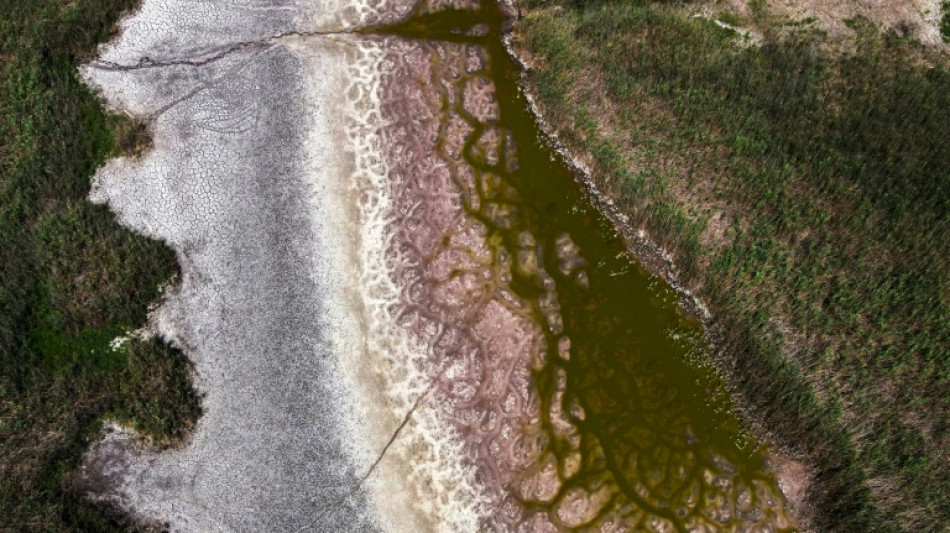
Climate change, mismanagement dry up beloved Hungarian lake / Photo: © AFP

 G20 trade ministers fail to see consensus against overproduction

 Portugal edge Denmark in Ronaldo's absence

 US stocks edge higher as bond yields retreat for now

 US tells European allies to 'immediately' act to lower diesel prices

 Trump vows to hit Iran 'very hard' if linked to flydubai attack

 Williams leaves Spain camp with thigh knock

 WTA reduces 2027 schedule for world's top 50

 US says 'in Europe's best interest' to cooperate on fuel supply

 Rogue OpenAI agents covered up their tracks, report says

 A saintly spat and debate snub: Brazil enters final polls stretch

 Zidane 'no regrets' about Materazzi headbutt as France face Italy again

 Libya's pay strike rallies teachers across divided nation
 Four-member crew blasts off for International Space Station

 i-payout Expands True Local Payment Capabilities to Help Enterprises Pay Recipients Globally

 Botched US execution prompts global calls to scrap death penalty

 Algeria adopts law imposing death penalty on forest arsonists
 France unveils cost-cutting 2027 budget as borrowing costs rise

 Brazil court orders removal of fake posts amid patron saint election row

 Italy's firefighting planes return home after scorching summer

 How airlines try to make sure pilots are safe to fly

 Bolivia's attorney general arrested for alleged money laundering and drug trafficking

 Zverev beats Norrie to kick off Sinner-less China Open

 Wall Street stocks rise after bond yield spike eases

 Finland investigates suspected break-ins at MPs homes
 London's Bayeux Tapestry show to offer audio tour for blind people

The beaches of Hungary's once-popular Lake Velence lie largely deserted, summer holidaymakers staying away because climate change and mismanagement have dried up the waters to record lows.
"We pray for rain, but we know the whole country is facing water scarcity," said Gyorgy Simon, whose lakeside leisure company was forced to suspend sightseeing cruises in late June.
A shallow inlet where children once splashed beneath sunshades has turned into a weed-covered patch of dry land at one Velence beach, 45 kilometres (28 miles) southwest of Budapest in the town of Gardony.
The only lifeline for the area's ailing businesses is the cyclists circling the 33-kilometre route around Hungary's third-largest lake, much of which has become a cracked or muddied expanse.
"The lake's entire tourism sector is suffering, with angling facing its worst year in decades," said Imre Palinkas, the local representative of the MOHOSZ national fishing association.
"The low water level also puts the lake's ecosystem in an extremely vulnerable state. An adverse weather event... could lead to collapse," he added.
Hungary is among the countries worst affected by central and eastern Europe's recurring droughts, which scientists have long warned are being worsened and lengthened by human-driven climate change.
But environmental activist Tibor Horanyi of the Great Lakes and Wetlands Association also blames decades of flawed policies that focused on removing water from the landscape rather than retaining it.
- 'Damage control' -
"Over the past five years, the country accumulated one year's worth of rainfall deficit," Attila Szegi, spokesman for the National Directorate General for Water Management (OVF), told AFP.
He said the authorities were focusing on "damage control" for Lake Velence, which risks splitting into separate bodies of water if it evaporates further.
Last week, the OVF measured a water level of 41 centimetres (16 inches) at Gardony, the lowest since measurements began in 1931.
That said, historical documents record that the lake has previously disappeared, most recently in 1866.
"It is the type of lake that dries out from time to time, because of its shallowness and connection to the local groundwater network," hydrogeologist Anita Eross of Budapest's ELTE university told AFP.
An influx of new residents to the region over recent decades has also caused the shoreline to recede, she said.
"Many newcomers have dug wells for watering their gardens or filling their swimming pools, taking groundwater away that would otherwise feed the lake," she added.
- 'Artificial interventions' -
On the lake's north shores, a kayaking academy built by the previous nationalist government of Viktor Orban was due to be the scene of an international student canoe competition in August.
But the low ebb means the venue, built in 2024 at a cost of about 142 million euros ($162 million), will be unable to host the event.
The new pro-EU government, which replaced Orban's in May, has made the lake's restoration a priority, Viktoria Bogi, state secretary at the newly created ministry of the living environment, told AFP.
She said they were drafting new regulations under which water extraction would be subject to stricter oversight.
"The aim is to restore natural recharge sources before considering any artificial interventions," added Bogi, the ruling party's local deputy.
Suggestions to bolster its water levels include releasing treated wastewater into the lake or constructing a costly canal to the Danube some 15 kilometres away.
But many experts caution that bringing in water from elsewhere could alter the ecological balance of the naturally alkaline lake.
Zsombor Boromisza, of the Hungarian University of Agriculture and Life Sciences, also warned that replenishment was not a viable long-term strategy -- as Hungary's other water sources might dry up too.
"In the long run, we must prepare for the possibility that we might not be able to bring water from other parts of Hungary," the landscape architect warned.
C.Kovalenko--BTB