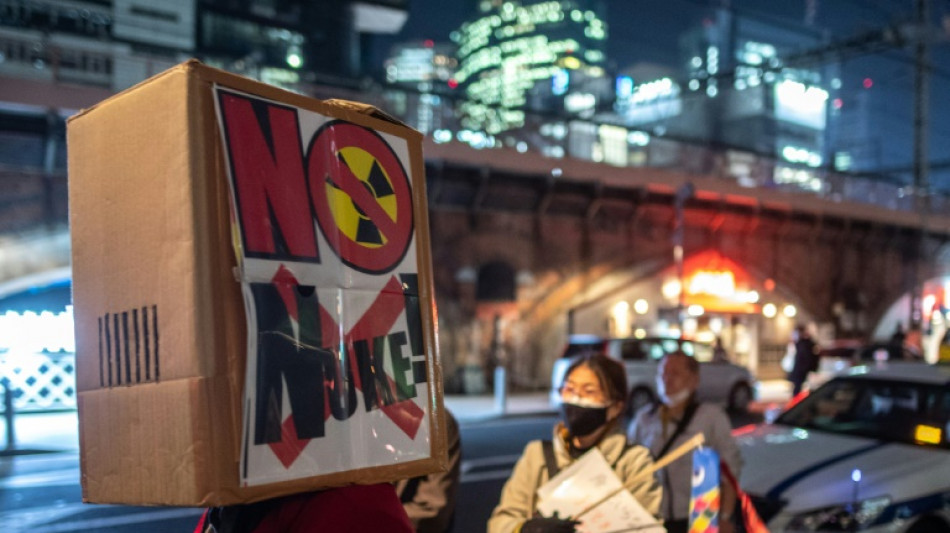
Japan eyes nuclear power push to combat energy crunch / Photo: © AFP

 Australia touts new funds for Pacific infrastructure at Fiji 'pre-COP'

 Eva Marie Saint, Oscar winner of Hollywood classics, dies at 102

 Australia probes app used in cheap smart glasses over privacy fears

 England needed to 'move on' from World Cup pain, says Tuchel

 O'Neill to stay at Celtic after period of "reflection"

 Kane marks 125th England cap with Wembley Nations League double

 Quebec's incoming separatist leader wants to block Crown from swearing-in

 Emmys gala will now stream its premier television awards

 Paramount completes Warner Bros takeover, creating Skydance
 Trump blames France unrest on Islam, migration

 Apple's Cook praises EU over efforts to protect children online
 Nobel winner Halzen says years of October 'misery' finally over

 Quebec separatist win rattles Carney's unity push

 'Itching' for change: Shiffrin cuts back slaloms this season

 'Gen Z has risen up': Tens of thousands mass for tense France school protests

 Caribbean tourism hotspot loses men to Russian war machine

 Danish reservists practice war games to respond to 'aggression'
 Bhuvneshwar returns to India's T20 squad for New Zealand tour

 Asos says probing 'unauthorised activity' after phone alerts

 Stocks climb as oil prices retreat under $100 per barrel

 Neutrinos: space particles that change our view of universe

 'Destined' Djokovic wins China Open, extending unbeaten record
 Iceland is 'critical outpost' for security, says Rubio during visit
 Israeli settlers beat AFP photographer covering West Bank

 'Gen Z has risen up': Tens of thousands demand better education in France

Japan's prime minister on Wednesday called for a push to revive the country's nuclear power industry in a bid to tackle soaring imported energy costs linked to the war in Ukraine.
Such a move could prove controversial, after the 2011 Fukushima disaster led to the suspension of many nuclear reactors over safety fears.
Like many countries, Japan -- which is aiming to become carbon neutral by 2050 -- has faced a squeeze on its energy supplies since Russian forces entered Ukraine six months ago.
The nation has also sweltered through record-breaking temperatures this summer, with residents asked to conserve power wherever possible.
"Russia's invasion of Ukraine has vastly transformed the world's energy landscape" and so "Japan needs to bear in mind potential crisis scenarios", Prime Minister Fumio Kishida said at an energy policy meeting.
Japan should consider building next-generation nuclear reactors, he said, while the government will discuss bringing more nuclear plants online and extending the service life of reactors if safety can be guaranteed.
Kishida called for "concrete conclusions by the end of the year" on the topic, which remains a sensitive one after a deadly tsunami in March 2011 caused a meltdown at the Fukushima plant, the worst nuclear disaster since Chernobyl.
Eleven years on, 10 of Japan's 33 nuclear reactors are back in action, although not all are operational year-round, and the country is heavily dependent on imported fossil fuels.
The national nuclear safety watchdog has approved in principle the restart of seven more reactors, but those moves often face opposition from local communities.
- 'All it takes' -
"In addition to securing the operations of the 10 reactors that are already back online, the government will spearhead an effort to do all it takes to realise the restart" of the others whose safety has been approved, Kishida said.
The prime minister, who joined the meeting remotely after testing positive for Covid-19, also urged policymakers to consider "constructing next-generation nuclear reactors equipped with new safety mechanisms".
Before the Fukushima disaster, around a third of Japan's power generation came from nuclear sources, but in 2020 the figure was less than five percent.
Japan's government has overhauled and strengthened nuclear safety standards, and wants nuclear power to account for 20 to 22 percent of electricity production by 2030, as part of efforts to reach carbon neutrality.
Tom O'Sullivan, a Tokyo-based energy consultant at Mathyos Advisory, said building next-generation reactors in Japan would be a "major step", because "all the current reactors are conventional ones".
Bringing more existing nuclear plants online will need to be approved by local governors, which could prove "politically challenging", O'Sullivan told AFP.
"But again, there's a different environment now after the Ukraine war," he said. Polls in recent months also show that public opinion may be softening towards the use of nuclear power.
"I don't think it's just the electricity costs. It's the reliance on Russia, for natural gas, oil and coal... the Japanese public have really woken up to that," O'Sullivan said.
Japan has imposed sanctions on Russia over the war in Ukraine along with other G7 countries, and the government has pledged to try and reduce its energy dependence on Moscow.
The price of Japanese shares related to nuclear power surged in afternoon trade as local media reported the possible plans, with Tokyo Electric Power ending up 9.96 percent and Mitsubishi Heavy Industries jumping 6.85 percent.
A.Gasser--BTB