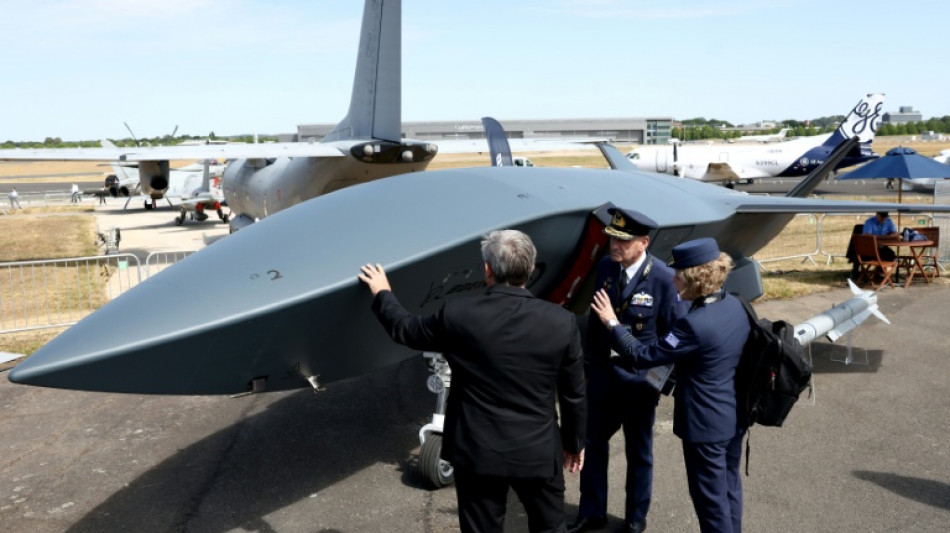
Autonomous fighter jets target Europe market at Farnborough airshow / Photo: © AFP

 Stocks move lower despite oil prices dropping

 AI driving up innovation investment: UN

 UN Security Council extends Haiti mission by 6 months

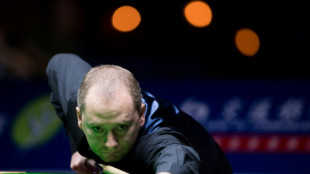
 Man Utd do not deserve medals if Man City stripped of titles: Rooney

 Vana Completes Expanded Staking as Part of the Vega Upgrade, Publishes Expanded VANA Token Economics

 Spain to cap gas price hikes, extend fuel discounts

 'We just need rain': Germany's Rhine river hits new low
 Yemen health system at 'breaking point': WHO
 Ireland undecided on second Israel match: coach

 France's Le Pen defiant after top ally hit by antisemitism claims

 Tom Cruise trades stunts for satire as toxic tycoon 'Digger'
 MEXC Unveils "WE SEE YOU" Brand Visual Refresh, Putting People Behind Every Trade in Focus

 Thai capital cleans up after deadly floods
 NATO, EU allies rally to Estonia after 'sabotage' blamed on Russia

 Families demand justice for Cameroon's 'nightmare' wave of murdered women

 Tebas says Man City should face 'most severe' sanctions if guilty of rule breaches

 Pochettino calls Man City success 'a period of deception'
 Settler attack on West Bank village injures Israeli forces, drawing rare rebuke

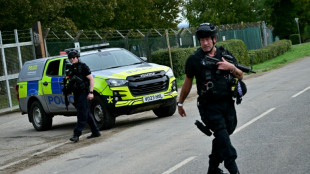 Mystery over UK airbase scare after reports no explosives found

 Spanish govt races to adopt housing law under protest pressure
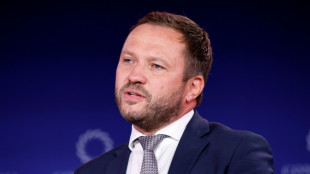 Estonia slams Russian 'sabotage' after arson attack on defence company

 Slovenia sees surge in '.si' sites after Trump hypes 'super intelligence'

 'Like a dream' for An as Games organisers 'sorry' for latest mix-up

 Tokyo suffers longest streak of rainy days on record

 Indonesia charges train driver over crash that killed 16 women
As Europe ramps up its rearmament drive, US aerospace giant Boeing is seeking a foothold in the emerging market for autonomous fighter aircraft, showcasing its capabilities at the Farnborough airshow this week.
Boeing's MQ-28 Ghost Bat is an uncrewed aircraft, developed with the Royal Australian Air Force, to fly alongside crewed fighter jets carrying out electronic warfare and surveillance and to help multiply forces.
It belongs to a category of AI-enabled Collaborative Combat Aircraft (CCA) which have risen to prominence as a new type of drone, as unmanned systems dominate the battlefield in Ukraine.
Boeing hopes to win over the European market by partnering with local defence companies.
In Germany, defence group Rheinmetall has teamed up with Boeing to integrate the MQ-28 into the German Air Force, with the capability expected to be available by 2029.
Such partnerships, however, have revived questions about the limits of Europe's push for greater defence sovereignty.
"The key objective is to deliver capabilities quickly," Pascal Fabre, a partner at advisory firm AlixPartners, told AFP.
"If you want to field new capabilities rapidly, you either develop the system yourself -- which takes time -- or you partner with someone who already has a mature platform, even if that company is not European," he added.
The trade-off lies at the heart of Europe's rearmament push, driven by growing security concerns and unease over relying on an increasingly unpredictable ally in US President Donald Trump.
"The defence industry is global, and European industry remains embedded in global networks with allies," said Emil Archambault, an associate fellow at the German Council on Foreign Relations.
"European-built CCAs will still require integration with these American systems and therefore do not offer a fully European solution," he told AFP.
- 'Take risks' -
"The thing we have going for us that no one else does, that no one can ever match, is we started nine years ago," Glen Ferguson, director of the MQ-28 Global Program, told AFP on the sidelines of Farnborough.
For Ferguson, the big advantage of CCAs is to "achieve missions that would be too high risk with normal human life at the stake".
The aircraft has a range of 3,700 kilometres, can fly at altitudes of up to 12,000 metres and reach a top speed of Mach 0.9 -- comparable to the speed of the world's fastest private jets.
It meanwhile has the possibility of being paired with the next-generation fighter being developed by Britain, Italy and Japan's GCAP program.
Ferguson said Boeing's model of building with regional partners was intended to give countries greater control over the capability rather than simply importing a US system.
"We would work with local industry because we're all about providing a sovereign capability to that country," he added.
- Multi-billion-dollar industry -
Boeing is not alone in the race.
BAE Systems unveiled Britain's first sovereign CCA at Farnborough, though London has yet to commit to a procurement decision, leaving the field open to competitors.
The UK government has pledged to spend £300 million ($400 million) on its autonomous jet programme over the next four years.
"Globally, the CCA sector is projected to be valued at more than £125 billion to 2050," said new UK defence minister Wes Streeting.
European aviation giant Airbus has partnered with US firm Kratos to use an existing American platform while integrating its own mission systems.
US rivals General Atomics and Anduril also showcased at Farnborough models of their autonomous aircraft at the airshow.
"From a Western world perspective, we need everyone who's creating a CCA to be successful," Ferguson said.
"The demand for CCAs in the rest of the world is going to be so immense that not one company, two companies, three companies can actually keep up," he added.
F.Pavlenko--BTB