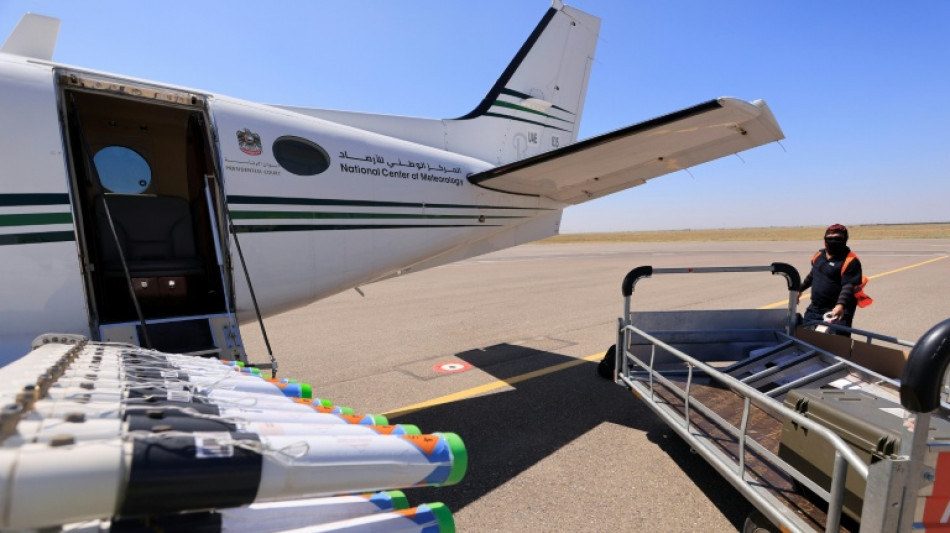
Parched and desperate for rain, Kazakhstan turns to cloud-seeding / Photo: © AFP

 AI startup urges optimism from Europe despite safety fears

 'Godlike, invincible': Japan hails 11-year-old Games history-maker

 Nepal's hydropower ambitions face climate reality check

 Power cuts, rubble: millions come home to find Sudan's capital unlivable

 Internationals keep Presidents Cup lead with late fightbacks

 Tuchel to 'keep pushing' England to reach Spain's level

 Alcaraz saves match points to keep Europe ahead in Laver Cup

 Spain success driven by hunger to improve, says De La Fuente

 Lyon collapse at Stade Francais to suffer first Top 14 loss
 Oyarzabal and Spain sink England again as Modric shines for Croatia

 Housing protesters camp in central Madrid after mass demonstration

 Louise Trotter expands her palette at Bottega Veneta

 Pope prays at Lourdes after huge Paris mass

 USA trims International lead after Presidents Cup four-balls

 Russia accuses Europe of blocking Ukraine talks, as strikes drag on

 'He said hello': Families pray with pope on Paris avenue

 Pope celebrates giant Paris mass, flies to Lourdes

 Thousands march in Madrid over eviction of 87-year-old woman

 England women back to winning ways with last-gasp defeat of New Zealand

 Trump rejects Iran proposal for deal to reopen Hormuz

 England's Cox says injured Buttler leaves 'big shoes to fill'

 Ruthless Perpignan upset sloppy Bordeaux-Begles
 Deadly abbey attack feeds anti-Ukrainian sentiment in Poland
 Antonelli says he drove 'safety-first' on his worst weekend of season

 Fernandez fights back to reach Singapore Open final

There were only arid steppes in sight when a small plane took off from an airport in southern Kazakhstan, embarking on a delicate mission: bringing rain for the scorched earth below.
To tackle the severe droughts and water shortages that plague the country, Kazakhstan has resorted to cloud seeding, a weather modification method previously unseen in Central Asia.
"The aircraft is specifically equipped with a cloud-seeding flare system," Ahmed Aljaberi, a pilot with the United Arab Emirates' meteorological centre, which conducts cloud seeding at home and is collaborating with Kazakhstan on the project, explained to AFP.
Cartridges fixed on the aircraft's wings contain a substance that, when dispersed, sticks to cloud droplets, making them heavy enough to fall as rain.
Kazakh authorities are betting on cloud seeding to reduce the impact of drought and water shortages in its southern Turkestan region, the country's leading cotton-growing region.
Areas in the region with some 9,110 square kilometres of arable land are being targeted, with estimated economic benefits of around $75 million a year through better harvests.
- 'Local and short-lived' -
Delivering droplets onto the parched crops requires meticulous preparation to identify suitable clouds.
The plane must "get as close as possible, detect the updrafts, and begin seeding," Aljaberi told AFP on board the flight.
At best, the technique can increase precipitation by 15 to 20 percent, according to various scientific studies.
But those involved also highlight the significant risk of failure due to numerous factors, not least because not just any cloud can be seeded.
"Salt particles -- specifically sodium chloride and potassium chloride -- are most often used" as cloud-seeding agents, said Adnan Yarmohammed, one of the Emirati officials in charge of sharing his country's experience.
The techniques vary: either seeding rockets are burned to release a plume of particles, or the saline solution is sprayed directly into the cloud for greater precision.
This "weighs down the droplets," which "grow from a few micrometres to several millimetres: up to two or three. They fall, and it rains," explained Yarmohammed.
He added that the technique "does not create new clouds".
Kazakhstan's cloud-seeding trials raised alarm in neighbouring Kyrgyzstan where fears were flagged of "cloud theft" -- alleging that rain clouds could be diverted to Kazakhstan, aggravating its own drought.
The Kazakh meteorological service said the impact of the project is "local and short-lived," and that it "does not affect climate processes or alter the movement of air masses".
No clouds were detected during the flight an AFP team took part in -- bringing no respite to a part of the country that last year set a new record-high temperature of 44.9C.
- Cloud seeding shortfalls -
The effects of boosting rainfall through cloud seeding remain uncertain, its consequences difficult to measure, and its large-scale application costly.
The World Meteorological Organization has called for more scientific research, pointing to a "rise in demand for these activities ... due to the frequency of droughts".
The UN organisation also ruled out any danger to human health or the environment and acknowledged potential economic benefits if the technique proved successful.
The method, already used in around 50 countries to combat drought, hail and air pollution, is new for Central Asia -- a region warming twice as fast as the global average.
In Kazakhstan, Central Asia's largest economy, the average annual temperature could rise by more than six degrees by the end of the century, the World Bank has warned.
Neighbouring Uzbekistan has also expressed interest in the method and is looking at trialing its own cloud seeding project.
In 2025, Kazakhstan's Turkestan region experienced eight months without rain and very low humidity levels, regional agricultural official Kazbek Bedebayev told AFP.
"The water deficit problem must be addressed comprehensively (and) a set of complementary measures is needed," Bedebayev said.
Cloud seeding "will not meet all needs," he said and less advanced measures still have a role to play -- like "drip irrigation and repairing the irrigation system and canals," which suffer from frequent leaks due to the ageing Soviet infrastructure.
S.Keller--BTB