Why Global Finance Still Relies on Wall Street Despite Diversification Trends

 Bolivia's Paz appoints new economy minister amid bailout talks

 US designates UK-based Palestine Action as foreign 'terrorist group'

 'Rocky Horror Picture Show' star Tim Curry dead at 80

 American Moll wins women's pole vault at Zurich city event

 As Canada takes on US tariffs, what's behind the David and Goliath fight?

 UEFA 'likely' to drop threat to boycott FIFA tournaments: source

 US disrupts platforms allegedly used by Chinese hackers

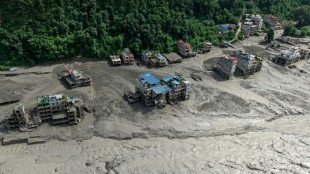 The foreign tourists missing in Nepal's flash floods

 Hundreds missing after Nepal-Tibet flood kills 98

 CIA director was on 'semi-routine' mission in Moscow: Trump

 Aldeguer switches to Rossi's VR46 for next season

 Rent TRON Energy and Reduce USDT Fees : TronBid Expands Marketplace

 Pakistan captain Babar Azam returns against England '90 percent fit'

 Stocks mixed as oil drops, inflation stays high

 Improving standards transform pole vault as spectacle, says Duplantis

 India close in on win despite Sri Lanka fightback in second Test

 MEXC TradFi Gala Concludes With Over 170,000 Registrations and $4.3 Billion in Daily Trading Volume

 Olympic skating champion Liu to skip new season

 Benfica sign midfielder Palhinha from Bayern

 Flick says Barca may go without striker as Atletico resist Alvarez sale

 Too hot to incubate: Nile crocodiles hatch on their own in French reserve

 Spurs closing in on Man City's Marmoush after signing Savio

 Celtic count the cost of Champions League flop

 Lebanon accuses Israel of burning forest, farmland in south

 Nepal floods at China border kill 8, cause 'major casualties' in Tibet

Global investors seek to diversify away from the United States due to political polarization and rising public debt, yet no significant exodus has occurred. This persistence stems not from loyalty but from a lack of viable alternatives; other financial systems lack the depth and infrastructure to absorb massive capital flows without destabilizing themselves.
Investors have numerous motivations to reduce exposure to the United States, citing rising public debt, deepening political polarization, unpredictable trade policies, and concerns over the rule of law. Additionally, the use of financial sanctions has prompted other governments to explore alternatives to the dollar. Despite these pressures, there has been no mass withdrawal from US markets.
The dollar remains dominant, accounting for 56.8 percent of allocated foreign-exchange reserves at the end of 2025 and facilitating 89.2 percent of all foreign-exchange trades surveyed by the Bank for International Settlements. While analysts often attribute this to America’s economic scale, legal protections, and innovative corporate sector, a more fundamental constraint exists: the world lacks the capacity to receive a massive reallocation of capital.
The issue is not a shortage of promising economies or assets elsewhere, but rather that other financial systems cannot absorb large, rapid inflows without destabilizing themselves. This concept, known as system-wide financial absorptive capacity, refers to a market’s ability to price, hedge, and settle enormous capital flows without causing extreme volatility in asset prices, yields, or exchange rates.
This capacity depends on more than just the volume of securities; it requires a robust ecosystem of exchanges, banks, dealers, clearinghouses, custodians, regulators, courts, auditors, lawyers, data providers, and central-bank backstops. Diversification is often viewed from an individual perspective, where a pension fund or central bank can easily shift assets at the margin. However, if thousands of large institutions attempted this simultaneously, destination market prices would surge, yields would fall, and currencies would appreciate.
High-quality bonds with suitable maturities would become scarce, hedging costs would rise, and regulatory limits would bind. Markets that appear deep in normal times may prove shallow under exceptional inflows. What is rational for one investor becomes impossible when all act together, a classic fallacy of composition.
The US holds a formidable advantage in this regard. As of July 2026, the US Treasury market held $31.5 trillion in outstanding securities with an average daily trading volume exceeding $1.2 trillion. Treasuries serve not only as investments but as liquid stores of value, collateral, pricing benchmarks, and regulatory instruments. Surrounding them is an unmatched institutional infrastructure capable of pricing, financing, hedging, and settling huge transactions.
Alternatives present significant hurdles. Europe possesses sophisticated institutions and vast savings, yet its capital markets remain fragmented and lack a common safe asset comparable in scale to US Treasuries. This reality underscores the geopolitical importance of initiatives like the EU Savings and Investments Union.
China has an enormous bond market, but capital controls, managed convertibility, state influence, and uncertainty regarding investor rights limit its ability to freely absorb global portfolios. Emerging markets face a sharper trade-off: large inflows can cause currency appreciation and inflate asset prices, undermining the returns that initially attracted investors.
These constraints explain why geopolitical multipolarity is advancing faster than financial multipolarity. Production and trade can be redirected relatively quickly, whereas financial ecosystems are cumulative. Scale attracts issuers, investors, and intermediaries; their presence creates liquidity, which in turn attracts more activity. The dollar’s centrality is sustained by this constructed comparative advantage.
However, this advantage is not immutable. It can be eroded by fiscal irresponsibility, attacks on institutional independence, arbitrary sanctions, recurrent market disruptions, and fears of governmental corruption. Volatility following US tariff announcements in April 2025 demonstrated that investors may hedge dollar exposure rather than reflexively buy into it.
For countries seeking a more multipolar financial order, the policy lesson is clear. Alternative payment systems or reserve currencies alone are insufficient. Europe requires deeper integration, common issuance, and harmonized supervision and insolvency rules. Emerging economies must build local-currency yield curves, derivatives, clearing and settlement infrastructure, and a larger supply of standardized assets. Multilateral development banks can help aggregate projects into instruments that global institutions can buy at scale.
Wall Street’s power rests on its productive capacity to transform global savings into liquid, tradable, and hedgeable claims. A genuinely multipolar financial system cannot simply be proclaimed; until rival markets can perform these functions at comparable scale, the world may desire to leave Wall Street faster than it is able to do so.
Jorge Arbache is a professor of economics at the University of Brasilia.
F.Pavlenko--BTB