UN team 'staying' at Ukraine nuclear plant / Photo: © AFP

 Turkey, Australia's joint COP31 leadership raises doubts

 For Turkish NGOs, COP31 offers rare space for action

 Sleep, appetite, gene-editing experts contend for Nobel chemistry prize

 Nobel Peace Prize haunted by the 'spectre' of Trump

 Africa launches own credit agency in bid for cheaper borrowing

 US, China, EU: three paths to regulating AI

 Australia's High Court rules against coal mine in landmark climate case

 Australia touts new funds for Pacific infrastructure at Fiji 'pre-COP'

 Eva Marie Saint, Oscar winner of Hollywood classics, dies at 102

 Australia probes app used in cheap smart glasses over privacy fears

 England needed to 'move on' from World Cup pain, says Tuchel

 O'Neill to stay at Celtic after period of "reflection"

 Kane marks 125th England cap with Wembley Nations League double

 Quebec's incoming separatist leader wants to block Crown from swearing-in

 Emmys gala will now stream its premier television awards

 Paramount completes Warner Bros takeover, creating Skydance
 Trump blames France unrest on Islam, migration

 Apple's Cook praises EU over efforts to protect children online

 Nobel winner Halzen says years of October 'misery' finally over

 Quebec separatist win rattles Carney's unity push

 'Itching' for change: Shiffrin cuts back slaloms this season

 'Gen Z has risen up': Tens of thousands mass for tense France school protests

 Caribbean tourism hotspot loses men to Russian war machine

 Danish reservists practice war games to respond to 'aggression'

 Bhuvneshwar returns to India's T20 squad for New Zealand tour

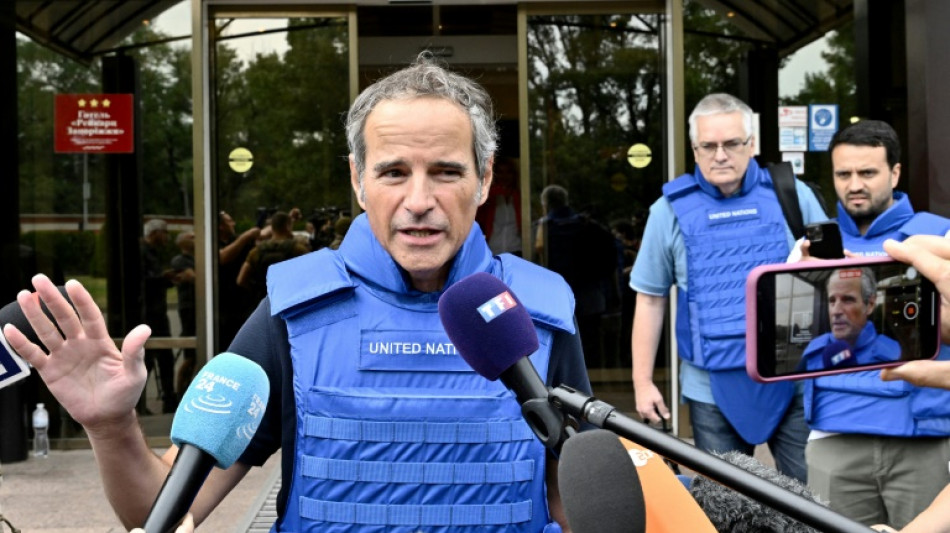
UN inspectors will be "staying" at a Russian-held nuclear plant in southern Ukraine, its head said Thursday after their first visit to the facility following a risky journey across the frontline despite early-morning shelling of the area.
Wearing bright blue flak jackets and helmets, the 14-strong team crossed into Russian-held territory, reaching the facility around 1200 GMT with the International Atomic Energy Agency chief describing it as a productive first visit.
"Today we were able, in these few hours, to gather a lot of information," Rafael Grossi told reporters outside the plant.
"The key things I needed to see I saw, and their explanations were very clear."
After the inspection, in a video released by the Russian RIA Novosti news agency, Grossi said: "We have achieved something very important today and the important thing is the IAEA is staying here."
Despite a dawn shelling attack on the area that forced the closure of one of its six reactors, the team vowed to press ahead with their risky mission to reach Europe's biggest nuclear facility which is located on the frontlines of the fighting.
Energoatom, Ukraine's nuclear agency, said it was "the second time in 10 days" that Russian shelling had forced the closure of a reactor.
It said the plant's emergency protection system kicked in shortly before 5:00 am (0200 GMT), shutting reactor five, "due to another (Russian) mortar shelling" and that a backup power supply "was damaged" in the attack.
The area around the plant, which lies on the southern banks of the Dnipro River, has suffered repeated shelling, with both sides blaming the other, sparking global concern over the risk of an accident.
- 'Stop playing with fire' -
"It is high time to stop playing with fire and instead take concrete measures to protect this facility... from any military operations," ICRC chief Robert Mardini told reporters in Kyiv, warning the consequences of hitting the plant could be "catastrophic".
"The slightest miscalculation could trigger devastation that we will regret for decades."
After Russian forces seized the plant on March 4, Energoatom shut two reactors, followed by a third after shelling on August 5. With a fourth in repairs, Thursday's incident leaves only one of the six reactors working.
Mardini said it was "encouraging" the IAEA team was inspecting the plant because the stakes were "immense".
"When hazardous sites become battlegrounds, the consequences for millions of people and the environment can be catastrophic and last many years," he said.
On leaving Zaporizhzhia, Grossi said his team would be travelling through areas where "the risks are significant" but had decided to go ahead anyway.
"We have to proceed with this. We have a very important mission to accomplish."
- Shelling and saboteurs -
The town of Energodar next to the plant came under sustained attack at dawn, with Russian troops firing "mortars and using automatic weapons and rockets", its mayor Dmytro Orlov said.
But Moscow accused Kyiv of smuggling in up to 60 military "saboteurs" who reached the area near the plant at dawn, prompting Russian troops to take "measures to annihilate the enemy".
Ukraine has accused Russia of deploying hundreds of soldiers and storing ammunition at the plant.
Kyiv also suspects Moscow intends to divert power from the plant to the nearby Crimean peninsula, which was annexed by Russia in 2014 -- a view held by other international figures.
"Clearly the objective of the Russians... is they want to unplug (the plant) from the Ukrainian grid and plug it into the Russian grid," said outgoing British premier Boris Johnson, who steps down on September 6.
Meanwhile, Ukrainian troops pressed ahead with a counter-offensive in the nearby region of Kherson to retake areas seized by Russia at the start of the invasion.
In its morning update, the presidency said "heavy explosions continued for the last 24 hours" across Kherson, while five people were killed and 12 others wounded in the eastern Donetsk region.
- Back-to-school with gunfire soundtrack -
Despite the conflict, now in its seventh month, September 1 marked the start of a new school year for children across Ukraine.
In the southern Mykolaiv region, that meant children were back in front of screens for online classes as all school attendance was cancelled due to the ongoing fighting.
On her first day back, nine-year-old Antonina Sidorenko, who lives in a hamlet near the frontline, was doing her online lessons with the distant crackle of gunfire in the background.
"I'm happy to be back at school but I would be even happier if there was no war because I miss my teacher and my friends," she told AFP, saying her best friend had fled to Poland.
Updated figures from Ukraine's education ministry show more than 2,400 educational institutions have been damaged in the fighting, with 270 completely destroyed.
Just over half of the 23,000 institutions surveyed by the ministry are equipped with bomb shelters, meaning they can physically reopen, while those without will only offer online learning.
An investigation by the Centre for Information Resilience found 41 institutions had been "partially or completely destroyed" with the shelling "targeted, rather than a by-product of indiscriminate attacks on civilian infrastructure".
P.Anderson--BTB