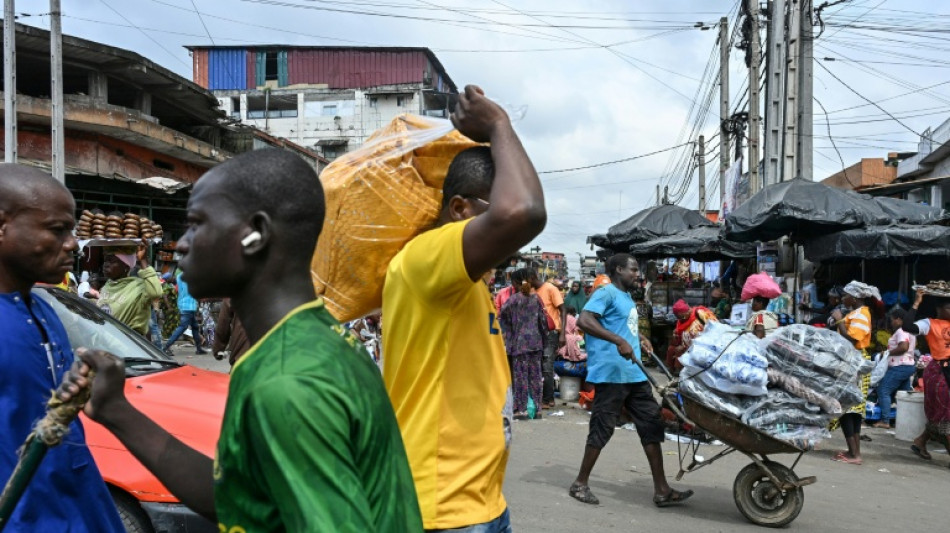
Africa's informal economy: a burden and lifeline / Photo: © AFP

 'Long live Chairman Mao': Supporters pay respects to founder of Communist China
 Sweden immigration restrictions spark healthcare concerns
 EU to help cities tighten screws on Airbnb, holiday rentals

 'Our year': Kane and Bayern primed for Champions League tilt
 Australian World Cup star Volpato fined over positive cocaine test
 Sabalenka edges Noskova to keep US Open treble bid alive
 Pegula outlasts Navarro to set US Open semi with Sabalenka

 From trenches to catwalk: Ukraine's amputee soldiers hit the runway
 UK airports face more disruption after air traffic control glitch

 ECB meets, weighing a tricky balance between savers and spenders
 Pakistan police counter drone attacks with Ukraine-style nets

 Russia torments Kyiv with new 'horror' jet drones
 Iran attacks US base in Jordan as Hormuz impasse deepens
 New Apple CEO to face first test with foldable iPhone launch

 Sabalenka edges Noskova, keeps US Open treble bid alive
 Real Madrid win Champions League opener as Haaland stars for Man City
 Gambian leader vows power boost after violent blackout protests

 Newcastle battle past Millwall to reach League Cup fourth round
 Mourinho's Real Madrid make winning start against Inter Milan

 Villa take 'big step forward' with win over Brugge

 Yaya Toure hails 'new era' for African coaches ahead of Champions League bow

 Lawes and Marchant told to prove themselves in quest for England recalls

 Smithsonian secretary to retire as Trump exerts control over institution
 Atletico have work to do to reach home Champions League final: Simeone

 Villa end goal drought to beat Brugge in Champions League opener

Across the pavements, residential areas and public spaces of African cities, the informal economy is booming under the noses of authorities, who are often powerless to stop it.
Poverty, unemployment and bureaucratic red tape force tens of millions of Africans into work that is not regulated, taxed or protected by the government.
From Abidjan to Dakar and Abuja, mechanics, scrap dealers, motorcycle taxi drivers and street vendors make the most of the tiniest corner to set up their business activity.
AFP spoke to informal-sector workers in several African cities where their affordable prices make them indispensable to daily life for many.
"Life starts somewhere, so I've started here," said Lohbip El-Pius Binyir, who runs a money transfer point and also sells bread, biscuits and drinks from a small pavement stall in the Nigerian capital, Abuja.
The 35-year-old has managed to set himself up in a fashionable district, even though informal businesses like his are mostly confined to poorer neighbourhoods.
He puts the authorities' leniency down partly to the tidy and spartan way he operates his business: a bench, umbrella, card reader and table that he folds up and carts away each evening.
On a street in Ivory Coast's economic capital, Abidjan, municipal officers were in pursuit of informal vendors who had set up their stalls on the pavements and, in some cases, the roads.
It's a common occurrence in megacities across the continent, where kiosks, carts, containers, tables and stalls laid out on the ground are part of the urban landscape.
Yacouba Sylla has been forced to move his informal garage several times because of demolition operations in Abidjan but has always found another place to resume his business.
If it were up to him, the 44-year-old mechanic would choose something better: a fully compliant workshop with modern facilities on which he would pay taxes and bid for contracts.
But all that requires "a lot of resources" or "support from the state", which he does not have, he told AFP, in the middle of repairing an engine laid out on the floor, his hands covered in oil.
In the early 1970s, more than 60 percent of employment in Africa was estimated to be informal, but it has surged to nearly 83 percent in recent years, according to the International Labour Organization.
In Ivory Coast, Senegal, Mali and Nigeria, the figure is more than 90 percent of the active population.
- Cracking down -
The United Nations says the informal economy is a burden that limits the impact of growth.
Many African countries' development is shaped by the weight of the informal sector, the absence of enterprises capable of scaling up and too few opportunities for creating decent jobs, the United Nations Development Programme (UNDP) said in a report in July.
Governments have stepped up an array of measures to counter the informal sector, ranging from the more repressive, such as demolition and seizure of merchandise, to supporting workers through training or moving services online.
But they have not stopped it expanding.
"It's not an easy task," acknowledged Yaya Doumbia, first deputy mayor of Yopougon, Abidjan's biggest district and a hotspot for informal enterprise, where authorities have created a "sanitation brigade".
"The pavements and public spaces are occupied. It's a real challenge," he said.
Economist Guillaume Liby said African countries were "tackling the problem from the wrong end: coercion".
He also blamed a heavy tax burden and administrative hurdles facing those wanting to work legally.
Fruit, juices, clothes, shoes, peanuts -- Lobe Sarr has turned her hand to various wares over the last 15 years, finally settling on a small street eatery in the Senegalese capital, Dakar.
"Running a shop in the street is difficult," she said.
"At least it gives us something to do and allows us to earn money to cover our daily needs," the aproned woman in her 30s told AFP.
- No alternative -
She, like others AFP spoke to, said they had no option but to work informally.
Beyond small vendors, the informal sector also includes large numbers of people employed without a contract or social security coverage in artisanal trades, security, the restaurant industry or cleaning, who face a precarious existence.
"It's a survival economy, the only door left open" for many Africans, said Liby, the economist, pointing to a failing institutional environment and strong population growth.
The informal sector is a major part of the economy, accounting for up to 65 percent of the continent's gross domestic product, according to the International Monetary Fund.
But, while the sector remains untaxed, it represents a considerable loss of revenue for African governments, economists say.
Countries must implement policies that encourage informal-sector workers to register with the tax authorities, facilitate access to financing and create infrastructure needed to accommodate small entrepreneurs.
In Ivory Coast, reducing the "significant weight" of the informal sector with notably the creation of a status for small entrepreneurs is one pillar of an ambitious national development plan, unveiled in July.
Benin's efforts have already borne fruit after it introduced a policy based on building new, modern markets and reorganising large commercial areas.
Formerly at 97 percent, its informal economy now accounts for 85 percent of jobs.
The Beninese authorities vaunt a strategy that has enabled the state to hike its tax revenues while providing better working conditions and combating unsanitary practices.
sjd-burx/bam/pid/kjm/jhb
A.Gasser--BTB