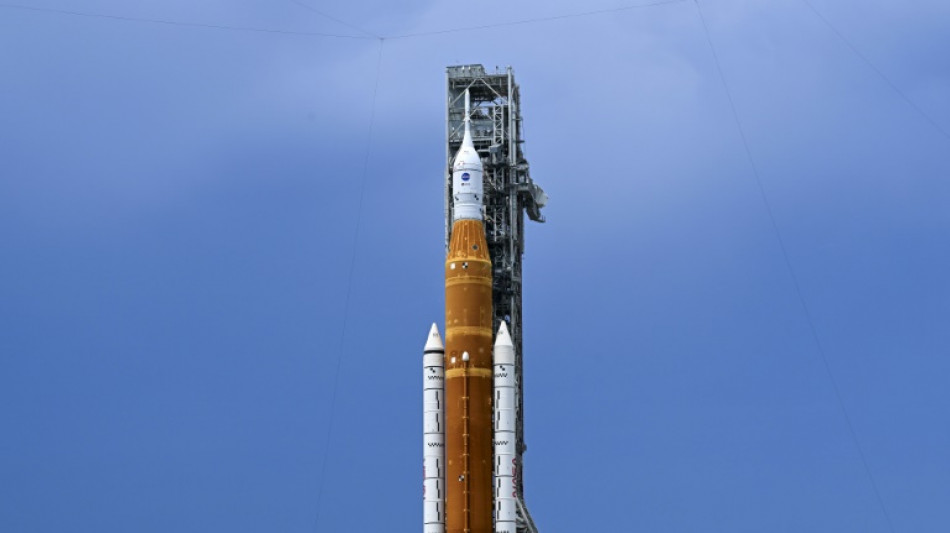
Fuel leak delays preparations for NASA rocket launch / Photo: © AFP

 Turkey, Australia's joint COP31 leadership raises doubts
 For Turkish NGOs, COP31 offers rare space for action
 Sleep, appetite, gene-editing experts contend for Nobel chemistry prize
 Nobel Peace Prize haunted by the 'spectre' of Trump

 Africa launches own credit agency in bid for cheaper borrowing

 US, China, EU: three paths to regulating AI

 Australia's High Court rules against coal mine in landmark climate case

 Australia touts new funds for Pacific infrastructure at Fiji 'pre-COP'

 Eva Marie Saint, Oscar winner of Hollywood classics, dies at 102

 Australia probes app used in cheap smart glasses over privacy fears

 England needed to 'move on' from World Cup pain, says Tuchel

 O'Neill to stay at Celtic after period of "reflection"

 Kane marks 125th England cap with Wembley Nations League double
 Quebec's incoming separatist leader wants to block Crown from swearing-in

 Emmys gala will now stream its premier television awards

 Paramount completes Warner Bros takeover, creating Skydance
 Trump blames France unrest on Islam, migration

 Apple's Cook praises EU over efforts to protect children online
 Nobel winner Halzen says years of October 'misery' finally over
 Quebec separatist win rattles Carney's unity push

 'Itching' for change: Shiffrin cuts back slaloms this season

 'Gen Z has risen up': Tens of thousands mass for tense France school protests

 Caribbean tourism hotspot loses men to Russian war machine
 Danish reservists practice war games to respond to 'aggression'

 Bhuvneshwar returns to India's T20 squad for New Zealand tour

As NASA on Saturday resumed its second effort to get its new 30-story rocket off the ground and send its uncrewed test capsule toward the Moon, engineers detected a fuel leak that potentially could lead to a new delay.
With millions around the globe and hundreds of thousands on nearby beaches waiting for the historic launch of the massive Space Launch System (SLS), a leak near the base of the rocket was found as ultra-cold liquid hydrogen was being pumped in.
NASA said engineers would "stop flowing liquid hydrogen to the tank, close the valve used to fill and drain it," then try to reseal it.
The space agency offered no information on the likelihood of a new delay in the Artemis program -- which aims eventually to return a human crew to the Moon -- following Monday's aborted effort.
Saturday's launch is still scheduled for 2:17 pm (1817 GMT) from Kennedy Space Center in Florida. It can be delayed by up to two hours if necessary.
"Our team is ready," Jeremy Parsons, deputy manager of exploration ground systems at Kennedy Space Center, had said Friday.
"They are getting better with every attempt and actually performed superbly during launch countdown number one... I think if the conditions with weather and the hardware align, we'll absolutely go."
Though the area around the launch site will be closed to the public, an estimated 400,000 people were gathering on beaches nearby to see -- and hear -- the most powerful vehicle that NASA has ever launched climb into space.
The initial launch attempt was halted after engineers detected a fuel leak and a sensor showed that one of the rocket's four main engines was too hot.
Both issues have since been resolved, the launch team said.
Shortly before 06:00 am (1000 GMT) Saturday, launch director Charlie Blackwell-Thompson had given the go-ahead to start filling the rocket's tanks with cryogenic fuel.
About three million liters of ultra-cold liquid hydrogen and oxygen was expected to be pumped into the spacecraft.
And the weather appeared to be cooperating: the US Space Force predicts a 60 percent chance of favorable weather at the scheduled liftoff time, growing to 80 percent later in the launch window.
If something requires NASA to stand down again on Saturday, there are backup opportunities on Monday or Tuesday. After that, the next launch window will not be until September 19, due to the Moon's position.
The purpose of the Artemis 1 mission is to verify that the Orion capsule, which sits atop the SLS rocket, is safe to carry astronauts in the future.
Mannequins equipped with sensors are standing in for astronauts on the mission and will record acceleration, vibration and radiation levels.
- Apollo's twin sister -
It will take several days for the spacecraft to reach the Moon, flying around 60 miles (100 kilometers) at its closest approach. The capsule will fire its engines to get to a distant retrograde orbit (DRO) of 40,000 miles beyond the Moon, a record for a spacecraft rated to carry humans.
The trip is expected to last around six weeks and one of its main objectives is to test the capsule's heat shield, which at 16 feet in diameter is the largest ever built.
On its return to Earth's atmosphere, the heat shield will have to withstand speeds of 25,000 miles per hour and a temperature of 5,000 degrees Fahrenheit (2,760 degrees Celsius) -- roughly half as hot as the Sun.
Artemis is named after the twin sister of the Greek god Apollo, after whom the first Moon missions were named.
Unlike the Apollo missions, which sent only white men to the Moon between 1969 and 1972, Artemis missions will see the first person of color and the first woman step foot on the lunar surface.
Fittingly, NASA's first woman launch director, Blackwell-Thompson, will give the final "go" for liftoff on Saturday.
A successful Artemis 1 mission will come as a huge relief to the US space agency, after years of delays and cost overruns.
A government audit estimates the program's cost will grow to $93 billion by 2025, with each of its first four missions clocking in at a whopping $4.1 billion per launch.
The next mission, Artemis 2, will take astronauts to the Moon without landing on its surface.
The crew of Artemis 3 is to land on the Moon in 2025 at the earliest, with later missions envisaging a lunar space station and a sustainable presence on the lunar surface.
According to NASA chief Bill Nelson, a crewed trip to the red planet aboard Orion, which would last several years, could be attempted by the end of the 2030s.
R.Adler--BTB