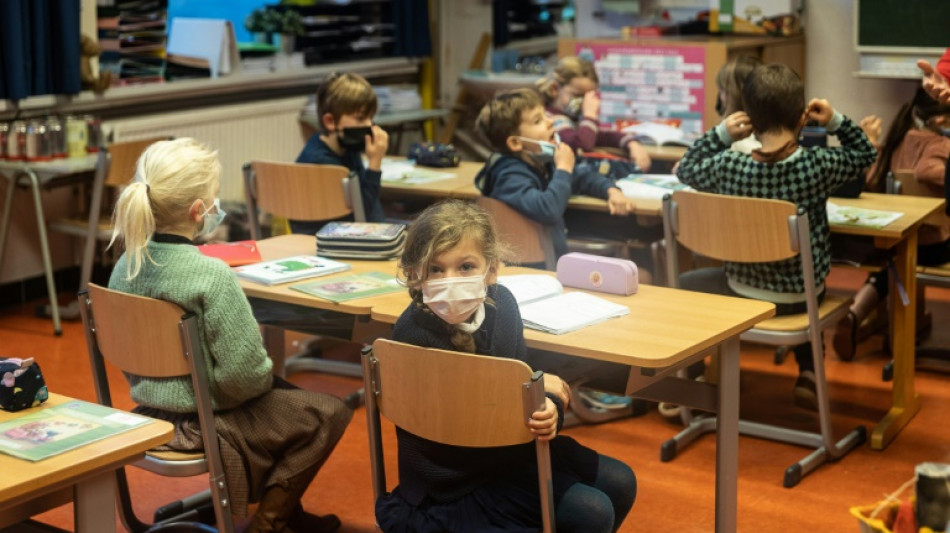
Masks in class -- how damaging to child development? / Photo: ©

 UN approves resolution on dealing with rising sea levels

 Yalcouye makes dream debut as Ivory Coast beat Ghana in AFCON qualifier

 Chicago's White Sox and Cubs book MLB playoff berths

 Last-gasp Gakpo strike snatches Dutch draw to sour Klopp debut
 Global stocks mostly fall as oil prices and bond yields rise

 Israel's Netanyahu denounces enemies, allies in fiery UN speech

 Hollywood stars among arrests in NY anti-Netanyahu protest
 Losing start in AFCON qualifying for 78-year-old coach Le Roy
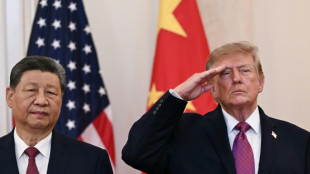
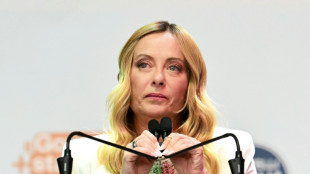 Italy bans burqas in schools, caps numbers of foreign students per class

 Israel policies threaten 'life and existence' of Palestinians, Abbas says

 Paolini steers Italy past China in BJK

 Zidane admits emotion on eve of first game as France coach
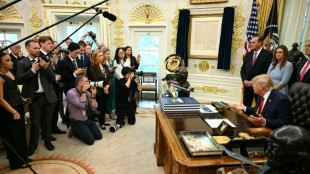
 Breetzke and Maharaj sink Australia in first one-day international

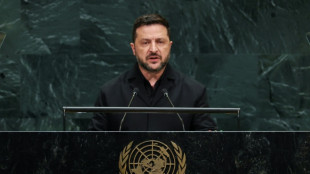 Zelensky broke confidentiality with North Korea POWs disclosure: South's president

 Former Liverpool star Carroll reveals he was sexually assaulted

 Dominican Republic calls for Haiti force to be strengthened

 Dolly Parton's nephew ordered to stay away from estate staff, properties

 Early exit for Philippine darling Eala at Singapore Open

 Hurricane Polo triggers huge waves in coastal Mexican city

 What happens if the US bans diesel exports

 Macklemore hits back with 'Free Palestine Tour' after Sheeran split

 Met Opera to give New Yorkers free tickets in affordability push

 Top ECB official to resign to take up IMF role

 Xi and Trump call for peace in lavish White House state visit

 Five up-and-coming players looking to make mark in Nations League

Two years into the pandemic, concerns around the effect of masks on the linguistic, emotional and social development of children are taking center stage.
In the United States, calls to lift mask mandates at school have multiplied in recent weeks, including within the scientific community, at a time when new cases of Covid-19 are plunging.
Scientific studies have shown that masks do indeed impact children's ability to recognize faces and emotions. As with adults, masks can also interfere with verbal communication. But experts are divided on the long-term effects on children's development.
- Learning language -
The first fear concerns the learning of language, which takes place in the first years of life. Children learn to speak through social interactions, and in particular look at the mouths of adults in order to dissect syllables.
This path being blocked, it seems logical to suppose a harmful effect.
"You do look at faces when you're learning to talk," Diane Paul, of the American Speech-Language-Hearing Association (ASHA) told AFP. "But it's not the only way."
Children also learn by listening to the voices and following the gestures and eye movements of those around them. Paul notes that those with visual impairment also learn to speak well -- and that masks are not worn permanently, for example at home.
"At least at this time, there aren't studies that have directly assessed the long term impact of speech and language development when young children interact with adults who wear masks," says the expert.
"But there are studies that demonstrate that children can tune into these different communication cues and gestures when an adult's mouth isn't visible."
A 2021 study demonstrated that infants were able to recognize unique words through a mask, just as well as without. But according to another, conducted in France, masks can interfere with learning to read among children with learning difficulties.
In general, research remains rare on the subject. But, says Paul, "I really do not see any cause for alarm."
According to the US Centers for Disease Control and Prevention (CDC), "the limited available data indicate no clear evidence that masking impairs emotional or language development in children."
The agency recommends masking in public for those aged two and up, while the World Health Organization suggests the age of five.
- Social and emotional development -
But among psychiatrists, the story is a little different.
"More important is the emotional side," says Manfred Spitzer, who's also a specialist in cognitive neuroscience at the University of Ulm in Germany. He notes that the first thing lost with a mask is the sight of a smile.
"In educational settings, there is a lot of implicit feedback back and forth between teacher and child," he told AFP.
"If you impair this ongoing communication, you will certainly interfere with successful teaching."
Fears also relate to the ability to form social ties. Numerous studies have shown that masks make it more difficult to identify faces and emotions, including -- or even more -- among the youngest.
But conclusions about the consequences differ.
A study of children aged seven to 13, published in the journal PLOS One, confirmed that emotions (fear, sadness, anger) were less well identified when a person wore a mask -- but with similar results compared to wearing sunglasses.
It concluded that "masks are unlikely to dramatically impair children's social interactions in their everyday lives."
Yet other work, published in Frontiers in Psychology, has shown that performance in identifying the emotions of masked people dropped significantly between ages three and five, results that "suggest that we live in a time that may potentially affect the development of social and emotional reasoning," the authors said.
Carol Vidal, a psychiatrist at Johns Hopkins University, said that she's concerned at a societal level, though parents shouldn't panic.
Vidal is part of a group of medics and scholars called "Urgency of normal" calling for the lifting of compulsory masking at school, where it's hard to maintain the stringent use of masks anyway.
"I just think they're not necessary at this point in the pandemic, knowing what we know about the risks for kids in terms of Covid, and knowing that we all have access to vaccinations, and that if we're concerned about our health we can wear N95s (high-caliber masks)," she tells AFP.
It boils down to balancing risks and benefits, she stresses. The downsides of masks "might not be dramatic in the sense that you might not have effects right away, but I think we have to be careful," said Vidal.
J.Bergmann--BTB