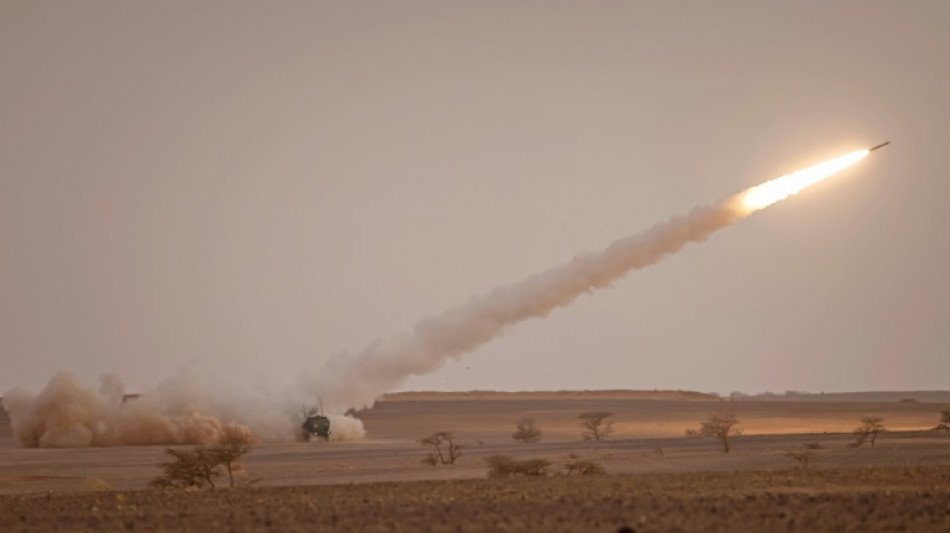
US ammunition supplies dwindle as Ukraine war drains stockpiles / Photo: © AFP/File

 Trump wants to turn Florida golf course into presidential retreat

 Mayor of Turkish opposition stronghold defects to Erdogan party
 Children among heavy casualties in Ukraine after Russian strikes

 Court orders German ex-spy chief kept in jail after spying, treason arrest

 Guinea caps bottled water prices after sachets banned

 Spared, married, hanged: the last weeks of Iranian protester Alireza Sepahi
 Nobel physics winner's pride at pioneering AI role
 IMF preparing El Nino assistance, concerned about AI bubble burst: chief to AFP

 West must embrace 'national power' or face decline: Rubio

 Shell refining margins reach record highs as wars hit supply

 Former Spain, Barca winger Pedro retires from football

 Arteta signs new Arsenal deal until 2030

 Stocks decline as oil climbs on Mideast flareup

 Gauff says online abuse was 'draining' after China Open exit

 As sector struggles, Porsche puts luxury ahead of volume

 'It's personal': Fiji minister pushes better climate finance at pre-COP

 Russia glosses over dark Soviet past in reinvented museum

 UK tax body opened probe into Man City in 2018: FT

 Yemen's Houthis claim new attacks on Saudi airports as conflict deepens

 Germany factory production at highest level for 18 months

 Thailand floods death toll rises to 60 since mid-September

 US pushes Russia for information on plague reports

 Myanmar leader lands in Malaysia for migrant return talks

 Indian central bank hikes rates for first time since 2023

 US military on Okinawa face curfew, alcohol ban after murder case

The United States will soon be unable to provide Ukraine with certain types of ammunition that are essential to Kyiv's battle against Russia's invasion, as supplies are being used up faster than they can be replaced.
Washington has become by far the largest supplier of arms to Ukraine since Russia launched the invasion on February 24, with more than $16.8 billion in military assistance provided since that date.
But US stockpiles of some equipment are "reaching the minimum levels needed for war plans and training," and restocking to pre-invasion levels could take years, Mark Cancian of the Center for Strategic and International Studies wrote in a recent analysis.
Washington is "learning lessons" from the conflict about ammunition needs in a great power war, which are "far greater" than expected, a US military official acknowledged on condition of anonymity.
American defense firms were forced to drastically reduce production in the 1990s as the United States slashed defense spending following the collapse of the Soviet Union, and their number fell dramatically, from dozens to single digits.
Now, the US government must convince the industry to reopen assembly lines and relaunch production of items such as Stinger anti-aircraft missiles, which have not been made since 2020.
Some US-provided equipment has become emblematic of the war in Ukraine, such as Javelin anti-tank weapons that were widely used by Kyiv's forces to blunt the Russian advance on the capital, and the Himars, a precision rocket system now playing a key role in counter-offensives against Moscow's troops in the east and south.
- 'No alternatives' -
But US stocks of ammunition for Himars -- which fires GPS-guided rockets known as GMLRS, with a range of more than 80 kilometers (50 miles) -- are dwindling.
"If the United States sent one-third of that inventory to Ukraine (as has been the case with Javelin and Stinger), Ukraine would receive 8,000 to 10,000 rockets. That inventory would likely last several months, but, when the inventory is exhausted, there are no alternatives," said Cancian, who previously worked on weapons procurement for the US government.
"Production is about 5,000 a year. Although the United States is working to increase that amount, and money has recently been allocated for that purpose, it will take years," he said, adding that older equipment could help fill the gap.
The United States has provided some 8,500 Javelin missiles to Kyiv, but production of a weapon that has become a symbol of Ukrainian resistance is only about 1,000 per year.
- 'As long as it takes' -
The US government ordered $350 million worth of the missiles in May, but it will again take several years before stockpiles are replenished.
The United States has also supplied more than 800,000 NATO standard 155 mm artillery shells to Kyiv -- three-quarters of the total amount delivered by all Western countries, according to official Pentagon statistics.
The amount of shells Washington has provided "is probably close to the limit that the United States is willing to give without risk to its own warfighting capabilities," Cancian said.
US production of these shells currently stands at 14,000 per month, but the Pentagon has announced that it aims to increase that figure to 36,000 within three years. That would still only bring annual production to 432,000 -- less than half of what has been provided to Ukraine in seven months.
And the US defense industry production is speeding up, Laura Cooper, a senior defense department official responsible for Russia and Ukraine, said Tuesday.
"The United States will continue to stand with the Ukrainian people and provide them with the security assistance they need to defend themselves for as long as it takes," she said.
B.Shevchenko--BTB