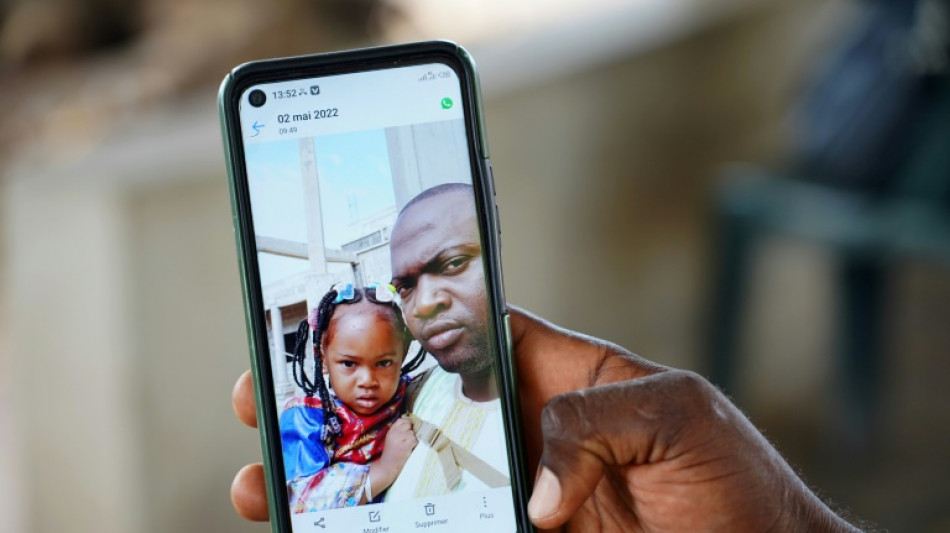
Grief and outrage in Gambia over cough syrup deaths / Photo: © AFP

 Rubio touts US power, calls on Europe to emerge from 'slumber'

 Trump says 'we don't think' Russian plague is bio-weapon

 Five children among 26 killed in Ukraine after Russian strikes

 Man City should 'accept' punishment for rule breaches, says Lineker

 US woman who survived botched execution is awake and speaking
 From 1800s to modern pharma: a Nobel-winning chemistry quest
 Southampton boss Eckert given suspended ban over 'Spygate'

 Russia warns of 'false' information as second plague case reported

 IEA ready to release more oil reserves if necessary
 HSBC 'consults' over UK unit job cuts amid AI adoption
 UK court quashes five ex-traders' Libor rate rigging convictions
 XM Receives “Global Customer Experience Leader Award 2026” at the TrustFinance Performance Awards
 Stocks slide as oil climbs on Mideast flareup

 Heavy casualties in Ukraine after Russian strikes
 French wine harvest set to hit historic low

 Kyiv 'cannot agree' to EU membership limiting food exports: minister

 Arteta targets more Arsenal glory after signing new deal until 2030

 Russell hit with Singapore grid penalty for taking new power unit

 Spotify expands audiobooks to more than 180 markets

 French-Japanese duo wins chemistry Nobel for solving molecular 'mystery'

 England's Nations League surge helps heal World Cup wounds

 Mayor of opposition stronghold Izmir defects to Erdogan party
 Mertens beats Gauff to set up Swiatek clash at China Open

 Benin full of pride at role in Messi's last dance

 France suspends stun grenade use at student protests ahead of PM speech

When Wuri Bailo Keita's two-year-old daughter Fatoumatta developed a fever, he took her to hospital where she was diagnosed with malaria and sent home with a prescription for a paracetamol syrup.
Less than a week later she was dead.
The infant is just one of 69 Gambian children to die of acute kidney failure since July in a series of cases linked to four Indian-made cough syrups.
The widening scandal has highlighted flaws in the tiny West African nation's healthcare system, in turn raising questions about potential loopholes in world pharmaceutical trade.
"She could not eat anything and she was oozing blood from her mouth and nose", Keita, a 33-year-old carwash attendant, told AFP, recounting his daughter's suffering.
"At some point, I was praying for God to take her life."
President Adama Barrow made a nationwide address on Saturday after the police launched an inquiry and health authorities were told to suspend the import licence of a suspected company.
Barrow also promised to update drugs-related laws and praised the work of the health ministry in preventing further deaths.
But fear and anger are mounting, and the death toll is still rising.
"President Barrow should sack the health minister, but instead of sacking him, he was praising the minister," said Keita, the grieving father.
"We want justice for these children."
Social media has been swamped by criticism of the healthcare system and by photos of the children who have died, most of whom were aged under five.
"It's time for the government to step up and stop these products," Mariama Kuyateh, a 30-year-old mother who lost her son Musa in September, told AFP.
"If they don't, and other syrups enter the country, it will be terrible."
- No test lab -
The deaths were catapulted to global prominence last Wednesday when the UN's World Health Organization (WHO) issued an alert over four syrups made by Maiden Pharmaceuticals of India.
Lab tests found "unacceptable amounts" of diethylene glycol and ethylene glycol, the WHO said.
The toxic impact from these substances includes "acute kidney injury which may lead to death," the agency said.
The Gambian health authorities, after launching their own investigation in July, on September 23 ordered a recall of all medicines containing paracetamol or promethazine syrup.
They have cited E.coli bacteria as a possible cause of the deaths.
India's health ministry said late Thursday it had been informed of the WHO's findings last month and was awaiting the results of its own lab tests on the four drugs.
Maiden Pharmaceuticals was not licensed to distribute the four products in India and had only manufactured and exported them to The Gambia, it said.
"It is a usual practice that the importing country tests these imported products on quality parameters, and satisfies itself as to the quality of the products," the ministry said.
But The Gambia has no national laboratory to test for drug quality and food safety -- a lack that Barrow on Saturday vowed to redress.
Maiden Pharmaceuticals did not respond to AFP requests for comment after the WHO alert.
- 'Failed miserably' -
Domestic critics accuse Barrow of having failed to protect the public and standing by watchdogs who should have been sacked.
The opposition United Democratic Party (UDP) criticised Barrow's "five-minute address" to a "traumatised nation left to wonder what other pharmaceuticals are on the market that may be fake or unsafe for use."
Nancy Jallow, of an NGO called Global Bridges, said she was appalled that top officials such as Health Minister Ahmadou Lamin Samateh and the head of the Medicines Control Agency, Markieu Janneh Kaira, were still in their jobs.
"We signed a social contract with Adama Barrow and his number one role is to protect the most vulnerable, and he has failed miserably," she told AFP.
She also called for a total halt to pharmaceutical imports "until Gambia's government can build a facility that can test medications."
Others voices, including the Gambia Bar Association, have insisted that the inquiry be conducted by independent experts.
- Weak healthcare -
Behind the political row is the reality of a country deep in poverty lacking many of the safeguards that elsewhere are taken for granted.
The Gambia is the smallest country in continental Africa, and nearly half of its population lives below the poverty line, according to the World Bank.
The country ranks a mere 174th out of 191 countries on the UN Human Development Index.
Its already weak health institutions were hit hard by Covid, with a 2020 UN assessment saying the pandemic had "exposed the shortcomings in the nation's healthcare system".
The UN flagged limited expertise, a shortage of basic equipment and a chronic lack of health professionals.
According to World Bank data, The Gambia in 2019 had just 0.1 physicians per 1,000 people -- less than a twentieth of the numbers in Canada.
The Gambia's under-five mortality rate is 49.4 deaths per 1,000 live births, according to UNICEF, compared to 3.7 deaths in Germany and 4.4 in France.
F.Pavlenko--BTB