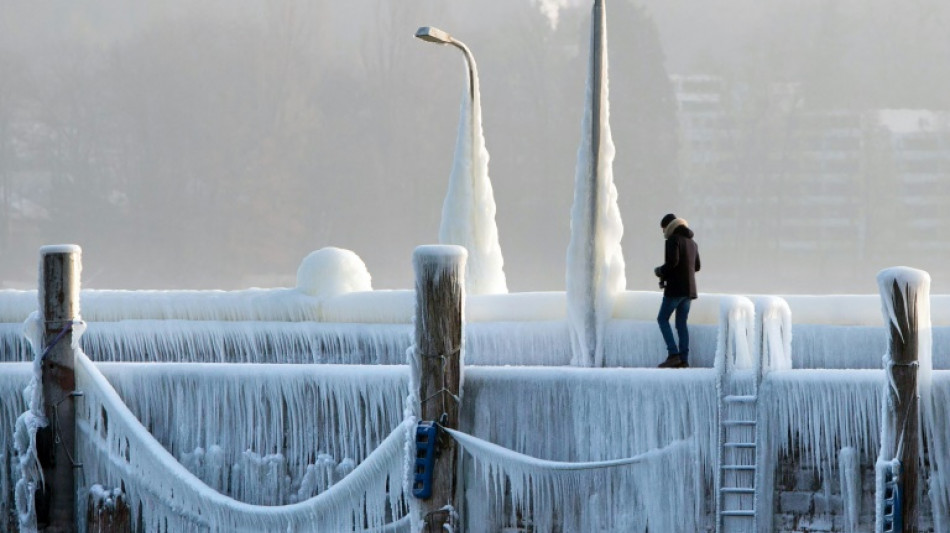
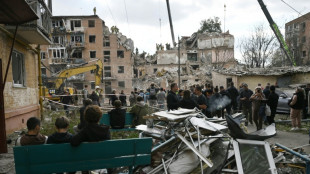
Cold Siberian air would help Putin this winter / Photo: © dpa/AFP

 Rubio touts US power, calls on Europe to emerge from 'slumber'

 Trump says 'we don't think' Russian plague is bio-weapon
 Five children among 26 killed in Ukraine after Russian strikes
 Man City should 'accept' punishment for rule breaches, says Lineker
 US woman who survived botched execution is awake and speaking
 From 1800s to modern pharma: a Nobel-winning chemistry quest

 Southampton boss Eckert given suspended ban over 'Spygate'

 Russia warns of 'false' information as second plague case reported
 IEA ready to release more oil reserves if necessary
 HSBC 'consults' over UK unit job cuts amid AI adoption
 UK court quashes five ex-traders' Libor rate rigging convictions
 XM Receives “Global Customer Experience Leader Award 2026” at the TrustFinance Performance Awards
 Stocks slide as oil climbs on Mideast flareup
 Heavy casualties in Ukraine after Russian strikes
 French wine harvest set to hit historic low
 Kyiv 'cannot agree' to EU membership limiting food exports: minister
 Arteta targets more Arsenal glory after signing new deal until 2030
 Russell hit with Singapore grid penalty for taking new power unit
 Spotify expands audiobooks to more than 180 markets
 French-Japanese duo wins chemistry Nobel for solving molecular 'mystery'

 England's Nations League surge helps heal World Cup wounds
 Mayor of opposition stronghold Izmir defects to Erdogan party
 Mertens beats Gauff to set up Swiatek clash at China Open
 Benin full of pride at role in Messi's last dance

 France suspends stun grenade use at student protests ahead of PM speech
Across Europe, governments are scrambling to prevent energy rationing and blackouts this winter. Whether they succeed will depend in part on something they have no control over: the weather.
Analysts say Russian President Vladimir Putin is hoping for a cold winter or a prolonged period of freezing temperatures after cutting Russia gas exports to Europe in retaliation for EU support for Ukraine.
Another cold season like 2010/2011 or a prolonged Artic blast like the "Beast from the East" which blew into western Europe from Siberia in 2018 could cause hardships that might weaken EU resolve in supporting Ukraine.
"The energy weapon has one bullet in the chamber and he has just fired it," said Eliot A. Cohen, a war historian and security expert at the the Center for Strategic and International Studies at Johns Hopkins University.
"Europeans will go through the worst of it this winter," he told AFP.
In many countries, households are being urged to turn down their thermostats and companies are being asked to find energy savings under EU plans to reduce gas consumption this winter by 15 percent compared to average.
In recent months, European states have raced to fill up their strategic reserves, buying extra supplies at record prices from Algeria, Qatar, Norway and the United States among other global gas suppliers.
EU stocks are now almost full -- at around 90 percent capacity -- providing a major safety cushion for consumers and businesses that rely on gas to heat their homes, offices and factories.
"Europe is well-placed to go through the winter under normal weather conditions," Alireza Nahvi, a research associate at Wood Mackenzie, an energy consultancy, told AFP in an email.
- 'Warm overall' -
With so much at stake, seasonal weather forecasts have become unusually important, with traders and policy makers eyeing reports from the EU-funded European Centre for Medium Range Weather Forecasts in particular.
Their Copernicus Climate Change Service produces rolling three-month forecasts that assess the probability of different weather patterns over the continent, using a supercomputer that crunches data from national forecasters.
"The last few weeks have been really busy for us," Carlo Buontempo, director of Copernicus Climate Change Service, told AFP ahead of the publication on Thursday of their next forecast for the November-January period.
"This year, there is clearly a geopolitical interest in the question," he added.
Although it is still too early to make confident predictions about the winter, initial indications are that it will be warm overall, but with a risk of early cold snaps in November and December.
"When you get into winter, the direction of the wind is what matters. If in mid-November to December, we have some of those strong easternly winds and and snow dropping over Europe, this will certainly have an impact on gas demand, prices and geopolitics," Buontempo explained.
On the other hand, after a summer of record temperatures in Europe, the Atlantic Ocean is warmer than usual, serving as a heatsink which should help keep temperatures higher when the winds are from the west.
"I stand by the fact that it is probably going to be a warm winter overall, but there is a higher than even chance of having an outbreak of cold periods at the beginning," he added.
- 'Achilles heel' -
The International Energy Agency, an energy consultancy financed by Western nations, has also been stress-testing Europe's ability to withstand this winter without Russian gas.
At average temperatures and assuming a reduction in gas demand of around nine percent this year compared to average, it believes that the continent will make it through without major disruption.
"If we don't have any Russian supplies and we have a winter that is colder-than-average by around 10 percent, that will put pressure on the European gas system," cautions Gergely Molnar, an IEA gas analyst.
Another important factor will be the level of stocks, which are mostly held in depleted gas fields or underground aquifiers.
Although they are filled to around 90 percent currently, not all of this gas can be accessed.
As the stocks are used up, the pressure falls, meaning the last 30 percent is difficult to extract.
A late cold spell in February or March when the pressure will be low was described by the agency as "the Achilles heel of European gas supply security" in a recent report.
Molnar also stressed to AFP that the weather is increasingly important for renewable electricity sources which make up a rising proportion of the European energy mix.
"One episode that should be remembered is the 'Beast from the East' which really showed how vulnerable the gas system can be to a major cold spell," he said.
B.Shevchenko--BTB