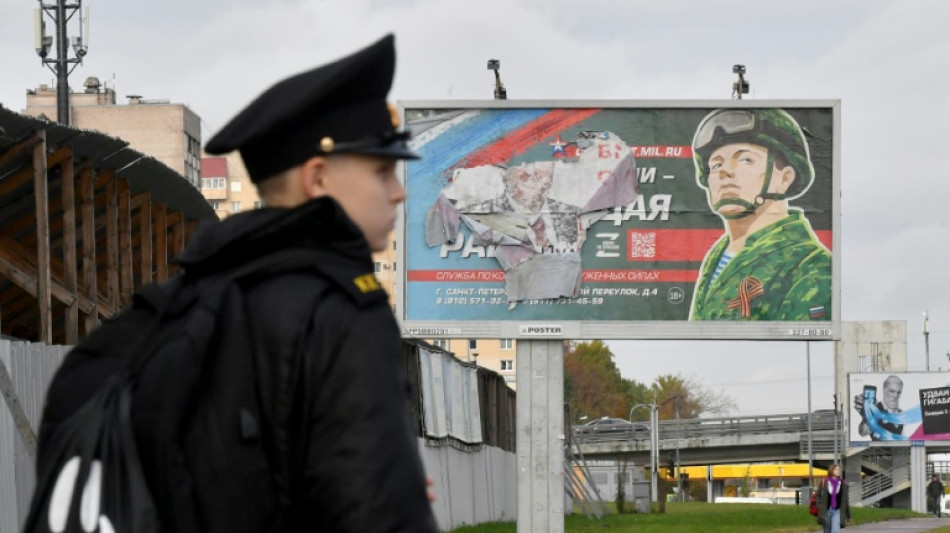
'Everything has collapsed': Russia's draft tanks small businesses / Photo: © AFP

 Rubio touts US power, calls on Europe to emerge from 'slumber'

 Trump says 'we don't think' Russian plague is bio-weapon
 Five children among 26 killed in Ukraine after Russian strikes
 Man City should 'accept' punishment for rule breaches, says Lineker
 US woman who survived botched execution is awake and speaking
 From 1800s to modern pharma: a Nobel-winning chemistry quest

 Southampton boss Eckert given suspended ban over 'Spygate'
 Russia warns of 'false' information as second plague case reported
 IEA ready to release more oil reserves if necessary
 HSBC 'consults' over UK unit job cuts amid AI adoption
 UK court quashes five ex-traders' Libor rate rigging convictions
 XM Receives “Global Customer Experience Leader Award 2026” at the TrustFinance Performance Awards
 Stocks slide as oil climbs on Mideast flareup
 Heavy casualties in Ukraine after Russian strikes
 French wine harvest set to hit historic low
 Kyiv 'cannot agree' to EU membership limiting food exports: minister

 Arteta targets more Arsenal glory after signing new deal until 2030
 Russell hit with Singapore grid penalty for taking new power unit
 Spotify expands audiobooks to more than 180 markets

 French-Japanese duo wins chemistry Nobel for solving molecular 'mystery'
 England's Nations League surge helps heal World Cup wounds
 Mayor of opposition stronghold Izmir defects to Erdogan party
 Mertens beats Gauff to set up Swiatek clash at China Open
 Benin full of pride at role in Messi's last dance

 France suspends stun grenade use at student protests ahead of PM speech
In his brand new co-working space in Chelyabinsk, a city in central Russia, entrepreneur Maxim Novikov is counting the empty seats.
The space is usually overflowing with designers, programmers and young Russians working on their start-ups.
But since President Vladimir Putin announced a mobilisation of hundreds of thousands of young Russian men last month, the 33-year-old has lost much of his clientele.
"Many have stopped coming," he told AFP by phone.
Instead, they are filling the depleted ranks of Russia's army or they are among the tens of thousands of others who have fled south for neighbouring Kazakhstan.
The Kremlin's mobilisation has brought uncertainty and chaos to businesses already hard-hit by sanctions and still recovering from the fallout of the pandemic.
In the last three weeks, a little more than half of the 77 spots in Novikov's co-working place were occupied.
He has "no idea" if the people who fled or were drafted will keep paying subscription fees, which cost between 70 and 130 dollars.
And now Novikov is worried about his loans.
"Turnover has already dropped by more than 40 percent this year," Novikov, an architecture graduate, said.
"I wanted to buy a third space but for the moment it is not possible to take the risk."
- 'Projects on hold' -
But he is far from the only business owner in Russia who is growing more nervous over the workforce vacuum.
"It means projects are being put on hold and private companies will be afraid to invest," said Natalia Zubarevich, an economist at Moscow State University.
Russia's economy has already been battered this year by unprecedented Western sanctions in response to Putin's decision to send troops to Ukraine on February 24.
But Zubarevich said mobilisation was an "additional aggravating factor."
She added she was not surprised young men from the provinces were joining the army, attracted by monthly payouts that are sometimes almost as much as their annual salaries.
Meanwhile, in glitzy central Moscow, 45-year-old Yelena Irisova is distraught at seeing her company, which produces luxury leather bags, stop production.
She employs around ten people in the small business.
But two of her craftsmen left the company in recent weeks -- one fearing mobilisation, another to help her daughter whose husband had been sent to the front.
"After September 21, everything collapsed," Irisova said. "Our sales fell threefold -- from 10 to three orders a day."
She says her savings will keep her going "a month or two, but not more."
- Almost no orders -
No Russian business seems unscathed.
Katerina Iberika, 39, who owns a pastry shop specialising in birthday cakes in Moscow, is also facing ruin.
Her five employees are women with exemptions from mobilisation. But it's the low morale among the public that's endangering her business.
"Cancellations of orders for big events started two days before mobilisation," Iberika told AFP.
Now she gets nearly no orders at all, except for "very small" ones.
She is considering leaving Russia.
In increased isolation -- and hit by sanctions and mobilisation -- an anxious Russian society is watching its spending closely.
"People are looking to put their money aside," Sofya Donets, chief economist for Russia at Renaissance Capital, said.
"They're not going to overspend."
Some industries have been harder hit than others by a sudden lack of men.
Employers have sounded the alarm in recent days, asking the government for exemptions from mobilisation, in particular for small and medium-sized companies.
Russia's economic development ministry told AFP that it had drawn up a list of measures for these "problematic issues".
It said it had facilitated grants and micro credits.
"A mobilised entrepreneur will be able to suspend the fulfilment of obligations" to pay the loans back, the ministry said.
Analyst Sofya Donets expects "more intervention and state aid" to calm the effects of mobilisation.
Especially since Russian coffers continue to fill up thanks to its energy exports.
S.Keller--BTB