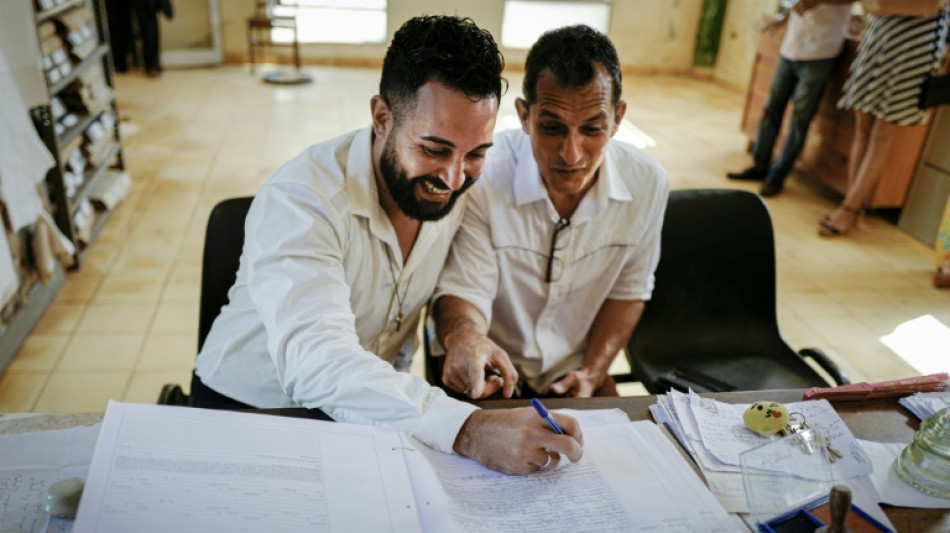
Gay Cuban couple's long wait to tie the knot / Photo: © AFP

 Rubio touts US power, calls on Europe to emerge from 'slumber'

 Trump says 'we don't think' Russian plague is bio-weapon
 Five children among 26 killed in Ukraine after Russian strikes

 Man City should 'accept' punishment for rule breaches, says Lineker

 US woman who survived botched execution is awake and speaking
 From 1800s to modern pharma: a Nobel-winning chemistry quest

 Southampton boss Eckert given suspended ban over 'Spygate'

 Russia warns of 'false' information as second plague case reported
 IEA ready to release more oil reserves if necessary

 HSBC 'consults' over UK unit job cuts amid AI adoption
 UK court quashes five ex-traders' Libor rate rigging convictions
 XM Receives “Global Customer Experience Leader Award 2026” at the TrustFinance Performance Awards

 Stocks slide as oil climbs on Mideast flareup
 Heavy casualties in Ukraine after Russian strikes
 French wine harvest set to hit historic low

 Kyiv 'cannot agree' to EU membership limiting food exports: minister

 Arteta targets more Arsenal glory after signing new deal until 2030

 Russell hit with Singapore grid penalty for taking new power unit

 Spotify expands audiobooks to more than 180 markets

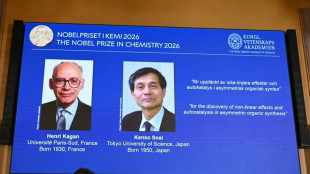 French-Japanese duo wins chemistry Nobel for solving molecular 'mystery'

 England's Nations League surge helps heal World Cup wounds

 Mayor of opposition stronghold Izmir defects to Erdogan party
 Mertens beats Gauff to set up Swiatek clash at China Open
 Benin full of pride at role in Messi's last dance

 France suspends stun grenade use at student protests ahead of PM speech

Adiel Gonzalez, a 32-year-old former theology student, was forced to break with his church eight years ago due to his sexuality.
He became a fierce LGBTQ+ rights campaigner and on Thursday, was able to tie the knot with his long-time partner and fellow activist Lazaro Gonzalez -- among the first gay weddings celebrated in Cuba.
Thanks in large part to the efforts of the pair and others like them, Cuba finally approved same-sex marriage on September 25 after a long battle against religious and cultural resistance in the socially-conservative country.
The Cuban family code adopted last month allows not only legal unions but also adoption, surrogate pregnancy for gay couples and parental rights for non-biological mothers and fathers.
"For us who have been involved so directly" in the struggle, which was "part of our daily life... for seven consecutive years, to get married was the closure, the culmination," Adiel Gonzalez told AFP next to his new husband, a 52-year-old artist, at their home in Bolondron, central Cuba.
On Thursday, Lazaro Gonzalez got up very early to prepare the banquet to which only the pair's closest family and friends were invited.
He cooked traditional fare such as fried rice, a casava dish called "yuca al mojo" and sweet plantain.
"We have been awaiting this moment for so long, it was a dream," he told AFP over coffee before getting dressed for the ceremony.
The happy couple exchanged vows, smiling ear to ear, at the only civil registry in the town of some 7,000 inhabitants.
- Church opposition -
Cubans voted in a referendum last month to approve same-sex marriage, joining only eight other countries in Latin America where it is legal: Argentina, Uruguay, Brazil, Colombia, Ecuador, Costa Rica, Chile and some Mexican states.
The approved family code, which had the support of President Miguel Diaz-Canel, replaced legislation from 1975 that defined marriage as a union between a man and a woman.
The government had sought to change this already in the 2019 constitution, but withdrew its proposal amid strong opposition from churches and conservative groups.
Marginalization of LGBTQ+ people in traditionally macho Cuban society peaked in the 1960s and '70s.
In 2010, Fidel Castro admitted the Cuban revolution had oppressed members of the community as deviants, including with forced labor camps for re-education. Some were driven into exile.
A major opponent of the family code is Cuba's powerful Catholic Church, which maintains "it is a child's right to have a father and a mother."
- 'God does not care' -
Adiel Gonzalez, who wears a religious cross around his neck, said he was born into a "very conservative and fundamentalist" Christian family.
"I was taught to reject any homosexual urges. Any love, even, was considered a sin," he recounted.
From the age of 11, he said, he tried to "change" himself through prayer.
"But it did not work because sexual orientation is not a choice," he told AFP. "I am convinced that God does not care about sexual orientation."
By the time he turned 20, Adiel had accepted his sexuality. He tried to foster grass-roots acceptance at his local church, but finally broke ties with the Church in 2014 to start a Christian LGBTQ+ activist group.
It was a painful process.
"I was in the crossfire because I was doing activism from the point of view of my Christian identity," said Gonzalez, who found himself the target of vicious attacks, including death threats, on social media.
But he did not give up, campaigning for the family code which was finally approved with 66,85 percent of the vote.
"We shouted, we embraced, it was very emotional," said Lazaro of the referendum's outcome. "It really was worth" the battle.
"We do not need a signature to be happy, but to have society recognize that we are in a relationship like any other heterosexual one, and that it is very important for us" to have legal protections, he added as he embraced his husband.
L.Janezki--BTB