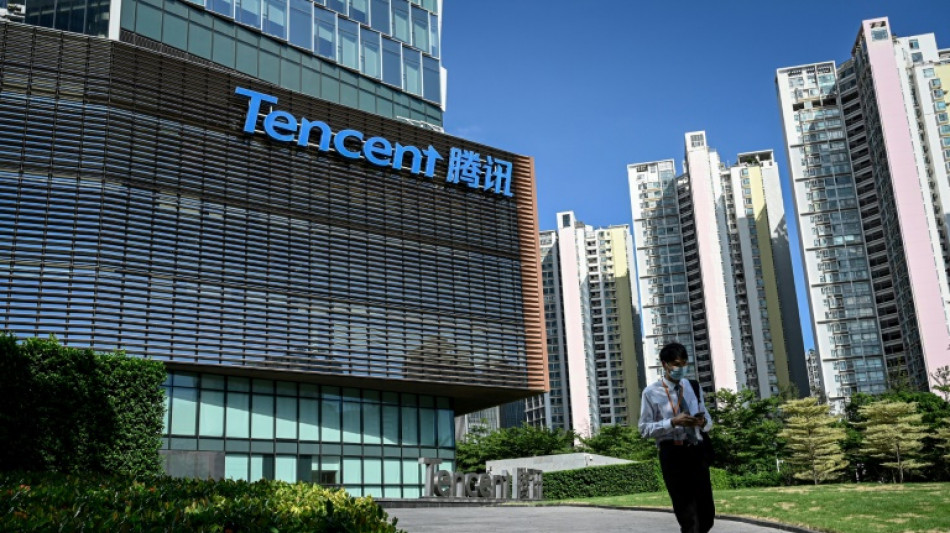
Hounded at home, China's video game firms welcomed in Europe / Photo: © AFP/File

 Rubio touts US power, calls on Europe to emerge from 'slumber'

 Trump says 'we don't think' Russian plague is bio-weapon

 Five children among 26 killed in Ukraine after Russian strikes

 Man City should 'accept' punishment for rule breaches, says Lineker

 US woman who survived botched execution is awake and speaking

 From 1800s to modern pharma: a Nobel-winning chemistry quest

 Southampton boss Eckert given suspended ban over 'Spygate'
 Russia warns of 'false' information as second plague case reported

 IEA ready to release more oil reserves if necessary

 HSBC 'consults' over UK unit job cuts amid AI adoption

 UK court quashes five ex-traders' Libor rate rigging convictions

 XM Receives “Global Customer Experience Leader Award 2026” at the TrustFinance Performance Awards
 Stocks slide as oil climbs on Mideast flareup

 Heavy casualties in Ukraine after Russian strikes

 French wine harvest set to hit historic low

 Kyiv 'cannot agree' to EU membership limiting food exports: minister

 Arteta targets more Arsenal glory after signing new deal until 2030

 Russell hit with Singapore grid penalty for taking new power unit

 Spotify expands audiobooks to more than 180 markets

 French-Japanese duo wins chemistry Nobel for solving molecular 'mystery'
 England's Nations League surge helps heal World Cup wounds

 Mayor of opposition stronghold Izmir defects to Erdogan party
 Mertens beats Gauff to set up Swiatek clash at China Open
 Benin full of pride at role in Messi's last dance

 France suspends stun grenade use at student protests ahead of PM speech

China is investing billions in Europe's video game industry, but analysts have warned that there could be trouble along the road unless regulators start to take stricter notice.
Europe is embroiled in long-running disputes with Beijing over trade, environment, education, raw materials, intellectual property -- but so far video games are not part of the fight.
As Beijing tightens up on the video game industry at home, China's tech giants are looking to make investments overseas -- prompting concerns ranging from data security to limits on creative freedom.
"Europe has this idea that we will be able to separate strategic industries from non-strategic industries," Antonia Hmaidi from the Mercator Institute think-tank told AFP.
"Video games for most policymakers will always go into the non-strategic pile."
This has helped Tencent, the world's largest games company by revenue, to buy into studios across Europe –- including the then world-record $8.6 billion deal for Finnish firm Supercell in 2016.
Chinese rival NetEase made its biggest foray into foreign gaming studios in August, snaffling French firm Quantic Dream -- just days before Tencent upped its stake in Ubisoft, another French studio.
EU regulators only look at major investments with a pan-European dimension, and national regulators have shown no interest.
When Tencent bought British studio Sumo for $1.3 billion last year, the deal was scrutinised not by UK regulators but by their US counterparts.
- 'Cold' China -
Chinese firms are increasingly seeking profits abroad, analysts say, because of stifling restrictions in their home market.
Tencent recorded its first-ever quarterly loss in August on the back of a wide-ranging crackdown on the tech sector.
The Chinese government has identified video games as a potential threat not only to state power but also to the wellbeing of citizens.
Beijing introduced a nine-month ban on approval of new video games last year and now approves only a fraction of the number it once allowed on to the market.
Game makers have had to scrub "politically harmful" content, and the state has tightly restricted the time youngsters can spend gaming.
"Chinese companies in general are looking further afield given the climate of the domestic market," said Louise Shorthouse of Ampere analysis.
Several reports have suggested that Tencent is preparing to ramp up its overseas investments and could even begin to take control of smaller firms.
Tencent is essentially "sitting on a load of cash", said Kevin Shimota, a former marketing manager at the company and author of "The First Superapp".
"The Chinese market is cold right now so in terms of Tencent's global strategy you'd expect it to be more aggressive," he said.
But he stressed that the aim was unlikely to be direct takeovers or deeper control of foreign companies, rather Tencent might look at ways of developing games for audiences outside of China.
- 'More erratic' -
Tencent is ubiquitous in China, an empire of games, social media and payment services largely funnelled through its WeChat app, which boasts more than one billion monthly users.
Its leader, Pony Ma, has worked hard to keep himself out of the limelight –- and out of Beijing's firing line.
And the company is determined to present a humble face to the world.
"Whether we are a minority investor or a majority shareholder, we do not exercise creative, editorial, management, or day-to-day control," Tencent told AFP in a statement.
Tencent's business model has generally been to buy into foreign firms and publish their games for the Chinese market.
As those foreign companies were unlikely to find any other way into China, they welcomed the investment and new revenue streams.
NetEase is following the same model.
A blog from Quantic Dream announcing the takeover stressed that the French firm would maintain control over the "editorial line, the artistic direction of our projects and the management of the studio".
NetEase did not respond to AFP's request for comment.
Analyst Hmaidi said the hands-off approach was fine when business was booming -- but the effects of an economic downturn or political upheaval were impossible to predict.
European regulators, she suggested, could benefit from a broader approach that questioned whether a single country -- China or any other nation -- should be allowed to dominate an entire industry.
"Having a sector dependent on China just in general is bad at the moment," she said.
T.Bondarenko--BTB