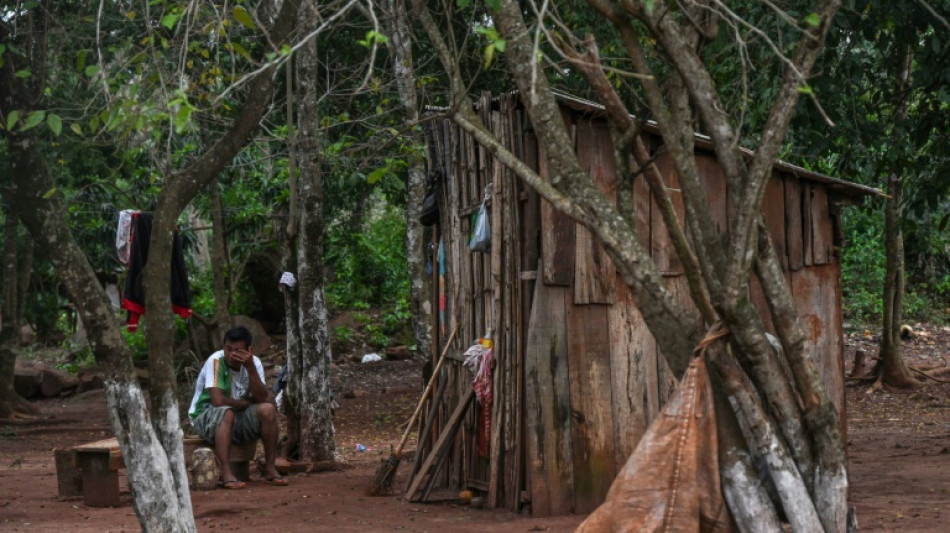
Indigenous Guarani live in deepening poverty in Brazil / Photo: © AFP

 EU trade chief seeks to dial down China tensions

 'Never again Bolsonaro': thousands march ahead of Brazil election runoff

 After botched execution, US woman was nearly taken off life support before revival
 Searing AIDS drama 'Elsinore' opens London film festival

 Evicted pensioner who sparked Spain housing protests dies: tenant union
 Golf star Rahm quitting LIV tour over 'unacceptable' terms

 Thousands march fearing return of a Bolsonaro presidency in Brazil
 French PM denies police ordered to confront student protesters

 Rubio touts US power, calls on Europe to emerge from 'slumber'

 Trump says 'we don't think' Russian plague is bio-weapon
 Five children among 26 killed in Ukraine after Russian strikes

 Man City should 'accept' punishment for rule breaches, says Lineker
 US woman who survived botched execution is awake and speaking
 From 1800s to modern pharma: a Nobel-winning chemistry quest

 Southampton boss Eckert given suspended ban over 'Spygate'

 Russia warns of 'false' information as second plague case reported
 IEA ready to release more oil reserves if necessary
 HSBC 'consults' over UK unit job cuts amid AI adoption

 UK court quashes five ex-traders' Libor rate rigging convictions
 XM Receives “Global Customer Experience Leader Award 2026” at the TrustFinance Performance Awards
 Stocks slide as oil climbs on Mideast flareup

 Heavy casualties in Ukraine after Russian strikes

 French wine harvest set to hit historic low
 Kyiv 'cannot agree' to EU membership limiting food exports: minister

 Arteta targets more Arsenal glory after signing new deal until 2030

In the middle of a football match on an improvised dirt pitch in southern Brazil, a famished young Indigenous boy abruptly abandons the game, throws a stick into the sky and fells a bird.
Then he runs home to have his family cook it.
Scenes like this leave chief Inacio Martins saddened.
"Hunger's no fun," says the 51-year-old head of the Ava Guarani people in the village of Marangatu, where some 200 Indigenous families live in deep poverty.
Their situation is similar to that of many native communities in Brazil, where far-right President Jair Bolsonaro -- whose political fate will be decided in a polarizing runoff election Sunday -- came to office four years ago vowing not to allow "one more centimeter" of protected Indigenous reservations.
Forced from their ancestral lands to make way for industrial-scale agriculture, the Ava Guarani have been reduced to living in hunger and hopelessness on a leftover scrap of unwanted territory in the state of Parana.
"We need land to farm. We know how, but the soil here is nothing but rock," says Martins, pointing to the dusty expanse surrounding the community's overcrowded huts.
"Where are we going to go?" he asks. "It used to be we'd run away whenever white people came to take our land. Now there's no land left to run to."
- 'Ashamed' to beg -
Daniela Acosta, 27, is one of the few Ava Guarani with a paying job.
She takes a bus every day at 2:30 am to work in a poultry processing plant 65 kilometers (40 miles) away.
She uses her salary to pay off her student debt from a teacher-training program.
After that, there is little left for food. But she would be "ashamed" to beg in the city, she says.
Indigenous people are not usually "well received" there anyway, says the mother of one, who lives in a tiny home with a small space for her bed and another to cook.
"No one comes here to see how we live. I hope some day we'll manage to have our land declared a reservation, so we can be self-sufficient and not have to depend on others," she says.
Inhabitants of the region's 14 Indigenous villages -- which hope to one day win the right to a reservation -- are chronic victims of discrimination, threats and even hit-and-run highway accidents, according to a 2017 report by a commission backed by Brazilian rights groups and the Norwegian embassy.
- Court battle -
"The problems started when (the Indigenous communities) began demanding their land" in the 2010s, says Marina Oliveira, of the Indigenous Missionary Council, which is helping them.
At that point, she says, the Ava Guarani came to be seen as a threat by local farmers, many of whom inherited their farms from grandparents who received titles from the government to settle the land in the 1940s.
"Landholders look at Indigenous people and think we're going to invade their land," says Martins.
"But we're not dumb enough to do something like that. We just want to protect our rights. This land is ours. We never sold it to the white man."
The government's Indigenous affairs agency, FUNAI, has established the borders of a 27,000-hectare (100-square-mile) reservation for the Ava Guarani, based on their documented presence on the land since at least the 16th century.
But a court annulled the process in 2020, after Bolsonaro took office, in what Oliveira calls a "completely abnormal" ruling.
In June, the public prosecutor's office asked FUNAI to appeal.
Critics say the Indigenous affairs agency has been hijacked by hard-line Bolsonaro allies.
- Little hope -
Martins says he has little hope, whether or not Bolsonaro loses Sunday's runoff against leftist ex-president Luiz Inacio Lula da Silva (2003-2010).
He himself is unsure how he will vote, he says, unconvinced electoral politics will make a difference in his people's plight.
"My father-in-law was over 100 years old when he died, and he didn't manage to get our reservation established. I'm approaching 60, and I don't think I'll see it, either," he says.
Of the 725 Indigenous lands identified in Brazil, 237 are still awaiting official recognition as reservations, according to the Socio-Environmental Institute (ISA).
G.Schulte--BTB