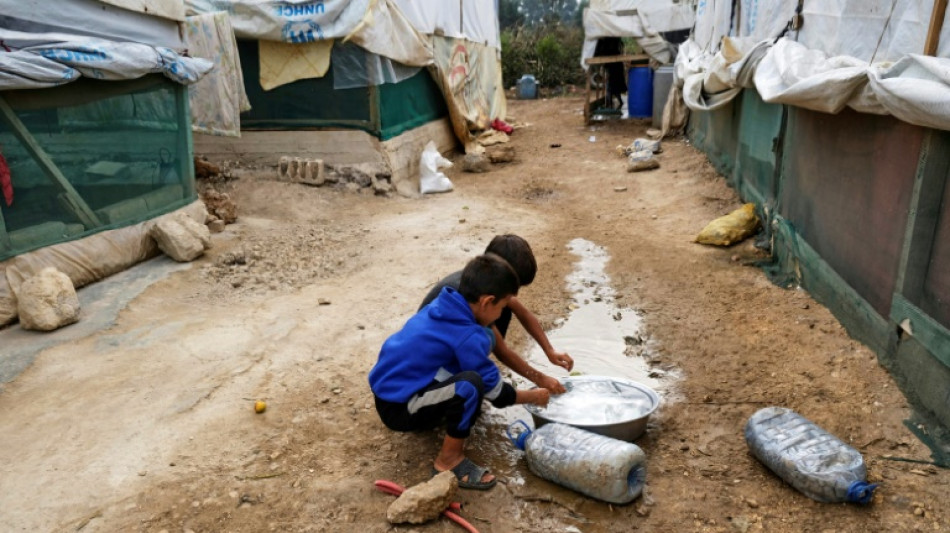
'No choice' but cholera water for Lebanon's poor / Photo: © AFP/File

 The growing protests against India's poll body - and PM Modi
 Stocks fall further as oil spike fans fresh inflation worries
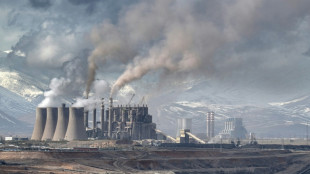 Bad COP, worse COP? EU tempers hopes for UN climate summit

 Rookie Henry named in Wallabies midfield to face All Blacks

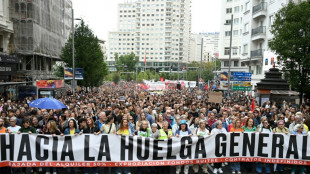 Housing crisis set to dominate Spain's snap election
 Gas, health care, utilities: high costs squeeze US midterm voters
 New Zealand Rugby seeks injunction over PNG Chiefs name
 Samsung expects 780% quarterly operating profit jump on AI boom
 Guardians survive with 9-3 win over White Sox

 Saudi Arabia says 3 dead at airports after Houthis claim attacks
 Stocks slide as oil sees volatile trading day over Iran war fears

 Microsoft pushes AI vision with new, expensive Surface laptop
 Five children among 28 killed in Russian strikes on Ukraine

 Odell Beckham Jr signs with Minnesota Vikings

 Saudi Arabia says three dead at airports after Houthis claim attacks

 Trump plans to turn Florida golf course into presidential retreat

 WHO says cannot conduct full risk assessment on Russia plague reports

 After botched execution, US woman is awake and shackled to bed

 New Zealand fly-half Mo'unga ruled out of Australia Tests

 Protests in major Turkish city after mayor defects to Erdogan party
 Climate change strips island's title of largest penguin colony: study

 Rubio says West must choose between national power or decline
 Russia's plague scare: What we know

 French luxury giant to fund redevelopment of two Paris streets: city hall

 Trump wants to turn Florida golf course into presidential retreat

Marwa Khaled's teenage son was hospitalised with cholera after drinking polluted water in Lebanon's impoverished north -- yet she still buys the same contaminated water, the only kind she can afford.
"People know (the water is contaminated), but they don't have any other choice," said 35-year-old Khaled, standing near her son, who is bedridden at a cholera field hospital.
"Everyone will end up with cholera."
Last month Lebanon recorded its first cholera case since 1993, in the nearby Syrian refugee camp of Rihaniye -- weeks after an outbreak in Syria, which lies about 20 kilometres (12 miles) away.
Now the World Health Organization warns the waterborne disease is spreading "rapidly" as Lebanon struggles with crumbling infrastructure, poor sanitation and limited access to clean water following three years of economic meltdown.
Over a quarter of the country's more than 400 recorded cases are from Khaled's hometown of Bebnine, where people resort to unsafe water sources as the state fails to provide clean water.
The actual number of cases could be much higher, with the health ministry recording more than 2,400 suspected and confirmed infections.
The mother-of-six and her family drink contaminated water, trucked to their home from nearby wells and water sources, because they lack access to running water and cannot afford bottled water.
Like much of Lebanon's marginalised north, Bebnine suffers from dilapidated infrastructure and government neglect.
A quarter of the town's residents are Syrian refugees living in squalid conditions.
- "Sewage water" -
Only 500 of Bebnine's households are registered with the state water network, in an overcrowded town of 80,000 people, according to engineer Tareq Hammoud of the North Lebanon Water Establishment.
But even these do not receive round-the-clock water supply.
A branch of the sewage-polluted Nahr al-Bared river flows through the town and has been contaminated with cholera, infecting nearby wells and water sources, field hospital director Nahed Saadeddine said.
Around 450 patients attend the hospital for treatments every day, she said.
The contaminated stream "provides water for all the crops in the area... There are wells, tanks, and springs pulling water from it, even water filtration sites," Saadeddine told AFP.
Cholera is generally contracted from contaminated food or water, and causes diarrhoea and vomiting.
It can also spread in residential areas lacking proper sewerage and drinking water systems.
"The infrastructure must be changed, the wells and water sources improved" to eradicate the disease, Saadeddine said.
"We want a long-term solution. Otherwise, we will see a lot more disasters."
The disease can kill within hours if left untreated, according to the WHO, but many of those infected will have no or mild symptoms.
It can be easily treated with oral rehydration solution, but more severe cases may require intravenous fluids and antibiotics.
- 'Diapers' -
Some patients at the hospital have contracted the disease more than once, among them Rana Ajaj's nine-year-old daughter.
"Five of us are sick at home. Even after the treatment, we will be sick again from drinking the same water," the 43-year-old said, passing a cup of water to her 17-year-old daughter who lay in bed, while her younger daughter sat close by.
In the next bed, 10-year-old Malek Hamad was struggling to drink his medicine, exhausted from losing 15 kilograms (33 pounds) after two weeks of illness.
His mother is terrified that her 10 other children may also be infected.
Outside the hospital, school supervisor Sabira Ali walked along the banks of the polluted stream, gazing at the water.
"Coronavirus didn't scare me as much as cholera," said the 44-year-old who lost two members of her family to cholera last month.
Bebnine resident Jamal al-Sabsabi, 25, blamed local authorities for failing to act as disease struck the town.
"What is the municipality doing?" he asked.
"Sewage water, diapers, waste... everything gets dumped into the stream," al-Sabsabi said, pointing to the murky brook running a few metres (yards) from his home.
"No wonder the disease is spreading."
P.Anderson--BTB