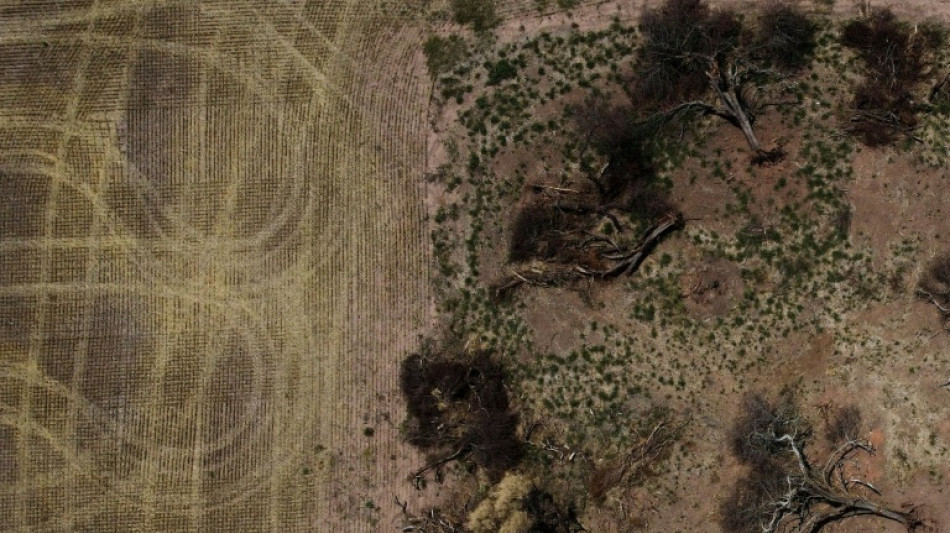
Colonists nibble at Gran Chaco, South America's other big forest / Photo: © AFP

 North Korea demands South show 'utmost respect' to restore relations

 Saudi says three dead in airport attacks claimed by Houthis

 'Mad dream': New showcase for African film opens in London

 All Blacks coach Rennie says Wallabies exit 'part of the game'

 The growing protests against India's poll body - and PM Modi
 Stocks fall further as oil spike fans fresh inflation worries

 Bad COP, worse COP? EU tempers hopes for UN climate summit

 Rookie Henry named in Wallabies midfield to face All Blacks

 Housing crisis set to dominate Spain's snap election

 Gas, health care, utilities: high costs squeeze US midterm voters

 New Zealand Rugby seeks injunction over PNG Chiefs name

 Samsung expects 780% quarterly operating profit jump on AI boom

 Guardians survive with 9-3 win over White Sox

 Saudi Arabia says 3 dead at airports after Houthis claim attacks

 Stocks slide as oil sees volatile trading day over Iran war fears

 Microsoft pushes AI vision with new, expensive Surface laptop

 Five children among 28 killed in Russian strikes on Ukraine

 Odell Beckham Jr signs with Minnesota Vikings

 Saudi Arabia says three dead at airports after Houthis claim attacks

 Trump plans to turn Florida golf course into presidential retreat

 WHO says cannot conduct full risk assessment on Russia plague reports

 After botched execution, US woman is awake and shackled to bed

 New Zealand fly-half Mo'unga ruled out of Australia Tests

 Protests in major Turkish city after mayor defects to Erdogan party

 Climate change strips island's title of largest penguin colony: study

Dwarfed by its more prestigious sibling, the Amazon, South America's second largest forest is a little-known victim of 25 years of gradual invasion by agriculture.
The Gran Chaco indigenous forest that spans one million square kilometers (386,000 square miles) across Argentina, Paraguay and Bolivia is at the mercy of ravenous soybean and sunflower crops, as well as pasture land.
Comprising a mix of dry thorn shrubland, woodlands and palm savannas, the dense tropical dry forest contains massive scars -- vast areas of deforestation gouged out with alarming regularity.
The harm to local fauna and flora is immeasurable.
In some places, as far as the eye can see, carob trees uprooted by heavy machinery lie waiting to be taken away and used as charcoal, tannin, furniture and railway sleepers, for which this dense hardwood is particularly prized.
Here, in Argentina's northeast, some 1,100-kilometers (685 miles) from Buenos Aires, is the country's agriculture frontier.
It is where the agro export industry, so crucial for a country short on foreign currency, advances at the expense various species of fauna and flora, as well as people.
"Practically all of Chaco province used to be covered by forests," agricultural engineer Ines Aguirre from the Chaco Argentina Agroforestry Network told AFP.
"But when the technological package of genetically modified soyabean appeared in the 1990s, the Chaco zone began to be colonized."
- 'Strong agro pressure' -
Two of Argentina's main exports, soybean (30 percent) and genetically-modified corn are, like sunflowers, resistent to dry climates, allowing them to thrive in the semiarid Chaco region.
Deforestation in the region has averaged around 40,000 hectares (154 square miles) a year, peaking at 60,000 on occasions, said Aguirre.
"This shouldn't happen because all forms of deforestation have been suspended in the province," said Noemi Cruz, the forests campaign co-ordinator at Greenpeace, while picking up a handful of dusty earth from a patch of ground cleared of trees.
Without the protection of those trees "water slides on the surface but won't penetrate the ground during the rainy season."
Chaco includes a 128,000 hectare national park called The Impenetrable that is designated a "red zone" and strictly protected by a forestry law. But there are also "yellow" zones where tourism and "soft" agriculture are allowed, and "green" zones that are a free-for-all.
But this law has not proved sufficient to protect the forests.
"There is strong pressure from companies and agricultural producers that want to open up more farmland and there is a permanent international demand for primary materials, especially soyabean and beef," said biologist and researcher Matias Mastrangelo, from the CONICET national scientific and technical research institute.
In the case of illegal logging, a lightly punitive fine "does not discourage clearing and the companies incorporate it as another production cost."
What this means is that deforestation around The Impenetrable park affects the rich fauna living within it, such as anteaters, peccaries, coral snakes, tapir and the continent's largest feline, the jaguar, which is endangered in the region and the subject of an ambitious reintroduction program.
"A forest that becomes a soybean field can no longer provide shelter for the jaguar, nor any of its prey. The destruction is absolute," said biologist Gerardo Ceron, coordinator of the Rewilding Argentina team managing the predator's reintroduction.
- Large mammals at risk -
"In the dry Chaco, we are probably facing a very serious effect of losing fauna. We are seeing especially the extinction of large mammals," said Micaela Camino, a biologist at CONICET, citing the giant armadillo and white-lipped peccary as examples.
"When a species is lost, you lose what is unique about the species. But also the nutritional security of local families and all the functions that this species performed in the ecosystem.
"You're losing the ability of this ecosystem to survive, regenerate and be resilient, which is very dangerous in a context of climate change."
It is not just fauna and flora being pushed out but also local indigenous communities, such as the Wichi and Criollo who live in the forest.
"What generally happens is that before the logging, the rights of these families are violated. They are swindled (out of their land) and forced to leave their homes," added Camino.
Aguirre says there are solutions to regenerate the lost Chaco forest, starting with the replanting of the carob tree.
"The carob tree, which is a legume, produces a reaction between bacteria and the tree's roots that recomposes the nitrogen in the soil. It's amazing, the growth is incredible," she said.
But such programs are for later, for now the priority is "stopping deforestation."
S.Keller--BTB