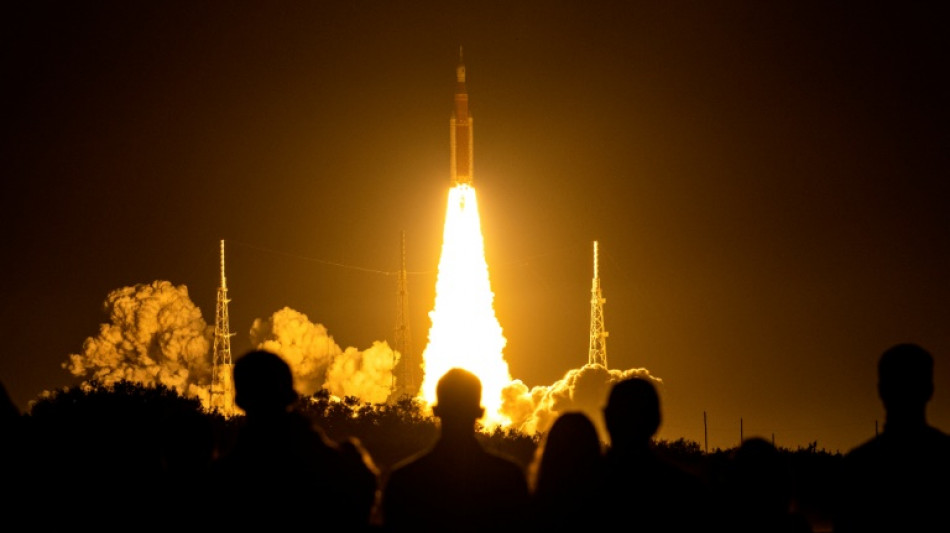
Liftoff! NASA successfully launches mega Moon rocket / Photo: © AFP

 Sri Lanka's de Silva quits as Test captain

 Alcaraz feeling 'mentally fresh' ahead of Shanghai return

 Israel drastically reduces British diplomatic presence in Jerusalem

 Stocks fall further as oil surge fans fresh inflation worries

 North Korea demands South show 'utmost respect' to restore relations

 Saudi says three dead in airport attacks claimed by Houthis

 'Mad dream': New showcase for African film opens in London

 All Blacks coach Rennie says Wallabies exit 'part of the game'

 The growing protests against India's poll body - and PM Modi

 Stocks fall further as oil spike fans fresh inflation worries

 Bad COP, worse COP? EU tempers hopes for UN climate summit

 Rookie Henry named in Wallabies midfield to face All Blacks

 Housing crisis set to dominate Spain's snap election

 Gas, health care, utilities: high costs squeeze US midterm voters

 New Zealand Rugby seeks injunction over PNG Chiefs name

 Samsung expects 780% quarterly operating profit jump on AI boom

 Guardians survive with 9-3 win over White Sox

 Saudi Arabia says 3 dead at airports after Houthis claim attacks

 Stocks slide as oil sees volatile trading day over Iran war fears

 Microsoft pushes AI vision with new, expensive Surface laptop

 Five children among 28 killed in Russian strikes on Ukraine

 Odell Beckham Jr signs with Minnesota Vikings

 Saudi Arabia says three dead at airports after Houthis claim attacks

 Trump plans to turn Florida golf course into presidential retreat

 WHO says cannot conduct full risk assessment on Russia plague reports

NASA launched the most powerful rocket ever built on a journey to the Moon on Wednesday, in a spectacular blaze of light and sound that marked the start of the space agency's new flagship program, Artemis.
The 32-story tall Space Launch System (SLS) blasted off from the storied Kennedy Space Center in Florida at 01:47 am (0647 GMT).
"We are going," tweeted the space agency.
Fixed to its top was the uncrewed Orion spaceship that will later separate and complete an orbit-and-a-half of Earth's nearest neighbor, in a test run for later flights that should see the first woman and first person of color touch down on lunar soil by the mid-2020s.
America last sent astronauts to the Moon during the Apollo era, from 1969-1972. This time it hopes to build a sustained presence -- including a lunar space station -- to help prepare for an eventual mission to Mars.
The launch came despite technical issues that ate into the two-hour launch window that opened at 1:04 am.
Engineers were forced to pause the flow of liquid hydrogen into the core stage Tuesday night because of a valve leak, though a team sent to the launch pad resolved the problem after an hour.
Later, the space agency reported that a radar site monitoring the rocket's flight path was experiencing problems due to a faulty ethernet switch that had to be replaced.
It was third time lucky for NASA after two previous launch attempts were canceled for technical reasons. Launch was also delayed due to weather setbacks, including Hurricane Ian that battered Florida in late September.
- 'Extremely excited' -
About 100,000 people were expected on the coast to watch the launch, with the rocket promising to light up the night sky.
Andrew Trombley, a space enthusiast from St. Louis, Missouri, was anxiously hoping for a successful liftoff after several futile trips made for the launch.
"I've been down here a couple of times already to watch this thing go up and have it canceled, so, this is like, whatever, the third trip down here for this, so I'm excited to see it go," said the network engineer.
"I was too little for the Apollo missions, so ... I wanted to be here in person."
Kerry Warner, 59, a grandmother and semi-retired educator who lives in Florida, was fired up for liftoff, which she said was "part of America and what America is all about."
"Third time's the charm. We're hoping for it."
- Far side of Moon -
The Orion crew capsule was being lifted by two boosters and four powerful engines under the core stage, which detached after only a few minutes.
After a final push from the upper stage, the capsule will be well on its way, taking several days to reach its destination.
Rather than landing on the Moon, it will assume a distant orbit, venturing 40,000 miles (64,000 kilometers) beyond the far side -- further than any other habitable spacecraft so far.
Finally, Orion will embark on the return leg of its journey. When passing through the atmosphere, the capsule's heat shield will need to withstand a temperature half as hot as the Sun's surface.
The mission will last 25 and a half days, with a splashdown in the Pacific Ocean on December 11.
NASA is banking on a successful mission after developing the SLS rocket for more than a decade. It will have invested more than $90 billion in its new lunar program by the end of 2025, according to a public audit.
Artemis 2 will involve a flyby of the Moon with astronauts in 2024, while Artemis 3 will see boots on lunar soil, no sooner than 2025.
N.Fournier--BTB