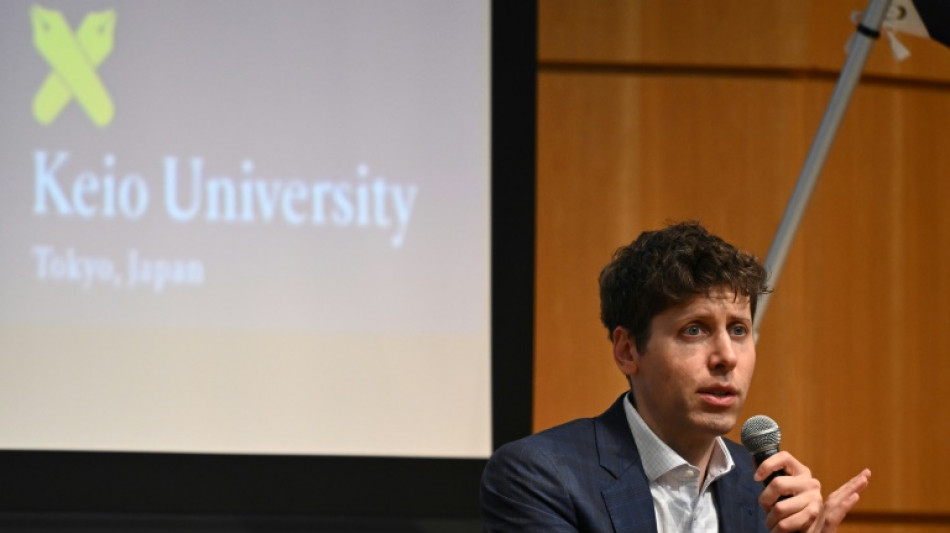
Homework will 'never be the same' says ChatGPT founder / Photo: © AFP

 Prague’s Concert for the Future Kicks Off on Wenceslas Square

 Prince William and Princess of Wales to Announce Earthshot Prize Winners in Mumbai

 Indonesia Forest Fires: Health Crisis, Diplomatic Strains and the Search for Solutions

 BYD Dolphin G Leasing Deal: Plug-in Hybrid Supermini Available from £174 a Month

 JUEL Group Expands from Real Estate to Hospitality with Hyatt Centric Malta Opening

 French Economy Shrinks 0.1% as Consumer Confidence Slumps

 Wall Street Ends Turbulent Week Higher Despite Inflation and AI Jitters

 Kansas City Fed Chief Says Inflation Is Still Running Too Hot

Artificial intelligence tools will revolutionise education like calculators did, but will not supplant learning, ChatGPT's founder Sam Altman told students in Tokyo on Monday, defending the new technology.
"Probably take-home essays are never going to be quite the same again," the OpenAI chief said in remarks at Keio University.
"We have a new tool in education. Sort of like a calculator for words," he said. "And the way we teach people is going to have to change and the way we evaluate students is going to have to change."
ChatGPT has captured the world's imagination with its capacity to generate human-like conversations, writing and translations in seconds.
But it has raised concern across many sectors, including in education, where some worry students will abuse the tool or turn to it rather than producing original work.
Altman was in the Japanese capital as part of a world tour where he is meeting business and political leaders to discuss possibilities and regulations for AI.
He has regularly urged politicians to draft regulations for AI, warning "if this technology goes wrong, it can go quite wrong".
"The tools we have are still extremely primitive relative to tools we are going to have in a couple of years," he said Monday, again urging safety measures and regulation.
He said he felt "positive" about new regulatory frameworks for AI after meeting world leaders, without offering details, but reiterated his fears.
"We will feel super responsible, no matter how it goes wrong," he said.
He also repeated previous attempts to calm fears that AI could make many existing jobs obsolete, though he conceded that "some jobs will go away".
"I don't think it is going to quite have the employment impact that people expect," he added, insisting that "new classes of jobs" will emerge.
"Almost all of the predictions are wrong," he said.
Y.Bouchard--BTB