N Macedonia's Roma Rock School strikes chord against prejudice / Photo: © AFP

 Prague’s Concert for the Future Kicks Off on Wenceslas Square

 Prince William and Princess of Wales to Announce Earthshot Prize Winners in Mumbai

 Indonesia Forest Fires: Health Crisis, Diplomatic Strains and the Search for Solutions

 BYD Dolphin G Leasing Deal: Plug-in Hybrid Supermini Available from £174 a Month

 JUEL Group Expands from Real Estate to Hospitality with Hyatt Centric Malta Opening

 French Economy Shrinks 0.1% as Consumer Confidence Slumps

 Wall Street Ends Turbulent Week Higher Despite Inflation and AI Jitters

 Kansas City Fed Chief Says Inflation Is Still Running Too Hot

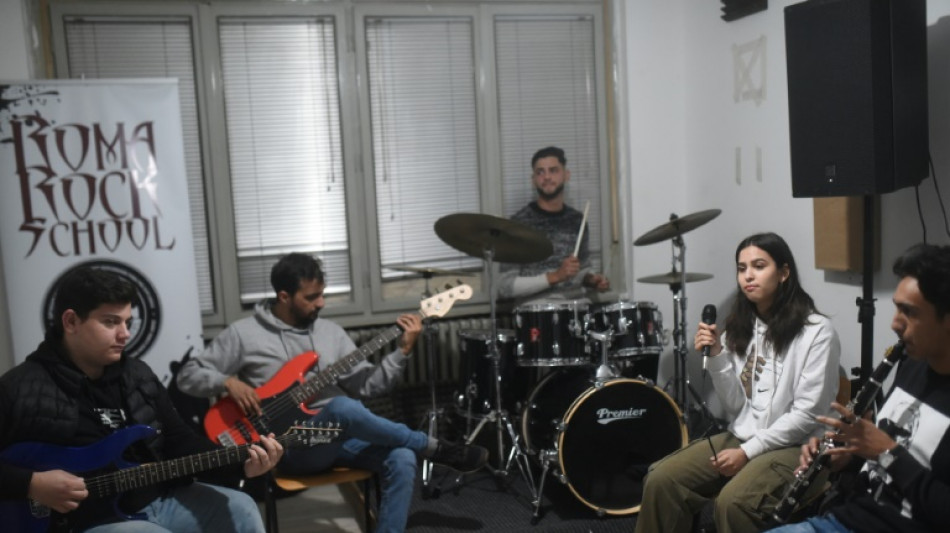
Crunchy guitar riffs reverberate through an apartment block in downtown Skopje -- the sound of the silence on discrimination in North Macedonia being well and truly broken.
At the Roma Rock School, children of all ages and backgrounds are brought together to learn, jam and overcome deep divisions in the hugely diverse Balkan country.
The school offers courses in music theory and instrument and voice classes along with rehearsal space for aspiring young musicians.
"All of this is free of charge for all the students. One of the main missions is breaking the stereotypes through music," co-founder Alvin Salimovski told AFP.
"I think that the only functional and effective way to do that is through music, something that we proved over the years."
One of the school's main focuses has been recruiting children from Skopje's largely Roma neighbourhood of Suto Orizari -- or Shutka -- where poverty and a lack of opportunities have remained stubbornly entrenched.
Despite traditionally providing the musicians who play at weddings, feasts and funerals -- as well as some of the country's most beloved singers -- just 13 ethnic Roma have graduated from the University of Skopje's Faculty of Music since its establishment in 1966.
Indeed, North Macedonia's Roma community has remained largely excluded from formal education in the arts despite the community's rich history of music and performance.
"At this moment we work with mixed bands of Roma and Macedonian children, but we are open," Salimovski said. "One of our goals is making music with bands of different ethnicities."
- 'Friendships, music and learning' -
Currently, Roma Rock School works with around 60 students between the ages of 10 and 19. Students can learn a range of instruments including guitar, bass, drums and wind instruments along with instruction on band arrangements.
Initially, many of the bands formed at the school focused on playing covers of popular songs, but over the years they have started writing original pieces, including compositions that feature traditional Roma influences.
The school's music director Nevrus Bajram, 30, is a guitar player in one of the country's most popular hardcore metal bands, Smut.
In the small makeshift studio packed with a menagerie of instruments, Bajram hangs out with his students, giving them advice and coaching them on techniques to help synchronise with the others in the band.
"Many people are surprised when they see our approach, especially when it comes to the relationship between teacher and student. We try to remove that barrier," Bajram said.
"We have a mission and vision for happiness, to create something that will outlast us."
But the lessons learned at the Roma Rock School are not just intended for the classroom. Every year its students perform at festivals, participate in summer schools and host friends from similar organisations.
The institution enjoys an active partnership with the Mitrovica Rock School in neighbouring Kosovo, where Roma, Macedonian, Albanian and Serb students perform together.
Gjulizar Kadri, a 16-year-old student, said the school had paved the way for new friendships and a burst in creativity.
"We make new songs. I feel good and comfortable," said Kadri, who is the vocalist in the band Right Turn. "It is about friendships, music, and learning new things."
D.Schneider--BTB