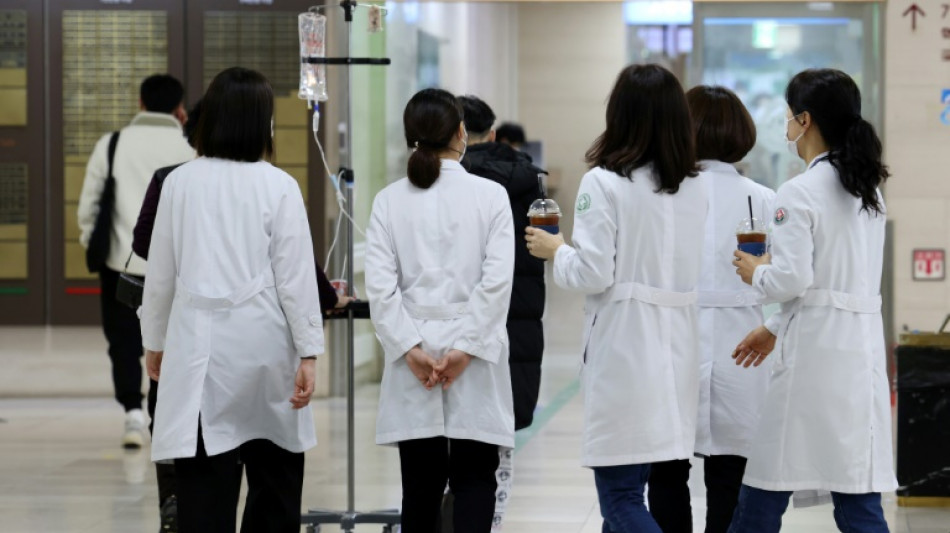
Operations cancelled as South Korea doctors' strike grows / Photo: © YNA/AFP

 Prague’s Concert for the Future Kicks Off on Wenceslas Square

 Prince William and Princess of Wales to Announce Earthshot Prize Winners in Mumbai

 Indonesia Forest Fires: Health Crisis, Diplomatic Strains and the Search for Solutions

 BYD Dolphin G Leasing Deal: Plug-in Hybrid Supermini Available from £174 a Month

 JUEL Group Expands from Real Estate to Hospitality with Hyatt Centric Malta Opening

 French Economy Shrinks 0.1% as Consumer Confidence Slumps

 Wall Street Ends Turbulent Week Higher Despite Inflation and AI Jitters

 Kansas City Fed Chief Says Inflation Is Still Running Too Hot

Pregnant women had C-sections cancelled and cancer treatments were postponed Wednesday as the number of South Korean trainee doctors to walk off the job over proposed reforms swelled, officials and local reports said.
More than 8,800 junior doctors -- 71 percent of the trainee workforce -- have now quit, said Seoul's Second Vice Health Minister Park Min-soo, part of a spiralling protest against government plans to sharply increase medical school admissions.
Seoul says the reforms are essential, citing the country's low doctor numbers and rapidly ageing population, but doctors claim the changes will hurt service provision and education quality.
Critics say doctors are mainly concerned the reform could erode their salaries and social prestige, and the plan enjoys broad public support among South Koreans, many of whom are fed up with long wait times for many medical services.
Park said Wednesday that 7,813 trainee doctors had not shown up for work -- an almost five-fold increase from the first day of the action Monday -- despite the government ordering many of them to return to their hospitals.
"The basic calling of medical professionals is to protect the health and lives of the people, and any group action that threatens this cannot be justified," Park said.
The doctors' walkout was a violation of South Korean law, as medical workers cannot refuse so-called return to work orders "without justifiable grounds", he said.
South Korea's general hospitals rely heavily on trainees for emergency operations and surgeries, and local reports said cancer patients and expectant mothers needing C-sections had seen procedures cancelled or delayed, with scores of cases causing "damage", Park said.
"My surgery was canceled on the day of admission due to the doctors' strike, and I'm still dumbfounded," wrote @August_holiday on social media platform X.
Another user on South Korea's Naver web portal said her mother's long-awaited cerebral aneurysm surgery had been abruptly delayed.
"I'm furious that (the doctors) can act so irresponsibly," user @488653 wrote.
Junior doctors claim the new medical education reforms are the final straw for many workers in a profession already struggling with tough working conditions, such as in emergency rooms.
"Despite working more than 80 hours a week and receiving compensation at minimum wage level, trainee doctors have been neglected by the government until now," the Korea Interns and Residents Association said in a statement.
The over-reliance on trainee doctors in the current healthcare system was not reasonable or fair, they added.
Nurses, who have been left in charge during the strike, urged doctors to return to work, even as they sympathised with their fight against the reform.
"Do not ignore your conscience toward the patients being left behind," the Korean Young Nurses Association wrote in a social media post.
N.Fournier--BTB