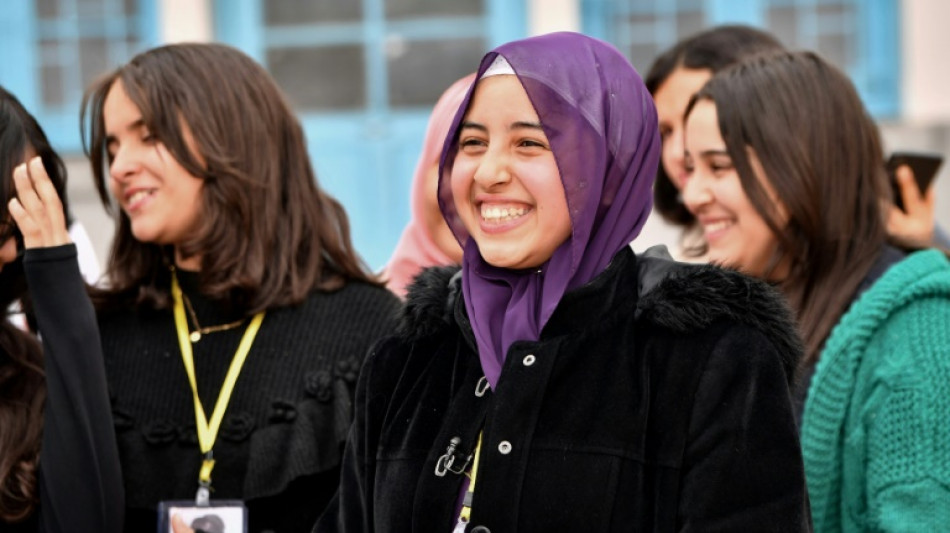
Music beats the blues in Tunisian youth project / Photo: © AFP

 Prague’s Concert for the Future Kicks Off on Wenceslas Square

 Prince William and Princess of Wales to Announce Earthshot Prize Winners in Mumbai

 Indonesia Forest Fires: Health Crisis, Diplomatic Strains and the Search for Solutions

 BYD Dolphin G Leasing Deal: Plug-in Hybrid Supermini Available from £174 a Month

 JUEL Group Expands from Real Estate to Hospitality with Hyatt Centric Malta Opening

 French Economy Shrinks 0.1% as Consumer Confidence Slumps

 Wall Street Ends Turbulent Week Higher Despite Inflation and AI Jitters

 Kansas City Fed Chief Says Inflation Is Still Running Too Hot

The Tunisian town of Haffouz lies in an impoverished region known for high rates of joblessness and suicide, but every Friday traditional music and techno beats lift spirits in a dilapidated classroom.
Local children and teenagers come together in the afternoon to compose and rehearse music for a creative break from their bleak surroundings in the dust bowl of central Tunisia.
"It's a place of escape and to free yourself from the stress of school, to compose songs, organise outings, take part in events," said the club's elected leader, Eya Makhloufi, 16, who plays the electric organ.
The after-school music club project is called Tunisia 88 -- a reference to the number of keys on a piano -- and aims to get youngsters to develop their creative and leadership skills.
It has engaged 5,000 to 10,000 youths a year across Tunisia's almost 600 schools since it was founded in 2017 by US concert pianist Kimball Gallagher and Tunisian entrepreneur Radhi Meddeb.
Local clubs put on concerts and compete nationwide for the best song and best event, all entirely organised by the students.
"They do everything on their own," even looking for sponsors, said Rabaa Mwelhi, coordinator of Tunisia 88 clubs.
The goal, she said, "is not really music itself but that they work as a team, learn to manage everyday stress, and work within a limited deadline".
Gallagher, 43, said the clubs cater to young musicians but also those interested in graphic design, videography and public communication with venues and art centres.
Each club, he said, "is a protected space where young people can express themselves, make their voices heard and convey very interesting messages: extreme emotions, the fulfilment of women, the state of the country, their dreams, the environment".
"For us, a student is not an empty glass to be filled, but a seed that we plant and which will grow if we offer the right conditions," added Gallagher, whose project provides instruments, teachers and training in musical creativity and leadership skills.
- Fighting despair -
Tunisia 88 has won praise for helping youths in the north African country that has been hit hard by political and economic crises and become a transit hub on the irregular migrant route to Europe.
More than 40 percent of people between 16 and 25 are unemployed and 100,000 students abandon their studies each year, in a country long hailed for its education system.
Climate change has been blamed for exacerbating years of withering drought that has devastated farmlands around Haffouz, a town of 8,000 people located a two-hour drive from the nearest major city.
The wider Kairouan region tops national rankings in unemployment, illiteracy and suicides.
Kairouan recorded 26 out of Tunisia's 147 documented suicides and attempted suicides last year, says non-government group FTDES.
"We went from isolated cases to a terrifying phenomenon which mostly affects young people between the ages of 16 and 35," the group's Rihab Mabrouki told AFP.
She blamed unemployment, poor development levels and "a lack of cultural spaces, which increases a feeling of frustration and stagnation among young people".
Eya and her 15 fellow club members have produced a song and video clip in praise of Kairouan, the region's ancient city with spiritual importance to many Muslims, expressing hope it will soon recover.
The 16-year-old also said the music project has been key to helping lift the spirits of local youths.
"Young people are stuck at home doing nothing, which can lead to psychological disorders, problems with family and friends, harassment at school and humiliations," she said.
"These things can lead to suicide."
As the youngsters rehearsed, Eya's parents had come to watch, clapping and cheering them on.
Her father, Mehrez, 52, a high school teacher, said in the years since the club was set up, "many students have come out of their isolation and begun to believe in their abilities".
Mwelhi said some parents in the conservative rural region can be reluctant to let their children join, but that most are won over once they see their children "taking more initiative, becoming more responsible".
J.Bergmann--BTB