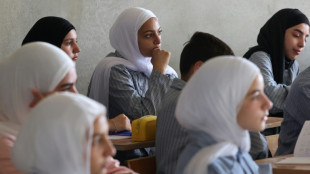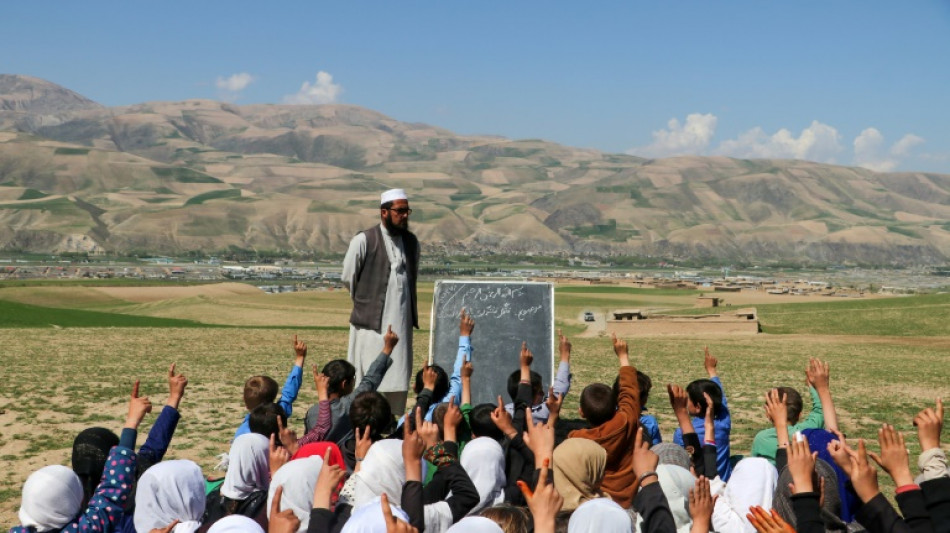
Afghan girls and women cling to glitchy, lonesome online learning / Photo: © AFP/File

 Spain brush aside Croatia in Nations League, England down Czechs

 Trump hails 'morally binding' AI self-regulation pledge

 Yamal inspires Spain to Croatia romp on World Cup homecoming

 UN to hold fourth informal poll of secretary-general candidates
 Who are the Emiratis behind crisis-hit Manchester City?

 Singer Angelique Kidjo urges Africans to 'create together'

 Alleged Rihanna mansion shooter mentally fit for trial, says judge
 Mystery over UK airbase scare as police find petrol not explosives

 OpenAI unveils low-cost AI model, a day after shelving Astra upgrade

 Premier League confirms Man City guilty of serious financial breaches
 Brazil's Lula turns to Bad Bunny tune to criticise Trump ahead of polls

 Nigerian dancer eyes world record after seven-day marathon

 Swiss regulator concludes Julius Baer bank probe

 Brazil's patron saint pulled into latest election scrap

 Football overload leaves players near 'breaking point', warns Tebas
 Paris Eiffel Tower says chief to step down after uproar over removing women staff

 Amaze Holdings (NYSE: AMZE) Executes Binding LOI to Acquire BullionFX | Alchemy, a Decentralized Gold-Backed Financial Ecosystem for Valued at US$155 Million
 Clashes between French teens, police as school blockades intensify

 Stocks move sideways despite oil moving lower

 African leaders to gather in Egypt for business summit
 UK decides against charging foreign visitors for museums

 Dallaglio to sell England World Cup winners' medal

 Brazil come from behind to beat Australia 4-2 in friendly

 Ruthless An retains Asian Games badminton crown as Kunlavut triumphs

 Alonso to stay with F1 team Aston Martin in 2027
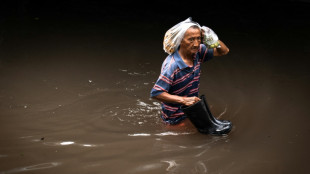
Sequestered at home in a remote Afghan town, 18-year-old Shekiba often roams the house hunting for the patchy internet signal that is her last link to an education.
Shekiba has turned to online learning since the Taliban returned to power in 2021 and shut her out of classrooms, signing up for live economics lectures she squints at on a pocket-sized phone screen.
She hopes to save for a laptop but is forced to buy expensive mobile data packages that still don't guarantee a signal in the town of Ishkashim perched high in mountainous Badakhshan province.
"If there were no internet issues, it would be much easier," she told AFP by phone. "But it's better to carry on, instead of sitting and doing nothing."
"I just hope to study, to succeed, to progress. If one person progresses in a family, the whole family progresses, as well as the whole society."
Boys and men returned to classes with the start of the Afghan new year, but girls and women will be left behind again by a Taliban government education blockade that is part of a raft of restrictions the United Nations has labelled "gender apartheid".
While online alternatives have sprung up, a dearth of computers and internet, as well as the isolation of learning via screen, makes them a poor substitute for in-person learning, students and teachers say.
Many of those alternatives also cannot provide diplomas, which offer a promise that qualifications will be acknowledged.
- 'No perspective of future' -
It's unclear exactly how many girls and women are involved in online learning, but two higher education platforms report Afghans registering or applying in the tens of thousands since the Taliban takeover.
Begum Academy, an online platform with some 8,500 free videos in Dari and Pashto covering the Afghan secondary school curriculum, launched in December 2023 and quickly had more than 3,000 users.
Director Hamida Aman said parents are grateful but it's hard for girls to stay driven.
"It's difficult to get motivated when everything is closed to you and there's no perspective of future," she told AFP from France, where she is based.
"These girls cannot have certificates, or they cannot have the ambition to go to the university or to have any job later."
Education for girls and women was a key aim of the US-backed government but gains were largely limited to cities, with only 23 percent of girls aged 13 to 18 in school nationwide, according to the International Crisis Group.
The think tank said that figure dropped to 13 percent after the Taliban government issued its edicts barring female education in 2022.
Zainab was soon to start high school when it came into effect and was twice rebuffed by an online school that was at capacity before she finally secured a place.
"Before taking online classes, we were idle at home. We were worried. We used to sleep most of the time, which made us depressed," said Zainab, who asked not to use her full name for fear of reprisal.
Online classes "keep us busy", she told AFP, but they "cannot replace schools".
Twenty-two-year-old Ruhila teaches English classes online while trying to continue her university education, also virtually, and says the teaching helps her spirits.
"The only thing that gives me energy in the current situation is teaching these girls," she said.
"But when you accept that it's going to be online forever then you lose enthusiasm and you don't put in the same effort," she said. "Mentally, online classes are very tough. They are stressful, and boring."
Taliban authorities have insisted since girls were barred from secondary school that they are working on establishing a system that aligns with their interpretation of Islamic law.
- Poor internet, few computers -
Widespread virtual schooling during the Covid-19 pandemic demonstrated it was "at best, a rather partial substitute for in-person instruction", a UNESCO report found.
Afghan students face the burden of trying to log on in a country where the internet is often down -- or painfully slow -- and where electricity outages are common.
Less than a quarter of the population uses the internet, according to online insights company DataReportal. With stark poverty rates in Afghanistan, computers are also a luxury many cannot afford.
Some 90 percent of Begum Academy students use their phones to learn, according to Aman.
But even more than those frustrations, 18-year-old Aisha misses the social aspect of school.
"Online classes cannot be as effective as physical classes where we meet our peers and our teachers and exchange our ideas," she said.
"Online courses can only give us a hope," she added. "But we can never say, 'I have studied online so I have graduated from school.'"
O.Krause--BTB