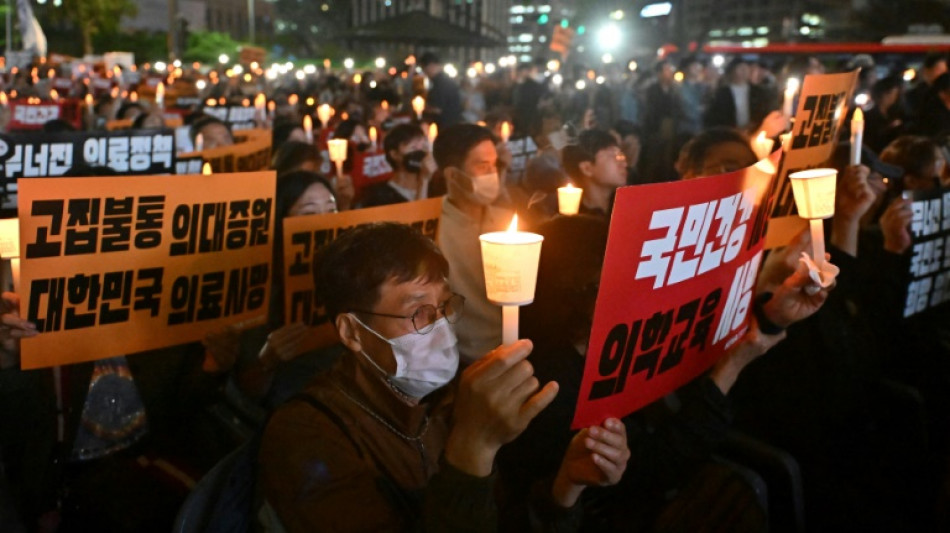
S. Korea's Supreme Court dismisses doctors' bid to halt reforms / Photo: © AFP

 Prague’s Concert for the Future Kicks Off on Wenceslas Square

 Prince William and Princess of Wales to Announce Earthshot Prize Winners in Mumbai

 Indonesia Forest Fires: Health Crisis, Diplomatic Strains and the Search for Solutions

 BYD Dolphin G Leasing Deal: Plug-in Hybrid Supermini Available from £174 a Month

 JUEL Group Expands from Real Estate to Hospitality with Hyatt Centric Malta Opening

 French Economy Shrinks 0.1% as Consumer Confidence Slumps

 Wall Street Ends Turbulent Week Higher Despite Inflation and AI Jitters

 Kansas City Fed Chief Says Inflation Is Still Running Too Hot

South Korea's highest court rejected on Wednesday a request by medical students and doctors to halt a government plan to train more physicians, while senior medics have joined a months-long strike.
Thousands of trainee doctors stopped working on February 20, protesting against government plans to increase medical school quotas.
The ongoing strike has caused disruptions in hospitals and forced delays or cancellations of key treatments, including chemotherapy.
Last month, the government finalised an admission quota hike of around 1,500 for medical schools for 2025, which it says will tackle shortages of doctors and a rapidly ageing population.
Senior doctors at the country's key medical institution, the Seoul National University Hospital, as well as its branches, began an indefinite walkout on Monday in response to the plan.
A lower court ruled in favour of the government in May, and the Supreme Court upheld that decision and dismissed the doctors' and students' request on Wednesday.
If the reform is "halted in a situation where there is a forecast of a shortage of doctors in the future", it may cause "significant disruption to the increase in medical school quotas, which plays a crucial role in public health", the Supreme Court said.
The court's ruling, however, is unlikely to bring doctors back to work.
Lawyer Lee Byung-cheol, who represents the doctors and students, told AFP that the court's decision was "very unfortunate and regrettable".
He said he will focus on other legal cases that have been initiated by the medical community against the reform.
The government welcomed the decision and urged doctors to accept the changes in medical training and return to their patients.
The reform plan is broadly popular with the public, and proponents of it say doctors are simply trying to safeguard their salaries and social status.
The medical community says the reform, once implemented, will diminish the quality of education and healthcare, and that it should be abandoned entirely.
Patients suffering from severe illnesses have said they are the biggest victims of the situation.
According to a recent survey of 281 cancer patients, 67 percent said they have been denied care by medical facilities, while 51 percent said their treatment has been delayed due to the strike.
"As of yesterday, it has been about 120 days. We are now entering the fifth month of this situation," Kim Sung-ju, the head of the Korean Cancer Patients Rights Council, told AFP.
"We know that this Supreme Court ruling cannot be the driving force to bring the doctors back, and we are in great pain."
C.Meier--BTB