Phone bans sweep US schools despite skepticism / Photo: © AFP

 UN to hold fourth informal poll of secretary-general candidates

 Who are the Emiratis behind crisis-hit Manchester City?

 Singer Angelique Kidjo urges Africans to 'create together'

 Alleged Rihanna mansion shooter mentally fit for trial, says judge
 Mystery over UK airbase scare as police find petrol not explosives

 OpenAI unveils low-cost AI model, a day after shelving Astra upgrade
 Premier League confirms Man City guilty of serious financial breaches

 Brazil's Lula turns to Bad Bunny tune to criticise Trump ahead of polls

 Nigerian dancer eyes world record after seven-day marathon

 Swiss regulator concludes Julius Baer bank probe

 Brazil's patron saint pulled into latest election scrap

 Football overload leaves players near 'breaking point', warns Tebas

 Paris Eiffel Tower says chief to step down after uproar over removing women staff

 Amaze Holdings (NYSE: AMZE) Executes Binding LOI to Acquire BullionFX | Alchemy, a Decentralized Gold-Backed Financial Ecosystem for Valued at US$155 Million

 Clashes between French teens, police as school blockades intensify

 Stocks move sideways despite oil moving lower

 African leaders to gather in Egypt for business summit

 UK decides against charging foreign visitors for museums

 Dallaglio to sell England World Cup winners' medal

 Brazil come from behind to beat Australia 4-2 in friendly

 Ruthless An retains Asian Games badminton crown as Kunlavut triumphs

 Alonso to stay with F1 team Aston Martin in 2027

 China badminton 'still strong' despite Asian Games slump

 'Exceptional' Turner painting shown in Rome before sale
 European stocks climb as oil dips

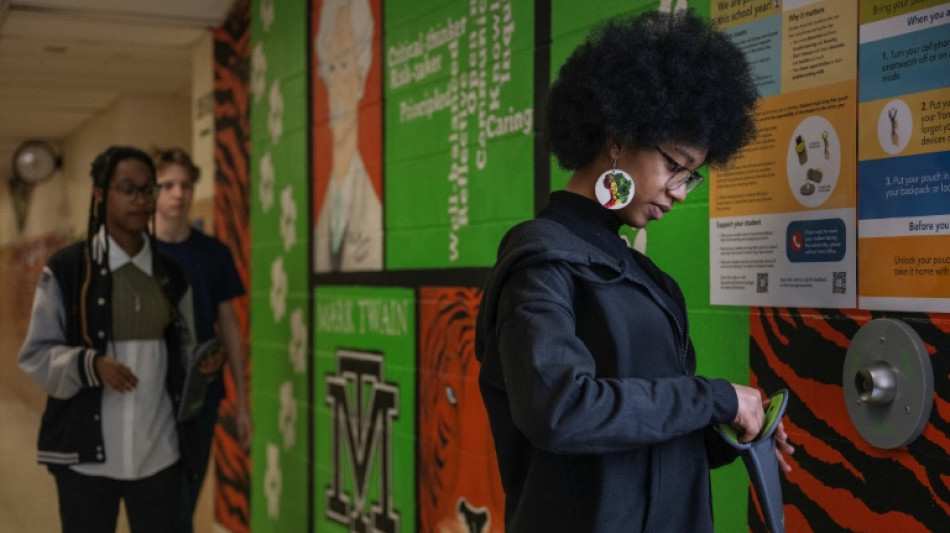
At a red-brick school in Virginia, Hayden Jones is one of 1,000 students banned from using their phones as part of a trial hoping to boost learning.
But the 12-year-old's verdict on the restrictions -- a shrug of his shoulders -- reflects the skepticism shared by some students and parents.
The phone ban at Twain Middle School is among a wave of measures implemented around the United States, and is part of a global movement replicated in Brazil, France and beyond.
Supporters believe restrictions will guard pupils from the apparent harms of smartphone use while at school, but opponents say the measures fail to prepare teenagers for the digital world they will inevitably enter.
Since September, Jones must now place his Android phone in a magnetic pouch each morning, which is locked until the end of the school day as part of a pilot scheme this academic year.
Jones, speaking to AFP in a corridor lined with classrooms, said he hopes the ban will be gone by the time he starts eighth grade in September.
"I like being able to go to my locker and call my parents. That's a big concern for me," he said, adding that some pupils have found ways to still use their devices -- including by bringing a "dummy phone" to put in the pouch.
School principal Matthew Mough admitted that enforcing the ban -- and winning over students -- has proved challenging, though he said most follow the rules.
"The majority of kids who have phones don't love it," he said. "However, if you dig deeper with them in the conversation, they will acknowledge that it's helped them remain focused."
Mough said the phone ban has reduced classroom distractions, cyberbullying and instances of students meeting up to skip lessons.
- 'Heads in the sand' -
Cell phone bans come alongside research suggesting that social media use increases the likelihood of mental illnesses like anxiety and depression in young people.
Advocacy groups regularly cite these studies as justification for school phone bans, which have seen rare political consensus in a nation deeply divided on virtually every other political issue.
Around 76 percent of US public schools -- from liberal California to conservative Florida -- had some sort of ban on non-academic phone use, according to the latest Department of Education figures, with several state-wide measures also in place or under consideration.
They are largely backed by teachers, with the National Education Association saying 90 percent of its members support policies banning phones during lessons.
"The biggest problem is that kids aren't in a place developmentally where they're able to handle the type of technology that we're talking about," said Sabine Polak, co-founder of the Phone-Free Schools Movement, which backs full-scale phone bans.
Critics of the restrictions argue that educating children about the potential risks of social media and smartphone use is better than prohibition.
"The answer is not to just ban and put our heads in the sand," said Keri Rodrigues, president of the National Parents Union, which represents over 1,000 parent organizations in the United States.
She compared efforts to ban phones to "abstinence education," noting that failing to properly teach children about complicated issues such as sex has failed in the past.
"It's not effective, and frankly, it's dumb," Rodrigues told AFP. "What we need to do is equip our kids with the information, with the skills and the strategies they're going to need to navigate a digital future."
At the school in Virginia, Jones said the phone ban has not changed how he interacts with his device, still using it for games, social media and watching YouTube videos.
His one complaint about his phone? "Nothing really, honestly, I mean besides the fact that it weighs a ton in my pocket."
E.Schubert--BTB