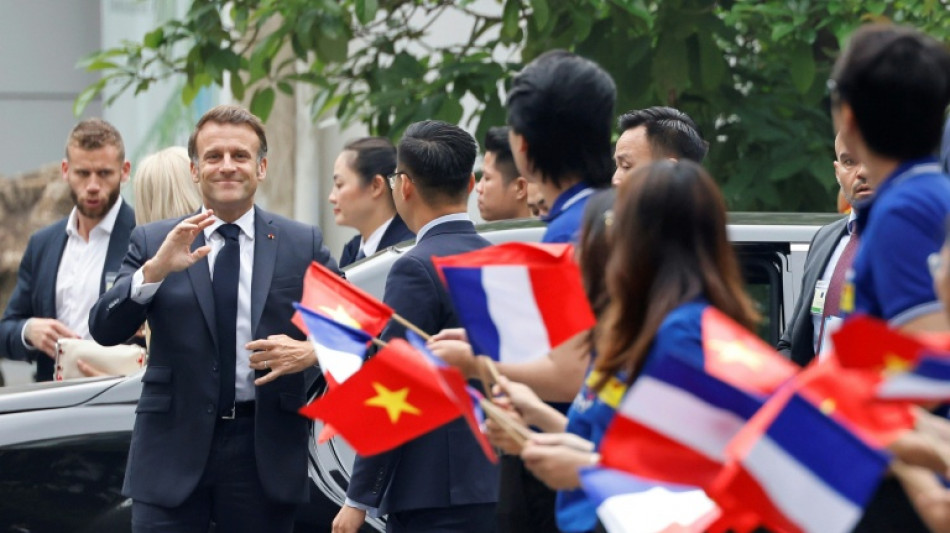
Macron gives Vietnamese students a lesson in 'impulsive' superpowers / Photo: © AFP

 Prague’s Concert for the Future Kicks Off on Wenceslas Square

 Prince William and Princess of Wales to Announce Earthshot Prize Winners in Mumbai

 Indonesia Forest Fires: Health Crisis, Diplomatic Strains and the Search for Solutions

 BYD Dolphin G Leasing Deal: Plug-in Hybrid Supermini Available from £174 a Month

 JUEL Group Expands from Real Estate to Hospitality with Hyatt Centric Malta Opening

 French Economy Shrinks 0.1% as Consumer Confidence Slumps

 Wall Street Ends Turbulent Week Higher Despite Inflation and AI Jitters

 Kansas City Fed Chief Says Inflation Is Still Running Too Hot

Between jabs at Donald Trump's US trade tariffs and criticism of Beijing's assertiveness in the South China Sea, French President Emmanuel Macron warned Vietnamese students Tuesday that "on the impulse of a superpower, everything can change".
Macron is in Vietnam as part of a six-day Southeast Asian tour that includes Indonesia and Singapore, as he tries to pitch his offer of a "third way" between the United States and China to a region caught up in a confrontation between the two.
"The conflict between China and the United States of America is a geopolitical fact that casts the shadow of risk of a much larger conflict in this important region," he told a group of around 150 students at the University of Science and Technology in Hanoi, listening through translation headsets.
China would do well to remember that "freedom of navigation, maritime freedom is important for the South China Sea", he said, adding that what is happening there "worries everyone".
Macron quickly moved on to a swipe at the United States, which he described as "imposing tariffs according to the side of the bed on which he woke up", before presenting France as a reliable alternative.
His address comes a day after he visited a Hanoi war memorial to those who fought against French colonial occupation, which ended in 1954 following a bloody uprising by Vietnamese pro-independence forces.
Vietnam has been careful to follow a balancing act between China and the United States.
It shares concerns about Beijing's increasing assertiveness in the contested waterway, but it has close economic ties with its giant neighbour.
Communist-run Vietnam has also been threatened with a hefty 46 percent tariff by US President Donald Trump as part of his global trade blitz.
France's "Indo-Pacific strategy" could offer a "path of freedom" and "sovereignty", Macron told the students.
More than 100 other students who were unable to fit into the university hall where he spoke tuned in via video link from a side room, often clapping as he spoke.
Some seemed convinced, seeing an opportunity in France to avoid the chaos that many international students in the United States are enduring after Trump attempted to block Harvard University from enrolling foreigners.
"Given the context in the US where visa issues for international students are quite risky, I will prioritise studying in France because it is more stable," 21-year-old Nguyen Quang Bach told AFP.
Nguyen Thi Thuy Linh, 21, who chatted to Macron ahead of the speech, called the president "friendly and approachable".
During the speech, Macron also urged the students, a few of whom spoke French, not to fall into the "world of fools" that prevails on social media, where people are free to criticise with short messages "those whose thoughts you do not understand".
"I do not believe all words are equal. I think there are people who know (things) and people who know less," he said.
D.Schneider--BTB