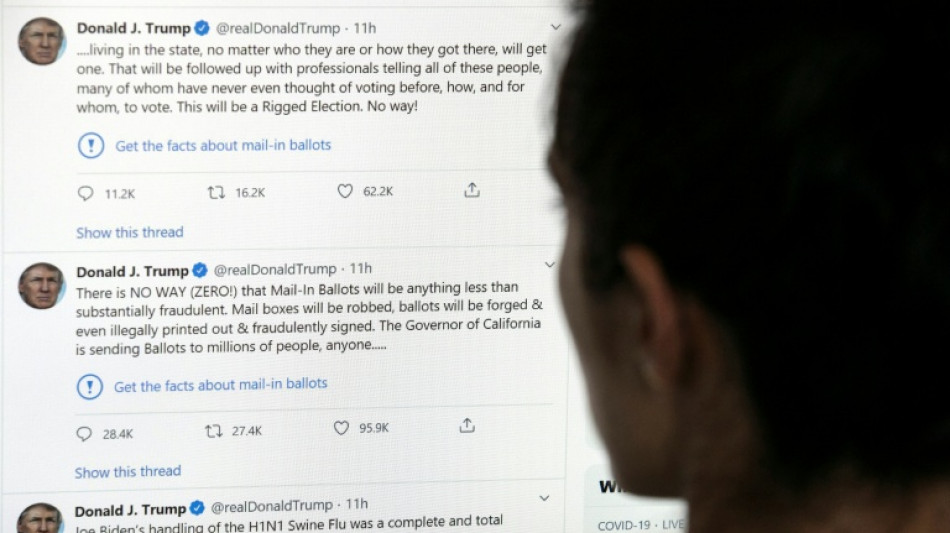
US to screen social media of foreign students for anti-American content / Photo: © AFP/File

 Prague’s Concert for the Future Kicks Off on Wenceslas Square

 Prince William and Princess of Wales to Announce Earthshot Prize Winners in Mumbai

 Indonesia Forest Fires: Health Crisis, Diplomatic Strains and the Search for Solutions

 BYD Dolphin G Leasing Deal: Plug-in Hybrid Supermini Available from £174 a Month

 JUEL Group Expands from Real Estate to Hospitality with Hyatt Centric Malta Opening

 French Economy Shrinks 0.1% as Consumer Confidence Slumps

 Wall Street Ends Turbulent Week Higher Despite Inflation and AI Jitters

 Kansas City Fed Chief Says Inflation Is Still Running Too Hot

Foreigners seeking to study in the United States will be required to make public their social media profiles to allow screening for anti-American content under new State Department guidelines released Wednesday.
The State Department had temporarily paused issuing visas for foreign students at the end of May while it came up with the new social media guidance and it will now resume taking appointments.
"The enhanced social media vetting will ensure we are properly screening every single person attempting to visit our country," a senior State Department official said.
US consular officers will conduct a conduct a "comprehensive and thorough vetting of all student and exchange visitor applicants," the official said.
To facilitate the screening, student visa applicants will be asked to adjust the privacy settings on all their social media profiles to "public," the official said.
In an executive order on his first day as president, Donald Trump called for increased vetting of persons entering the United States to ensure they "do not bear hostile attitudes toward its citizens, culture, government, institutions, or founding principles."
Student visas are one of a series of battles waged over higher education by the Trump administration, which has rescinded thousands of visas and sought to ban Harvard University from accepting international students.
Secretary of State Marco Rubio has revoked visas in large part of students who led demonstrations critical of Israel's offensive in Gaza, as he uses an obscure law that allows the removal of people deemed to go against US foreign policy interests.
In April, the Department of Homeland Security said the social media of foreign student applicants would be examined for "antisemitic activity" that could result in visa denial.
The US government has been vetting the social media of persons seeking to immigrate to the United States or obtain a green card for more than a decade.
L.Janezki--BTB