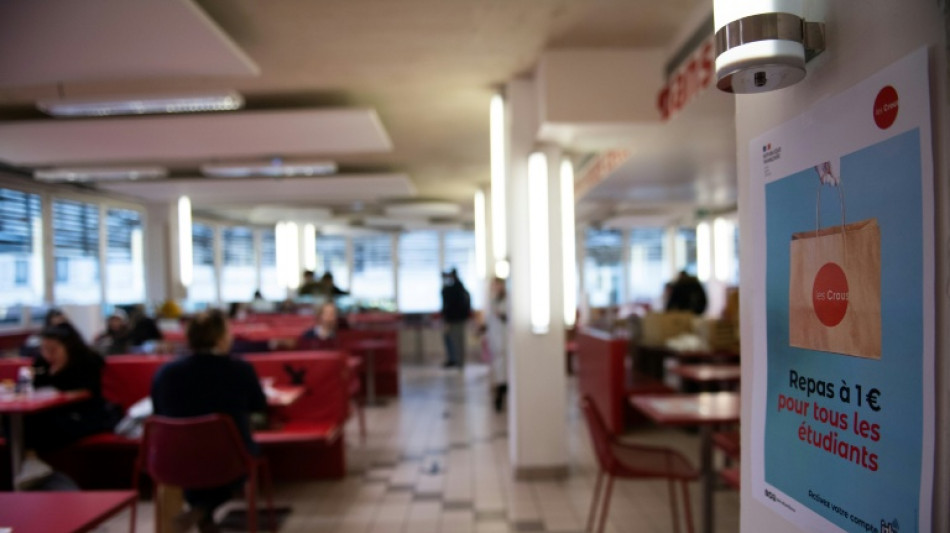
France launches one-euro university meals for all students / Photo: © AFP/File

 UN to hold fourth informal poll of secretary-general candidates

 Who are the Emiratis behind crisis-hit Manchester City?
 Singer Angelique Kidjo urges Africans to 'create together'
 Alleged Rihanna mansion shooter mentally fit for trial, says judge

 Mystery over UK airbase scare as police find petrol not explosives

 OpenAI unveils low-cost AI model, a day after shelving Astra upgrade
 Premier League confirms Man City guilty of serious financial breaches

 Brazil's Lula turns to Bad Bunny tune to criticise Trump ahead of polls
 Nigerian dancer eyes world record after seven-day marathon
 Swiss regulator concludes Julius Baer bank probe

 Brazil's patron saint pulled into latest election scrap

 Football overload leaves players near 'breaking point', warns Tebas

 Paris Eiffel Tower says chief to step down after uproar over removing women staff
 Amaze Holdings (NYSE: AMZE) Executes Binding LOI to Acquire BullionFX | Alchemy, a Decentralized Gold-Backed Financial Ecosystem for Valued at US$155 Million
 Clashes between French teens, police as school blockades intensify

 Stocks move sideways despite oil moving lower

 African leaders to gather in Egypt for business summit

 UK decides against charging foreign visitors for museums

 Dallaglio to sell England World Cup winners' medal

 Brazil come from behind to beat Australia 4-2 in friendly

 Ruthless An retains Asian Games badminton crown as Kunlavut triumphs

 Alonso to stay with F1 team Aston Martin in 2027

 China badminton 'still strong' despite Asian Games slump
 'Exceptional' Turner painting shown in Rome before sale

 European stocks climb as oil dips

French university canteens began offering one-euro meals to all students regardless of income on Monday, in a measure designed to address financial hardship.
The move follows a push by student unions to extend the one-euro rate ($1.17) for a three-course meal to all students, down from the usual 3.30 euros.
The price, which covers a starter, main course and dessert, was previously only available to those with low incomes or receiving financial aid.
For Alexandre Ioannides, an 18-year-old student in Paris, the measure will slash his monthly canteen expenses.
"I come here 20 times a month. That's about 60 euros. Whereas now, I'll pay 20 euros," he said, adding the savings would go towards "going out or eating at a restaurant".
The policy aims to alleviate financial strain for students in France, where a January survey by a student union organisation found 48 percent have gone without food for financial reasons and 23 percent do so several times a month.
Around 667,000 students benefited from the one-euro lunch scheme in 2024, a 5.3-percent increase from the previous year, with around 46.7 million meals served at both the discounted and standard 3.30-euro rates, according to university restaurant operator Crous.
Authorities are preparing for a rise in demand, with Higher Education Minister Philippe Batiste promising 120 million euros in 2027 to back the scheme.
"It is a small internal revolution," said Batiste, who pledged to oversee the programme to ensure it does not lead to an excessive workload for canteen staff or a decline in food quality.
N.Fournier--BTB