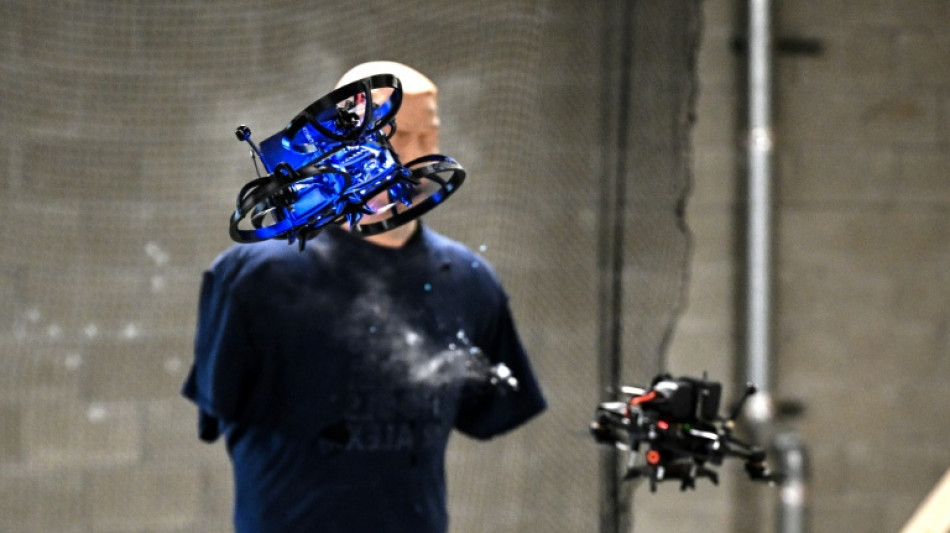
Drones to fight school shooters? One US company says yes / Photo: © AFP

 Prague’s Concert for the Future Kicks Off on Wenceslas Square

 Prince William and Princess of Wales to Announce Earthshot Prize Winners in Mumbai

 Indonesia Forest Fires: Health Crisis, Diplomatic Strains and the Search for Solutions

 BYD Dolphin G Leasing Deal: Plug-in Hybrid Supermini Available from £174 a Month

 JUEL Group Expands from Real Estate to Hospitality with Hyatt Centric Malta Opening

 French Economy Shrinks 0.1% as Consumer Confidence Slumps

 Wall Street Ends Turbulent Week Higher Despite Inflation and AI Jitters

 Kansas City Fed Chief Says Inflation Is Still Running Too Hot

A new idea for combatting America's horrific problem of school shootings is to unleash an unarmed drone to confront the attacker, like a giant buzzing insect.
It is the brainchild of a company called Campus Guardian Angel, which has pilot programs using the technology in Georgia and Florida, with growing interest in Texas. These drones have not yet been battle-tested, however.
The approach seems to reflect that part of America which says the way to address recurrent school shootings -- part of the country's broader gun violence epidemic -- is not with stricter gun control laws but rather with weaponry, such as giving teachers guns.
The company says the new approach would work like this: when a potential shooter enters a school, a teacher hits an alarm on their cell phone to alert the police and as officers rush to the scene, a drone is activated from a pre-established position inside the school as a first line of defense.
These small, black, roughly square drones weighing about two pounds (one kilo) are piloted by humans in the Texas state capital Austin and can actually buzz around inside the school by navigating 3D maps that Campus Guardian Angel will have made beforehand.
The drones do not shoot bullets or any other kind of projectile.
Rather, they are designed to disable the attacker by flying right into him or her or spraying them with pepper gel.
Khristof Oborski, Campus Guardian Angel's director of tactical operations, said the firm's CEO Bill King observed that small drones were highly effective in attacks on the battlefield in the war in Ukraine.
"So he started thinking about how can you introduce this type of system to be able to combat a growing problem in the United States, with school shootings," Oborski said.
Oborski explained that what the drone actually does depends on what the shooter or potential shooter does.
If a child with a gun is walking in a school corridor, the drone has two-way radio so human operators can talk to the attacker and try to persuade him or her to put down the weapon, Oborski said.
The operators are in constant contact with police so officers can, say, be guided to where the attacker is.
If the assailant is actually shooting people, "we go straight to either kinetic impacts or we use our less lethal JPX pepper gel on the suspect," Oborski said.
In 2025, US schools endured 233 incidents involving firearms, according to a data base called IntelliSee.
One of the worst recent school shootings was in Uvalde, Texas in 2022, with 19 children and two teachers shot and killed. It took police 77 minutes to move in close enough to kill the attacker.
- 'To be the nerd' -
Campus Guardian Angel offers its services with yearly contracts, the fee depending on the size of the school and how many buildings it has.
Besides the pilot programs in Florida and Georgia, the company says some parents in Houston are interested in getting the drones set up in their kids' schools.
"The best-case scenario is we put this in every single school in America and then never have to use it, right? Because it's got a deterrent quality to it," said King, a former Navy SEAL.
He said he is often asked if the drones are operated by artificial intelligence and the answer is no, which King said people find reassuring.
Alex Campbell, a 30-year-old operator in this system and professional drone-racing competitor, describes himself as more of a nerd than a soldier.
"To be the nerd behind the scenes, to help the heroes on this Earth saving us from the bad things happening, it's really fulfilling to be able to have a hand in that," Campbell said.
L.Dubois--BTB