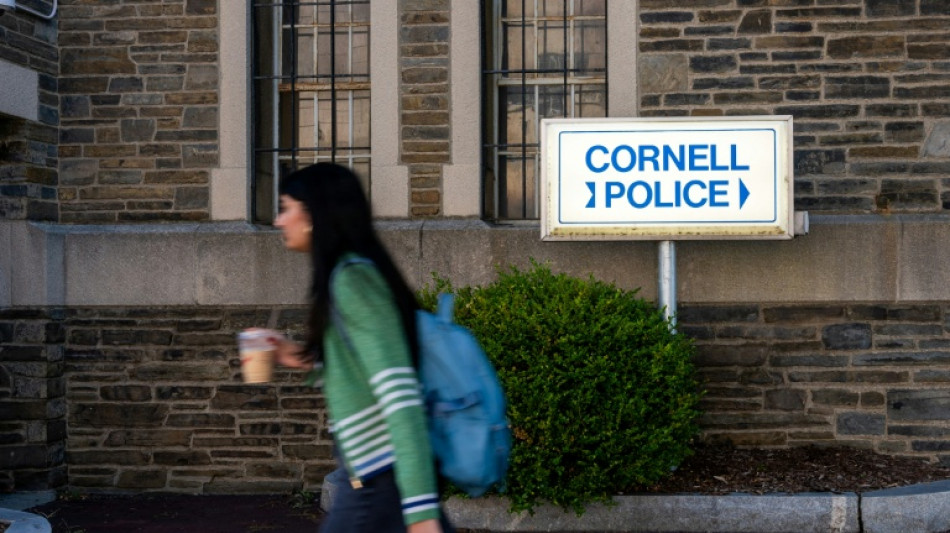
Cornell rape case exposes sexual violence at US colleges / Photo: © GETTY IMAGES NORTH AMERICA/AFP

 Prague’s Concert for the Future Kicks Off on Wenceslas Square

 Prince William and Princess of Wales to Announce Earthshot Prize Winners in Mumbai

 Indonesia Forest Fires: Health Crisis, Diplomatic Strains and the Search for Solutions

 BYD Dolphin G Leasing Deal: Plug-in Hybrid Supermini Available from £174 a Month

 JUEL Group Expands from Real Estate to Hospitality with Hyatt Centric Malta Opening

 French Economy Shrinks 0.1% as Consumer Confidence Slumps

 Wall Street Ends Turbulent Week Higher Despite Inflation and AI Jitters

 Kansas City Fed Chief Says Inflation Is Still Running Too Hot

An alleged gang rape at Cornell University, detailed in a graphic lawsuit last month, has provoked fury in the United States over sexual violence on campuses and colleges' failure to stamp out the behavior.
The accuser has said that in 2024 she was drugged with ketamine, assaulted and raped by seven members of the Chi Phi fraternity, a social club for male students.
Her allegations fell within what activists call the "red zone," a period at the start of the academic year when a large share of assaults happen, often at parties fueled by drugs and alcohol.
An estimated one in four female students and one in 14 male students experience rape or sexual assault at some point during their undergraduate studies, according to a 2020 study by the Association of American Universities.
Mental health nonprofit the Jed Foundation has reported that men in fraternities -- which are routinely criticized for shielding sexism -- are more likely to commit sexual violence.
The accused students in the Cornell case were members of the Chi Phi fraternity, one of several "Greek life" organizations common across US colleges.
Meanwhile, the accuser was part of a sorority for female students. Sorority members are statistically more likely than their non-affiliated peers to suffer sexual assault.
- Consent -
For Jennifer Freyd, a psychology professor at the University of Oregon, the Cornell case and the Ivy League college's response are "so typical of other universities."
Following the initial allegations in 2024, Cornell closed the fraternity and temporarily suspended the students allegedly involved, several of whom were later expelled.
Meanwhile, the district attorney declined to prosecute because he said the victim's police testimony did not establish a lack of consent.
The investigation was reopened after the complainant's civil lawsuit fueled allegations that prosecutors and the elite college had failed to hold the men accountable.
Observers have noted that severe punishments like full expulsions are rare for fraternity members as they are often connected to elite networks and represent a key source of revenue for universities.
Freyd added that there should be a wider institutional approach of respecting whistleblowers when they come forward with accusations.
"That doesn't mean they believe them without investigation, but it means that they take it seriously, and that they acknowledge the bravery involved," she said.
- Sex education -
A further challenge in the Cornell case is a legal provision that makes it harder to prosecute rape cases in New York and several other US states if accusers were willingly intoxicated.
In response to growing public anger, New York Governor Kathy Hochul has vowed to work with lawmakers to close that loophole.
"Voluntary intoxication is not a license for sexual assault or gang rape. Period," Hochul said.
The Democrat has also appointed Attorney General Letitia James, who has battled with President Donald Trump, as a special prosecutor for the Cornell case.
Shiwali Patel, of the National Women's Law Center, said she backed closing the legal loophole and added that better sex education is also crucial.
"One of the most effective ways of prevention is to have comprehensive sex education that is age developmentally appropriate from a young age, that includes talking about consent," Patel said.
"But we are not seeing these changes being implemented, and so this issue is happening over and over again."
F.Müller--BTB