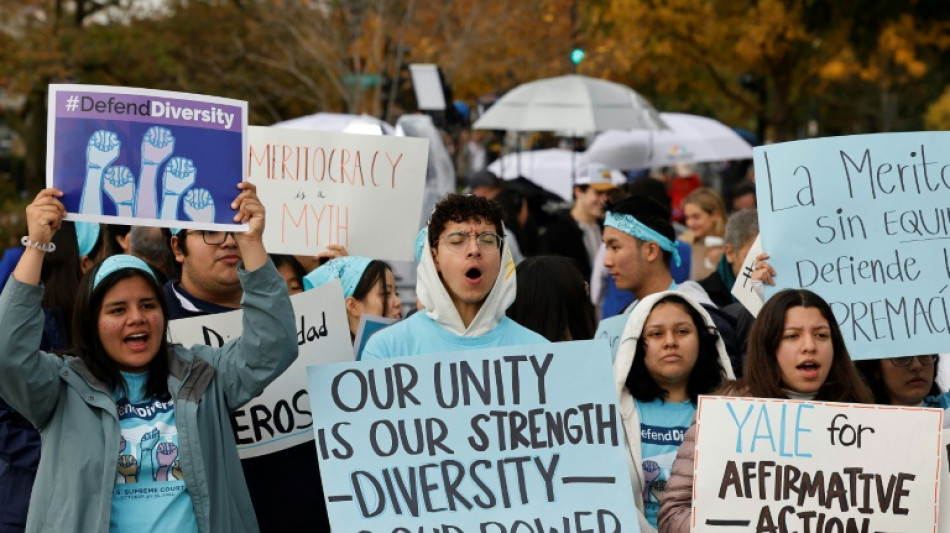
US Supreme Court's right-wing skeptical of using race in college admissions / Photo: © GETTY IMAGES/AFP

 UN to hold fourth informal poll of secretary-general candidates

 Who are the Emiratis behind crisis-hit Manchester City?

 Singer Angelique Kidjo urges Africans to 'create together'

 Alleged Rihanna mansion shooter mentally fit for trial, says judge

 Mystery over UK airbase scare as police find petrol not explosives

 OpenAI unveils low-cost AI model, a day after shelving Astra upgrade

 Premier League confirms Man City guilty of serious financial breaches

 Brazil's Lula turns to Bad Bunny tune to criticise Trump ahead of polls

 Nigerian dancer eyes world record after seven-day marathon

 Swiss regulator concludes Julius Baer bank probe

 Brazil's patron saint pulled into latest election scrap

 Football overload leaves players near 'breaking point', warns Tebas

 Paris Eiffel Tower says chief to step down after uproar over removing women staff

 Amaze Holdings (NYSE: AMZE) Executes Binding LOI to Acquire BullionFX | Alchemy, a Decentralized Gold-Backed Financial Ecosystem for Valued at US$155 Million

 Clashes between French teens, police as school blockades intensify

 Stocks move sideways despite oil moving lower

 African leaders to gather in Egypt for business summit

 UK decides against charging foreign visitors for museums

 Dallaglio to sell England World Cup winners' medal

 Brazil come from behind to beat Australia 4-2 in friendly

 Ruthless An retains Asian Games badminton crown as Kunlavut triumphs

 Alonso to stay with F1 team Aston Martin in 2027

 China badminton 'still strong' despite Asian Games slump

 'Exceptional' Turner painting shown in Rome before sale

 European stocks climb as oil dips

The conservative-majority US Supreme Court appeared poised on Monday to ban the use of race as a factor in deciding who gets into America's elite universities.
The top US court heard nearly five hours of arguments on the use of race in admissions to Harvard and the University of North Carolina (UNC) -- respectively the oldest private and public institutions of higher education in the country.
Harvard and UNC, like a number of other top US schools, consider an applicant's race as a factor in trying to ensure a diverse student body and representation of minorities, a policy known as "affirmative action."
It emerged from the Civil Rights Movement in the late 1960s to help address the legacy of discrimination in higher education against African Americans.
The suits against Harvard and UNC were brought by a group known as Students for Fair Admissions, which claims that race-conscious admissions policies discriminate against equally qualified applicants of Asian American origin.
"The racial preference is operating to the disadvantage of Asian American applicants," Patrick Strawbridge, attorney for Students for Fair Admissions, told the court.
"When you use race, you're telling applicants that their race matters," Strawbridge said, calling it "inherently divisive."
"It gets us further away from a world where the government treats race as irrelevant," he said.
Strawbridge's arguments appeared to get a sympathetic hearing from the conservative justices on the court, setting the stage for another potential historic reversal like in June, when the high court overturned its landmark 1973 "Roe v. Wade" decision guaranteeing a woman's right to abortion.
Conservatives currently enjoy a solid 6-3 majority on the Supreme Court, including three justices nominated by former president Donald Trump, a Republican.
- 'Don't have a clue what it means' -
Justice Clarence Thomas, a longtime opponent of affirmative action, said he could not think of another case "where the court deferred to the alleged discriminator."
"I've heard the word diversity quite a few times and I don't have a clue what it means," he added. "It seems to mean everything for everyone."
Conservative justices John Roberts, Brett Kavanaugh and Amy Coney Barrett repeatedly pressed the attorneys for Harvard and UNC about when there would be an "end point" to affirmative action.
"Your position is that race matters because it's necessary for diversity," Roberts said. "It's not going to stop mattering at some particular point.
"You're always going to have to look at race because you say race matters to give us the necessary diversity."
Justice Elena Kagan and the other two liberal justices on the court pushed back against the arguments put forward by Students for Fair Admissions.
"For decades, this court has rightly recognized that student body diversity is a compelling interest that can justify limited consideration of race in university admissions," Kagan said.
"That holding recognizes a simple but profound truth -- when students of all races and backgrounds come to college and live together and learn together they become better colleagues, better citizens and better leaders," she said.
"In your view, it really wouldn't matter if there was a precipitous decline in minority admissions," Kagan said to Strawbridge. "Your brief says it just doesn't matter if our institutions look like America.
"Doesn't it?" she asked.
- 'Cause racial diversity to plummet' -
The administration of Democratic President Joe Biden and dozens of major American companies have weighed in on the side of the universities.
"A blanket ban on race-conscious admissions would cause racial diversity to plummet at many of our nation's leading educational institutions," US Solicitor General Elizabeth Prelogar told the court.
Previous courts have upheld affirmative action -- in 2016 by a single vote -- but the policy has been controversial from the start, and a number of white students have mounted legal challenges over the years, claiming "reverse discrimination."
Nine states have banned affirmative action at public universities including California, where voters did so in a ballot proposition in 1996 and rebuffed an attempt to revive the policy in 2020.
In a 1978 decision -- Regents of the University of California v. Bakke -- the Supreme Court banned the use of quotas in university admissions as unconstitutional.
But the court said race or ethnic origin can be considered as one factor among others in admitting students to ensure a diverse student body and to combat previous discrimination that could have prevented marginalized students from being accepted to those schools.
Ketanji Brown Jackson, the first Black woman on the Supreme Court, sat out the Harvard case because she has served previously on the Board of Overseers at the school.
J.Bergmann--BTB