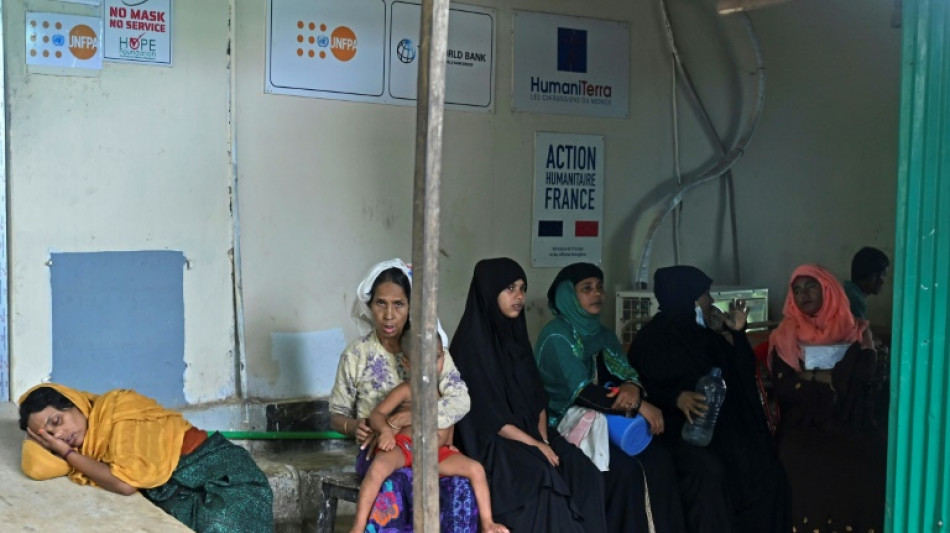
In crowded camps, Rohingya refugees embrace family planning / Photo: © AFP

 ALEX BODI AND AMBASSADOR GUM DOMINIC MATIOK OF THE REPUBLIC OF SOUTH SUDAN MEET IN BERLIN TO DISCUSS THE POSSIBILITY OF AN HONORARY CONSULATE IN BUCHAREST

 Lula, Bolsonaro wrap up campaigns ahead of Brazil's knife-edge vote

 Toulouse edge Castres in Top 14 derby

 Murakami homer propels White Sox to MLB playoff win over Guardians

 Israel targets top Hamas leader in deadly Gaza strike on anniversary

 Houthis say struck oil facility near Riyadh, as Saudis hit Sanaa

 AI needs safety layers like nuclear plants: ex-OpenAI engineer

 MVP Judge will miss Yankees' MLB playoff series against Rays

 New lizard species discovered in Peru

 Fernandes hails Portugal's 'greatest symbol' Ronaldo, calls for unity

 Grandidier-Nkanang double takes Pau to Top 14 summit despite Vannes fightback
 Trainer Scott gets perfect Arc boost with top notch double

 Ex-PM says Putin cannot admit 'mistake' over Ukraine

 Houthis say Saudi Arabia launches dozens of strikes on Yemen capital

 Qatar and Abu Dhabi F1 Grand Prix to go ahead - F1 boss

 South Korea lift gloom with smash-and-grab Games football gold
 Ireland news conference before Israel game cut short amid tensions
 Protests over housing flare in Spain after relief measures rejected

 Zverev thrashes Shang to set up Djokovic quarter-final at China Open

 Turkey football ref chief jailed pending trial for graft

 North Korea says test of intermediate-range strategic missile included use of AI

 Rampant Sayers leads Hong Kong to third men's rugby gold in a row

 Ethiopia's Tigray rebels abandon regional capital as govt advances

 Bulgaria's Tsar Samuel returns 'home' after 1,000 years
 'Glad it's over': Kim powers to Games gold and military exemption

Rohingya cleric Abdur Rashid still believes children are divine gifts, but life in a Bangladeshi refugee camp with six little mouths to feed has left him and his wife unwilling to accept another heavenly blessing.
Earlier this year, his wife Nosmin asked doctors to fit her with a contraceptive implant, a decision that cultural norms among the persecuted and largely Muslim minority would have rendered unthinkable a few years ago.
But since fleeing a military crackdown in Myanmar five years ago, life in the overcrowded refugee settlements of their reluctant hosts has prompted the couple and many other families to limit the size of their households.
Roughly two-thirds of Rohingya couples are now using some form of birth control -- up from virtually none five years ago, according to figures from the UN refugee agency.
"Children are blessings from God and he's the one who arranges necessities for them -- but we have been stuck in this squalid camp for years now," Rashid told AFP.
"I prefer not to bring in any more life in the face of this hardship."
Islam takes no uniform view of birth control -- a practice endorsed by some Muslim communities and abhorred by others.
A few short years ago, many Rohingya believed birth control was against the tenets of their faith.
That taboo has withered, with Rashid among hundreds of religious leaders within the refugee community delivering sermons in mosques in support of contraceptive use.
He and others have volunteered for a dedicated public health campaign that aid workers and Bangladeshi authorities say has brought a sweeping change in attitudes towards family planning.
Around 190,000 family planning visits were made in the first six months of the year from among the million or so Rohingya refugees living in the Bangladesh camps, including many women seeking abortions.
"Eventually, I may want one more baby. But not right now," said mother-of-two Noorjahan Begum, 25.
Begum spoke to AFP after walking through the day to her nearest clinic, carrying her six-month-old son, to ask doctors to terminate her latest pregnancy.
Dependent on humanitarian aid to survive, Begum said she lacked the resources to adequately feed and shelter another baby.
"God willing, I will take permanent birth control measures after my third child," she added.
Family planning has a fraught history for the Rohingya, about 750,000 of whom fled their homes in Myanmar five years ago after a crackdown by security forces now subject to a UN genocide investigation.
Before that exodus, the Rohingya were subject to decades of discriminatory policies by Myanmar authorities who considered them illegal immigrants from Bangladesh, despite their long-established presence.
Myanmar's government denied them citizenship and prevented them from moving freely in an effort to confine the population to a remote corner of the country.
It also attempted to forbid Rohingya women from having more than two children and made a written pledge to that effect a condition of issuing marriage licences to Rohingya couples.
- 'Make their lives harder' -
Since 2017, Bangladesh has struggled to support its immense refugee population, for whom the prospects of a wholesale return to Myanmar or resettlement elsewhere are vanishingly remote.
Efforts to ease overcrowding in the camps have seen thousands of refugees moved to a flood-prone island -- a policy criticised by rights groups, which said many had been relocated against their will.
Bangladesh has also been unnerved by resentment and protests from those living close to the camps, where refugees outnumber the local population two-to-one.
Yet public health experts say the most enthusiastic backers of the family planning campaign have been the refugees themselves.
"When they came here, almost every Rohingya we met had never heard of condoms or birth control pills," local family planning office chief Pintu Kanti Bhattacharjee told AFP.
"Now they welcome it. They understand too many children can make their lives harder."
I.Meyer--BTB



