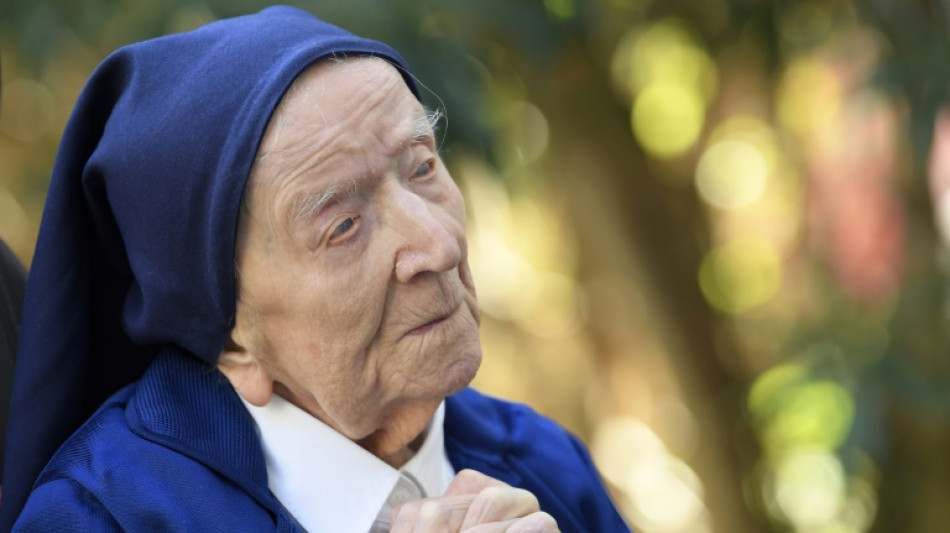
How long can a healthy human live? / Photo: © AFP/File

 'Act before it's too late': Tokyo residents fight for more trees

 'Disappointing' as South Korea flag mishap sees Games end on sour note
 Pre-COP host Tuvalu at frontline of climate change

 Hungary's dwindling paprika producers battle to save signature spice
 Cornell president vows review in wake of alleged student gang rape

 Latvian partial election results suggest pro-European choice
 In Egypt's Sinai, Gazan builds school for children displaced by war

 Trump tariffs a mixed bag for US auto industry

 Yemen government forces say struck Houthi targets

 Music links past, present for Pedro Pascal's cellist in 'Behemoth!'

 ALEX BODI ȘI AMBASADORUL REPUBLICII SUDANUL DE SUD, GUM DOMINIC MATIOK, DISCUTĂ LA BERLIN DESPRE POSIBILITATEA ÎNFIINȚĂRII UNUI CONSULAT ONORIFIC LA BUCUREȘTI

 Dodgers step up World Series three-peat bid with 5-3 win over Braves

 Spain break down Czechs as England outclass Croatia in Nations League

 Yamal on target as Spain hold off Czech Republic

 Latvian exit polls suggest pro-European choice

 Lula, Bolsonaro wrap up campaigns ahead of knife-edge election

 Tuchel hails 'complete' England after Croatia demolition

 Fury to invite Trump to lead ring walk before Joshua showdown

 Fashion industry in 'precarious moment', says Vivienne Westwood supremo
 Seventh heaven for England in Nations League rout of Croatia

 Storms, flooding cause chaos on Greek holiday island of Crete

 #IAmJaneDoe: online support campaign in US university rape case

 Brazil shine on Selecao's first visit to India

 Zverev sets up Djokovic quarter-final at China Open, Rybakina out

 Happier at home, Bordeaux hammer Lyon in Top 14

The death of the world's oldest person at the age of 118 has reignited a debate that has divided scientists for centuries: is there a limit on how long a healthy human can live?
After French nun Lucile Randon died last week, Spanish great-grandmother Maria Branyas Morera, 115, has assumed the title of the oldest living person, according to Guinness World Records.
Back in the 18th century, French naturalist Georges-Louis Leclerc, known as the Comte de Buffon, theorised that a person who had not suffered an accident or illness could live for a theoretical maximum of 100 years.
Since then, medical advancements and improving living conditions have pushed the limit back by a couple of decades.
A new milestone was reached when Frenchwoman Jeanne Calment celebrated her 120th birthday in 1995.
Calment died two years later at the age of 122. She remains the oldest person ever to have lived -- that has been verified, at least.
According to the United Nations, there were an estimated 593,000 people aged 100 years or older in 2021, up from 353,000 a decade earlier.
The number of centenarians is expected to more than double over the next decade, according to the Statista data agency.
The Comte de Buffon might also have been surprised by the rise of supercentenarians -- people aged 110 or over -- whose numbers have been increasing since the 1980s.
- Natural limit at 115? -
So how far could we go? Scientists disagree, with some maintaining that the lifespan of our species is limited by strict biological constraints.
In 2016, geneticists writing in the journal Nature said there had been no improvement in human longevity since the late 1990s.
Analysing global demographic data, they found that the maximum human lifespan had declined since Calment's death -- even though there were more elderly people in the world.
"They concluded that human lifespan has a natural limit and that longevity is limited to around 115 years," French demographer Jean-Marie Robine told AFP.
"But this hypothesis is partly disputed by many demographers," said Robine, a specialist in centenarians at the INSERM medical research institute.
Research in 2018 found that while the rate of death increases with age, it slows down after 85.
Around the age of 107, the rate of death peaks at 50-60 percent every year, the research said.
"Under this theory, if there are 12 people aged 110, six will survive to be 111, three to be 112, and so on," Robine said.
- A numbers game -
But the more supercentenarians, the higher chance a few have to live to make it to record ages.
If there are 100 supercentenarians, "50 will live to be 111 years old, 25 to 112," Robine said.
"Thanks to a 'volume effect', there are no longer fixed limits to longevity."
However Robine and his team are publishing research this year which will show that the rate of death continues to increase beyond the age of 105, further narrowing the window.
Does this mean there is a hard ceiling on how long we can live? Robine will not go that far.
"We will continue to make discoveries, as we always have, and little by little the health of the oldest people will improve," he said.
Other experts are also cautious about choosing a side.
"There is no definitive answer for the moment," said France Mesle, a demographer at the French institute of demographic studies (INED).
"Even if they are increasing, the number of people reaching very old age is still quite small and we still cannot make any significant statistical estimate," she told AFP.
So it might be a matter of waiting for rising numbers of supercentenarians to test the "volume effect".
And of course some future medical breakthroughs could soon upend everything we know about death.
Eric Boulanger, a French doctor specialising in the elderly, said that "genetic manipulation" could allow some people to live for 140 or even 150 years.
M.Furrer--BTB